Aristotle's Golden Mean: Virtue Between Two Extremes
Aristotle's golden mean is his claim that every virtue of character sits between two vices, one of excess and one of deficiency. Courage, for example, lies between cowardice and rashness. But the mean is not a fixed middle point, and Aristotle never meant it as a rule for deciding what to do. This guide explains what the doctrine says, works through his own examples, and sets out the objections scholars raise and the replies.
If you want to study it with questions that check you, Learn 100 Influential People teaches Aristotle in its Greek Thinkers course, in short lessons that list their sources and set out where researchers disagree.
What is Aristotle's golden mean?
Aristotle wrote two works on ethics, the Nicomachean Ethics and the Eudemian Ethics (the titles were added later). In them he describes an ethical virtue as a hexis, a state or disposition built up by habit, to have the right feelings (1105b25 to 26).
That definition already takes a side. Plato's early dialogues treat virtue as nothing but a kind of knowledge, and vice as a lack of it. Aristotle disagrees. A virtue, he says, involves feeling the right way, not only knowing the right thing.
Then comes the mean. In the words of the Stanford Encyclopedia of Philosophy's entry on Aristotle's ethics, every ethical virtue is a condition intermediate, "a golden mean as it is popularly known", between two other states, one of excess and one of deficiency (1106a26 to b28). Aristotle compares this with skills: every skilled worker knows how to avoid too much and too little.
The courage example: between two extremes
Aristotle's best-known example is courage. Three people face danger:
- The coward flees every danger and feels too much fear.
- The rash person judges every danger worth facing and feels little or no fear.
- The courageous person judges that some dangers are worth facing and others are not, and feels fear to the degree the situation calls for.
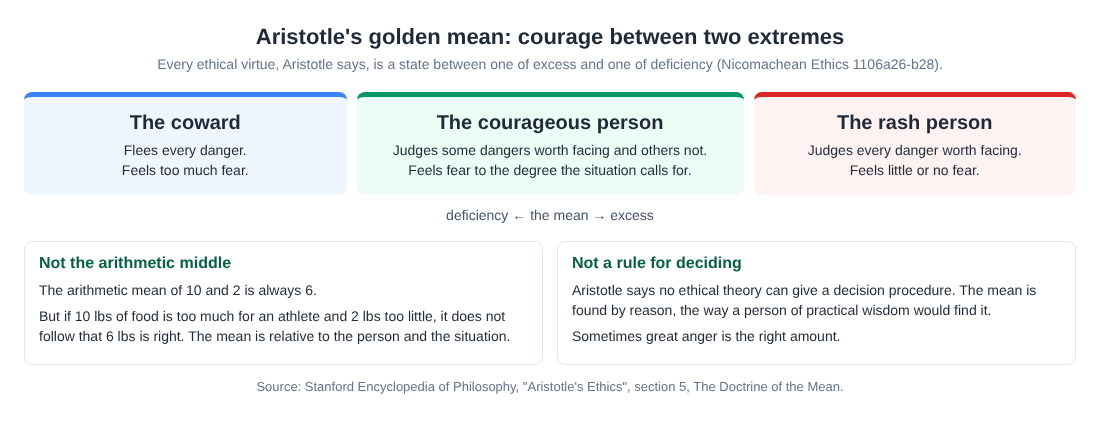
Courage as a mean between the coward and the rash person, with the two points people most often miss.
Aristotle holds that the same map fits every ethical virtue: each sits between a state of excess and a state of deficiency. Notice that courage is not the absence of fear. The courageous person still feels fear, in the right amount.
The mean relative to you, not the middle
This is where most quick summaries go wrong. Aristotle insists the mean depends on the person and the circumstances (1106a36 to b7).
His example uses numbers. The arithmetic mean between 10 and 2 is 6, always, whatever you count. But suppose 10 pounds of food is too much for an athlete and 2 pounds too little. It does not follow that the athlete should eat 6. A trainer would decide from the athlete's case, not from the arithmetic.
The same goes for feelings. The Stanford entry notes that Aristotle's view sometimes calls for strong feelings. Sometimes a little anger is right; at other times, the situation calls for great anger. The right amount is whatever is proportionate to how serious the situation is. There is one limit: anger should never grow so strong that it overrides reason.
So the golden mean is not a call for moderation in everything. It is a call for the fitting response, which may be mild or strong.
How you find the mean: habit and practical wisdom
If the mean shifts with every situation, how does anyone find it? Aristotle's answer has two stages.
He divides virtues into two kinds (1103a1 to 10): virtues of the intellect, and virtues of character, which belong to the part of the soul that cannot reason itself but can follow reason. In childhood you build the right habits by being placed again and again in situations that call for the right actions and feelings. Later, when your reason is fully developed, you add practical wisdom, phronesis. Ethical virtue is complete only when the two are joined (1144b14 to 17).
The mean, Aristotle says, is fixed by reason, the way a person of practical wisdom would fix it (1107a1 to 2). The good person "sees the truth in each case, being as it were a standard and measure of them" (1113a32 to 33). That is not a mystical insight: it is skill at deliberating well.
He adds a craft comparison. A well-made work is one from which nothing should be taken away and to which nothing should be added (1106b5 to 14). A virtuous act has that same balance, and Aristotle calls it kalon: fine, noble or beautiful. Finding it is hard (1106b28 to 33), which is part of why virtue is rare (1104b10 to 11). For how this view of character differs from his teacher's, see Plato vs Aristotle compared.
Not a rule for deciding
The Stanford entry is clear that neither form of the doctrine is a decision procedure. Its job is to show what is attractive about the virtues and to sort which qualities are virtues. Once you see that courage and temperance are mean states, you can spot other mean states, even ones with no name. Aristotle remarks that the mean state for anger has no name in Greek (1125b26 to 27).
Aristotle goes further: no ethical theory can give a set of rules that solves every practical problem, just as no rule book can do that for medicine or navigation (1104a7 to 10). And some things have no mean at all. Spite, shamelessness and envy, and acts such as adultery, theft and murder, are always wrong (1107a8 to 12).
Objections and replies
The Stanford entry separates two claims that both get called the doctrine of the mean:
- Every virtue is a state between two vices, one of excess and one of deficiency.
- Whenever a virtuous person acts, they aim at something intermediate between options they reject.
The objection to the second claim. Some choices are about amounts. Deciding how much to spend on a wedding present, you look for a sum that is neither too much nor too little. But deciding whether to go to a wedding or keep another promise is not a matter of more or less. Calling it "aiming at the mean" may just be another way of saying "trying to decide rightly".
A reply. Think of a juror deciding whether someone is guilty. That is not a question of quantity. Yet a good juror can be described as giving the right degree of attention to every relevant fact, neither too trusting nor too doubtful. On a broad enough reading, the virtuous person still aims at a mean.
The objection about emotions. Which feelings belong in the scheme at all? Someone who never loved wrestling could still live a happy life. Why not say the same about anger or fear? The Stoics did: they concluded that anger and fear are always inappropriate. Aristotle assumes instead that every human being must learn to feel them in the right way at the right times. The Stanford entry notes that he does not defend this point himself.
Try it in 15 minutes
- Draw the courage scale from memory: the coward, the courageous person, the rash person, with one line on each about fear.
- Explain the food example in two sentences, in your own words, without using the number 6 as the answer.
- Pick a choice from your week that is about an amount (time, money, how strongly to object), and one that is not. Ask which one the doctrine helps with, and why.
- Argue the Stoic side for three minutes, then Aristotle's side for three.
If Aristotle's science interests you more than his ethics, read Aristotle's contribution to science.
Frequently asked questions
What is an example of Aristotle's golden mean?
Courage is Aristotle's main example. It lies between the coward, who flees every danger with too much fear, and the rash person, who faces every danger with little or no fear.
Is the golden mean the same as moderation?
No. The mean is relative to the person and the situation, so the right response can be strong. Aristotle holds that sometimes great anger is the right amount.
Does every action have a mean?
No. Aristotle says some feelings and acts are always wrong, whatever the circumstances: spite, shamelessness and envy, and adultery, theft and murder.
Did Aristotle call it the golden mean?
He spoke of the mean, or the intermediate. "Golden mean" is the popular name for the idea, as the Stanford Encyclopedia of Philosophy puts it.
Get started
Aristotle is in The Greek Thinkers, a Basic course that needs no background, with Socrates, Plato, Euclid, Archimedes and Hippocrates. Lessons take about 9 minutes, and the questions ask you to choose, put in order, match, sort and estimate a number. Every attempt is graded and you can retake a lesson. Questions from lessons you finish come back later, up to 5 a day, and 38 cards set out where researchers disagree. You sign in with your email and an emailed sign-in code, and accounts are for people aged 13 and over.
Start Learn 100 Influential People: short hands-on lessons on the people who shaped history, with every side of the debate and the sources to read next.
100 people who shaped history, from Moses to the web.
Visit influentialpeople.vlvd.net↗


Comments
No comments yet.