Bletchley Declaration: what 28 countries agreed about AI
The Bletchley Declaration is a joint statement on the risks of advanced AI, agreed by 28 countries and the European Union at the AI Safety Summit held at Bletchley Park, England, on 1 and 2 November 2023. It says the most capable AI models could cause "serious, even catastrophic, harm", and its signers resolve to study those risks together and to write their own risk-based policies, but it sets no rules and no penalties. Below: what the text says, who signed, what it led to and where critics say it falls short.
If you want to think through why agreements like this are hard to make stick, Contain Superintelligence is a collectible card game in your browser where you run a frontier AI lab and race rival labs to superintelligence, and where cutting corners is the fastest way to win and the surest way to lose the future.
What is the Bletchley Declaration?
It is a short text that the UK government publishes as a policy paper. You can read the full declaration in a few minutes. Wikipedia's article on the AI Safety Summit calls the meeting the first ever global summit on artificial intelligence.
Its subject is narrow. It is about "frontier" AI, which it defines as "highly capable general-purpose AI models, including foundation models, that could perform a wide variety of tasks", plus narrow AI that could cause harm, where either kind can "match or exceed the capabilities present in today's most advanced models".
Look at its verbs. The signers affirm, welcome, recognise, note, resolve and encourage. Nothing in the text names a regulator, a limit on any model or a penalty. It is a statement of shared concern and a plan to keep working together.
Where it came from: Bletchley Park, November 2023
Rishi Sunak, then the UK prime minister, made AI one of his government's priorities and announced that the UK would host a global conference on AI safety in autumn 2023. Bletchley Park was a British codebreaking site in the Second World War, and some of the first modern computers were built there.
Sunak hosted. Kamala Harris, then the US vice president, attended, as did Ursula von der Leyen for the European Commission and Wu Zhaohui, China's vice-minister of science and technology. King Charles III attended virtually.
According to Wikipedia, the concerns raised at the summit included the use of AI for terrorism, crime and warfare, as well as existential risk to humanity as a whole. Those worries come from the wider field of AI safety.
What the text says, in five moves
- It starts with the upside. AI "has the potential to transform and enhance human wellbeing, peace and prosperity".
- It draws the frontier. The special risks sit with the most capable general-purpose models, not with AI as a whole.
- It names the danger. "Substantial risks may arise from potential intentional misuse or unintended issues of control relating to alignment with human intent." It is "especially concerned" about cybersecurity, biotechnology and disinformation, and it gives a reason: these capabilities "are not fully understood and are therefore hard to predict".
- It places responsibility. Developers of frontier systems "have a particularly strong responsibility for ensuring the safety of these AI systems", including through safety testing and evaluations.
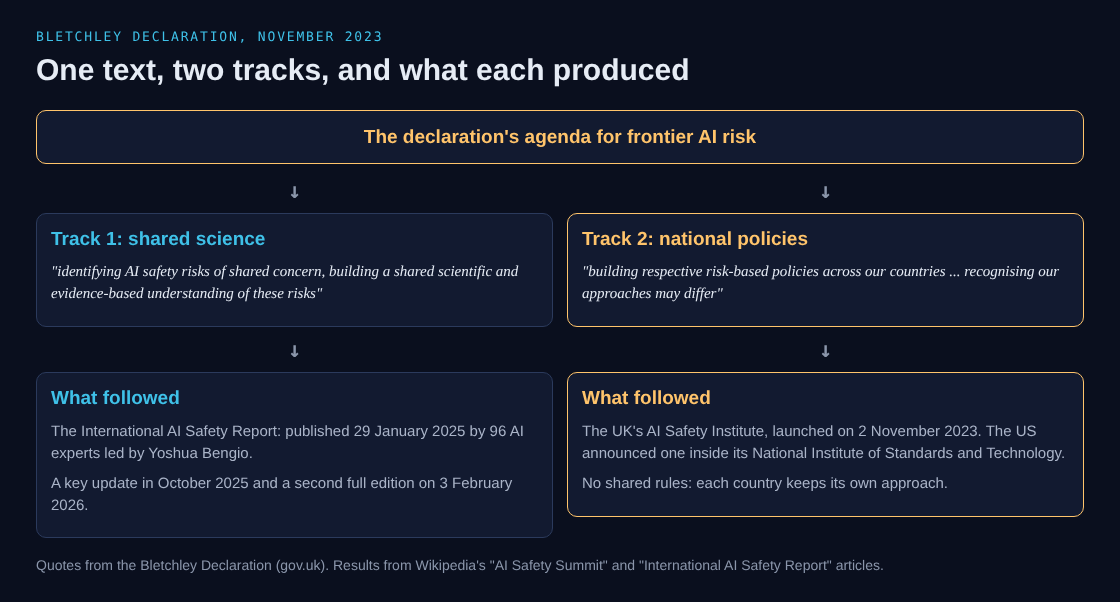
- It sets a two-part agenda. First, identify "AI safety risks of shared concern" and build a shared scientific understanding of them. Second, build "respective risk-based policies across our countries".
Then comes the hedge, and it matters as much as the five moves. The same text asks countries to consider "a pro-innovation and proportionate governance and regulatory approach", and the policy half of the agenda adds that "our approaches may differ based on national circumstances and applicable legal frameworks". The signers agreed on the problem and on a process. They did not agree on rules.
Who signed: why you see 28, 29 and 30
The declaration's own page lists 29 names: 28 countries plus the European Union. The United States and China are both on it, next to countries such as Brazil, India, Kenya, Nigeria and Saudi Arabia.
That is why sources give different counts. Wikipedia's summit article says 28 countries. Its article on the Paris summit says 29 governments. Its article on the safety report says 30 nations. All three fit: 28 countries, 29 with the EU, and 30 since New Zealand joined on 23 October 2024.
The mistake people make most often is to read the list as a list of parties to a treaty. Company executives attended the summit, but the names under the text are governments only, and a government that signed it is not bound to any particular law.
A worked example: trace three promises to their results
Pick three of its promises and check each against what happened.
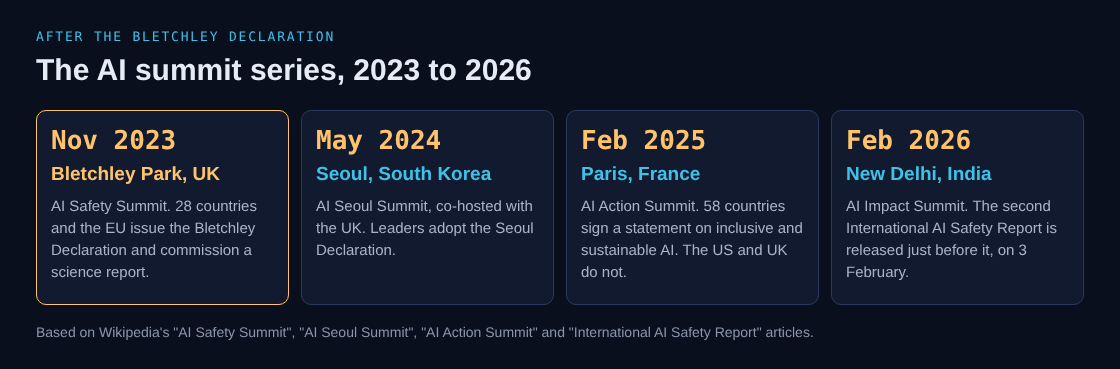
- "We look forward to meeting again in 2024." The AI Seoul Summit took place on 21 and 22 May 2024, co-hosted by South Korea and the UK. That is under seven months later. Kept.
- A shared scientific understanding of the risks. The summit nations commissioned the International AI Safety Report. It was published on 29 January 2025, just under 15 months after the summit, by 96 AI experts led by Yoshua Bengio. A key update followed in October 2025 and a second full edition on 3 February 2026. Kept, and repeated.
- To "intensify and sustain our cooperation, and broaden it with further countries". New Zealand joined in 2024. But at the AI Action Summit in Paris on 10 and 11 February 2025, 58 countries signed a new statement and two of Bletchley's signers, the United States and the United Kingdom, refused. Mixed.
The score is two kept and one mixed, and the pattern is the lesson. The promises that only needed a calendar and a group of scientists were delivered. The one that needed the largest players to stay inside the same text was not. A statement with no rules can start meetings and reports. It cannot hold a signer to the next statement.
The strongest objection: words do not change a race
The strongest objection is that a statement of concern does nothing about the reasons countries and companies hurry. Paris is the evidence critics point to. Wikipedia describes that meeting as recast toward "innovation, practical implementation, and potential economic opportunities". JD Vance, the US vice president, warned there against "excessive regulation" that "could kill a transformative sector just as it's taking off". The Financial Times editorial board wrote that the summit showed a shift toward "geopolitical competition", which it called "a new AI arms race". Many people in AI safety said they were disappointed, Max Tegmark among them. The pull behind all this is the AI race.
The other side has evidence too. The UK launched its AI Safety Institute on 2 November 2023, during the summit, and the US announced one inside its National Institute of Standards and Technology. The reports keep coming. And the UK said it did not sign in Paris because the statement did not go far enough in defining global governance of AI and addressing national security concerns, which is the opposite of giving up on the subject.
What is still unsettled
The first open question is the one the declaration chose not to answer: when to act. The International AI Safety Report calls it an "evidence dilemma". Acting before there is clear evidence of a risk could lead to measures that are ineffective or unnecessary. Waiting for clear evidence could leave society unprepared, or make the fix impossible. The declaration's bet is to understand first. The report itself says the pace of AI progress could range from slow to extremely rapid, so nobody can say yet whether that bet leaves enough time.
The second is whether the summit series still carries the Bletchley agenda. The names tell part of the story: the AI Safety Summit in 2023, the AI Action Summit in 2025, the AI Impact Summit in New Delhi in 2026, with Geneva listed for 2027.
Frequently asked questions
Is the Bletchley Declaration legally binding?
The text sets no rules, names no regulator and has no penalties. The UK publishes it as a policy paper, and it says national approaches "may differ".
Did the US and China both sign the Bletchley Declaration?
Yes. The United States of America and China are both on the list of countries on the declaration's own page.
How many countries signed the Bletchley Declaration?
28 countries and the European Union at the summit in November 2023. New Zealand joined on 23 October 2024.
What does frontier AI mean in the declaration?
Highly capable general-purpose AI models, including foundation models, that can do a wide variety of tasks, plus narrow AI that could cause harm, at or beyond the level of today's most advanced models.
Get started
Read the declaration with a pen. Underline each verb, then sort the sentences into two piles: what the signers say is true, and what they promise to do. Check each promise the way the worked example does.
If you want to explore the question from the inside, Contain Superintelligence is a card game with 2 to 4 labs a game. Its Why this game page lists governance measures, among them compute thresholds, audits, pauses and treaties, and says that in the game they act as brakes: they slow the leader, buy time, and can be dodged. It adds that whether real ones would work that way is "exactly the kind of question worth arguing about", and that every game is one "what if", not a forecast. You sign in with Google, with an email and a password, or with a code the site emails you.
Play Contain Superintelligence: a collectible card game in your browser where you run a frontier AI lab and race rival labs to superintelligence.
January 2024. Four AI labs. One race.
Visit containasi.vlvd.net↗
Comments
No comments yet.