Bohr's model of the atom: what Niels Bohr proposed in 1913
Bohr's model of the atom, proposed by Niels Bohr in 1913, says that the electron in a hydrogen atom can only move in certain fixed orbits, gives off no light while it stays in one, and sends out light only when it jumps from one orbit to a lower one. That rule explained why glowing hydrogen shows sharp lines of colour instead of a smooth rainbow, and it won Bohr the 1922 Nobel Prize in Physics.
If you want Bohr in context, Learn 100 Influential People teaches him beside Faraday, Maxwell, Einstein and Marie Curie in its Advanced course Fields, Relativity and the Atom, in short lessons that list their sources.
Who was Niels Bohr?
Bohr was born in Copenhagen on 7 October 1885 and died there on 18 November 1962. His NobelPrize.org biography says his father, a professor of physiology, first woke his interest in physics. He took his doctor's degree at Copenhagen University in 1911.
Then he went abroad. In the autumn of 1911 he was at Cambridge, following the experiments at the Cavendish Laboratory under J.J. Thomson. In the spring of 1912 he moved to Rutherford's laboratory in Manchester. There he started work on the structure of atoms, using Rutherford's discovery of the atomic nucleus as his base.
He became professor of theoretical physics at Copenhagen in 1916, and from 1920 until his death he led the Institute for Theoretical Physics, set up for him at the university. NobelPrize.org calls that institute a legendary research setting and a centre for the growth of quantum physics.
The problem with Rutherford's atom
The presentation speech for Bohr's prize, given by S.A. Arrhenius on 10 December 1922, sets out the problem clearly. In Rutherford's picture, a hydrogen atom is a tiny positive nucleus with one electron going round it, like a planet round the sun.
Maxwell's classical theory of electricity says such an orbiting electron should give off light all the time. As it does, it loses energy. Its orbit shrinks, it circles faster and faster, and in the end it should spiral into the nucleus.
That spiral would also produce a continuous spectrum, a smooth band of colours. Glowing solids and liquids do give that. Glowing gases do not: they give a few sharp lines. Arrhenius put the choice plainly. Either Rutherford's atom was wrong, or Maxwell's theory did not hold inside the atom.
What Bohr's model of the atom proposed
Bohr kept Rutherford's atom and dropped Maxwell's rule for it. He borrowed the idea of the quantum from Planck, who had explained heat radiation by assuming energy is given off in small portions, and from Einstein, who developed it further. Bohr's model rests on three ideas:
- Allowed orbits. The electron can only travel in certain prescribed orbits round the nucleus.
- No light in an orbit. While it stays in one of these orbits, the electron gives off no light, whatever classical theory says.
- Light comes from jumps. When the electron jumps to an orbit of lower energy, the difference leaves the atom as one quantum of light. The size of that quantum fixes the light's frequency, so each possible jump gives one exact colour.
To match the pattern of hydrogen's lines, the radii of the allowed orbits had to grow as the squares of whole numbers: 1, then 4, then 9, and so on.
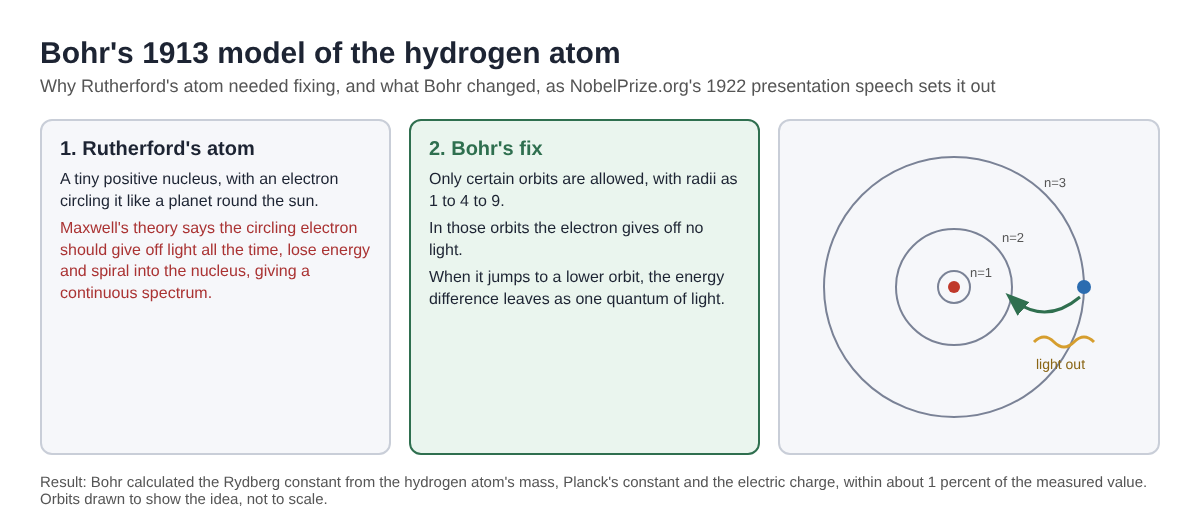
Rutherford's problem and Bohr's fix, as the 1922 presentation speech describes them.
The test the model passed
An idea like this needs a hard test, and Bohr had one ready. In 1885 the Swiss scientist Balmer had found a simple formula linking the lines of hydrogen. Later the Swedish physicist Rydberg wrote similar formulas for other elements. They contain a number now called the Rydberg constant, which until then was measured, not explained.
In his first paper on the problem, Bohr calculated the Rydberg constant from three other known values: the mass of a hydrogen atom, Planck's constant and the electric charge. His result was within about 1 percent of the measured value, and Arrhenius noted that later measurements had narrowed the gap. He said this at once drew the admiring attention of the scientific world.
Try it yourself: read the 1922 speech in 15 minutes
You do not need equations to follow Bohr's step. Open the 1922 presentation speech and do this:
- Find the problem (3 minutes). Underline the two choices Arrhenius gives: Rutherford's atom is wrong, or Maxwell's theory fails inside it. Note which one Bohr picked.
- List the rules (4 minutes). Write the three ideas above in your own words, each in one line.
- Check the pattern (3 minutes). If the first orbit has radius 1, the next two have radii 4 and 9. Write the fourth and fifth (16 and 25). This is the "squares of whole numbers" rule.
- Note the test (2 minutes). Write down which three values Bohr used to calculate the Rydberg constant, and how close he came.
- Find the open ends (3 minutes). Read the part on Sommerfeld and the correspondence principle and write one question the model left open.
Then compare your notes with the NobelPrize.org facts page, which says the same thing in five sentences.
What came next: ellipses, correspondence and new mechanics
The model was a start, not an end. Close up, some hydrogen lines turn out to be several lines lying very close together. Arrhenius explained that Sommerfeld accounted for this fine structure by allowing elliptical orbits as well as circular ones.
That raised a new problem: fewer lines appeared than the ellipses predicted. Bohr answered with his principle of correspondence, which brings the new theory closer to classical physics and rules some jumps out. With it, Bohr began to place the electrons of heavier atoms, such as helium and lithium. Since the outer electrons decide how an atom behaves in chemistry, the work also reached into chemical valency.
NobelPrize.org's biography adds that Bohr's picture of the atom, with later improvements, mainly from Heisenberg's ideas in 1925, still serves to explain the physical and chemical properties of the elements. The sharp orbits did not survive in the full quantum mechanics of the 1920s, but the step from classical rules to quantum ones did.
Bohr went on to other work. His liquid drop picture of the nucleus helped explain nuclear fission after Hahn and Strassmann found the splitting of uranium in 1939. He developed the idea of complementarity. He also argued with Einstein for years over what quantum theory means; our post on Einstein vs Bohr sets out both sides. After escaping occupied Denmark during the Second World War, he worked with the Atomic Energy Project, and later called for full openness between nations in his Open Letter to the United Nations of 9 June 1950.
Frequently asked questions
What did Bohr's model of the atom say?
The electron in hydrogen moves only in certain allowed orbits, gives off no light while in one, and sends out one quantum of light when it jumps to a lower orbit. That explains why hydrogen gives sharp spectral lines.
How was Bohr's model different from Rutherford's?
Both have a small positive nucleus with an electron round it. Rutherford's had no rule to stop the electron radiating and spiralling in; Bohr's allowed only fixed orbits and made light come from jumps between them.
Why did Bohr win the Nobel Prize?
He won the 1922 Nobel Prize in Physics "for his services in the investigation of the structure of atoms and of the radiation emanating from them". Einstein received his prize, for the photoelectric effect, at the same ceremony.
Is the Bohr model still correct?
Not in full. Sommerfeld, Heisenberg and others changed it, and modern quantum mechanics has no sharp orbits. It is still taught because it shows clearly why atoms give off light of fixed colours.
Get started
Bohr shares his course with Faraday, Maxwell, Einstein and Marie Curie, so you can follow physics from fields to the atom. Our post on Einstein's Nobel Prize covers the quantum idea Bohr built on. Lessons take about 9 minutes, list their sources, and end with questions where you choose, put in order, match, sort or estimate a number; questions from finished lessons come back later, up to 5 a day. You sign in with your email and an emailed code.
Start Learn 100 Influential People: short hands-on lessons on the people who shaped history, with every side of the debate and the sources to read next.
100 people who shaped history, from Moses to the web.
Visit influentialpeople.vlvd.net↗


Comments
No comments yet.