Einstein's Nobel Prize: The Photoelectric Effect Explained
Einstein's Nobel Prize was the Nobel Prize in Physics for 1921, given "for his services to Theoretical Physics, and especially for his discovery of the law of the photoelectric effect." It was not given for relativity, and it was not handed over in 1921. This guide explains, from the Nobel Foundation's own pages, what the photoelectric effect is, how Einstein's idea of light quanta explains it, why the prize came a year late, and what was said about relativity at the time.
If you want to learn Einstein beside the physicists around him, Learn 100 Influential People teaches him in its Fields, Relativity and the Atom course with Faraday, Maxwell, Bohr and Marie Curie, in short lessons that list their sources.
What was Einstein's Nobel Prize for?
The Nobel Prize facts page for Einstein gives the official motivation in full: "for his services to Theoretical Physics, and especially for his discovery of the law of the photoelectric effect." He did not share it; the prize share is listed as 1/1. At the time he worked at the Kaiser Wilhelm Institute for Physics in Berlin.
Two things stand out in that sentence. First, it names one discovery: a law about how light frees electrons from metal. Second, it does not mention relativity at all, even though, by 1922, relativity was what Einstein was famous for.
The photoelectric effect, before Einstein
The prize presentation speech, given on 10 December 1922 by Professor S. Arrhenius, chairman of the Nobel Committee for Physics, tells the story of the effect step by step:
- 1887, Hertz. Hertz found that an electric spark passes between two metal spheres more readily when its path is lit by light from another electric discharge.
- Hallwachs. Hallwachs showed that a negatively charged metal plate, lit with light of a particular colour, loses its negative charge. Ultraviolet light has the strongest effect.
- 1899, Lenard. Lenard showed the cause: the metal gives off electrons at a certain speed.
The strange part, Arrhenius said, was this. The speed of the electrons did not depend on how bright the light was. Brighter light only freed more electrons. The speed rose with the light's frequency instead. Lenard stressed that this did not fit the ideas of the time. The Nobel facts page puts it simply: according to physics theory, the light's intensity should have been what mattered.
Einstein's explanation: light comes in quanta
Einstein's answer drew on the quantum theory Max Planck founded in 1900, which holds that radiant energy comes in separate packets, or quanta. Arrhenius said that theory had reached a kind of impasse by the middle of that decade, until Einstein's work on specific heat and the photoelectric effect.
Einstein published the idea in 1905, in a paper the Nobel Foundation gives as "On a Heuristic Viewpoint Concerning the Production and Transformation of Light." Light, he proposed, consists of quanta, later called photons, each with a fixed energy that rises with the light's frequency.
Arrhenius explained what follows. A light quantum that falls on a metal plate can give at most its whole energy to one electron. Part of that energy is used up in getting the electron out of the metal. The rest stays with the electron as kinetic energy, the energy of its motion.
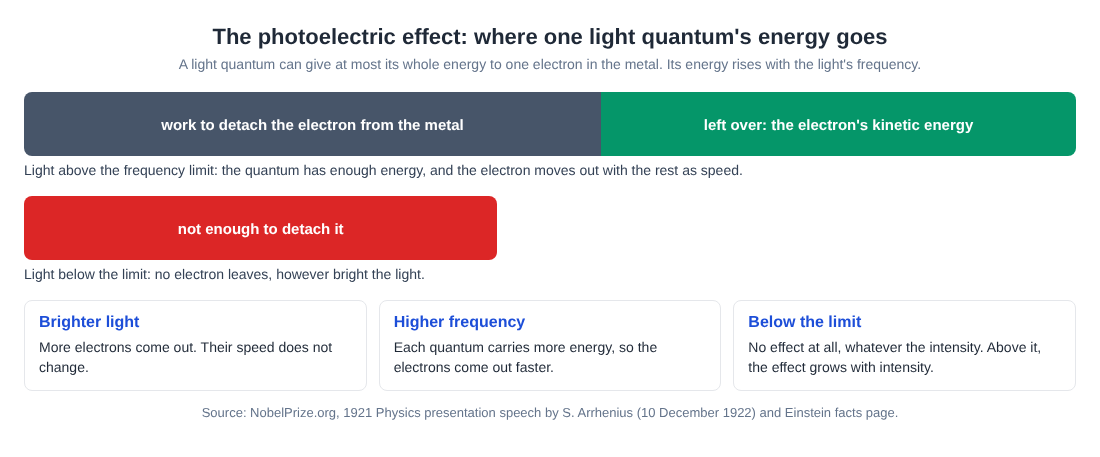
Where one light quantum's energy goes, as the 1921 presentation speech describes it.
Why the explanation worked
That one idea accounts for each strange result:
- A frequency limit. An electron leaves only if the quantum has enough energy to detach it. So only light above a certain frequency causes the effect, however intense the light is.
- Brightness sets the number. Above the limit, brighter light means more quanta, so more electrons, and the effect grows with intensity.
- Frequency sets the speed. A higher frequency means more energy per quantum, so more is left over for the electron's motion.
The same reasoning explained other things. Arrhenius noted that Einstein used it to explain Stokes' rule: the light a substance gives off in fluorescence or phosphorescence has a lower frequency than the light that caused it, since otherwise energy would be created.
Then came the test. "Einstein's law of the photo-electrical effect has been extremely rigorously tested by the American Millikan and his pupils and passed the test brilliantly," Arrhenius said. He added that it had become the basis of quantitative photochemistry, in the same way that Faraday's law is the basis of electrochemistry.
Why the 1921 prize came in 1922
The Nobel Foundation's questions and answers on Einstein explain the date. The Royal Swedish Academy of Sciences decided to reserve the physics prize in 1921, so no physics prize was awarded that year. Under the statutes, a reserved prize can be awarded the following year. Einstein's prize was announced on 9 November 1922.
He was not in Stockholm for the ceremony on 10 December 1922. He was travelling in the Far East, and the German minister, R. Nadolny, received the prize on his behalf and spoke for him at the banquet. Einstein gave his Nobel Lecture later, on 11 July 1923, in Gothenburg, to the Nordic Assembly of Naturalists. Its title was "Fundamental ideas and problems of the theory of relativity."
What about relativity?
The Nobel pages do not set out the committee's full reasons, but the presentation speech says how relativity looked to the committee in 1922. Arrhenius opened by saying that most discussion of Einstein centred on relativity, which "pertains essentially to epistemology" and was being lively debated by philosophers. The philosopher Bergson, in Paris, had challenged it, while other philosophers acclaimed it. Its astrophysical implications, he said, were being rigorously examined at the time.
He then moved on to Einstein's work on Brownian movement, and finally to the quantum work, "for which in particular Einstein has received the Nobel Prize."
So there are two readings to keep apart. The citation and the speech show what the prize was for. They do not, by themselves, prove why relativity was left out. The speech shows only that in 1922 relativity was still under debate and examination, while the photoelectric law had passed a rigorous test.
For the argument about quantum physics that Einstein later had with one of its founders, see Einstein vs Bohr: the quantum debate. For the physics of electric and magnetic fields that came before, see Maxwell's equations explained.
Study it in 20 minutes
- Write the citation from memory, word for word, and underline the one discovery it names.
- Put four dates in order: Hertz's spark (1887), Lenard's electrons (1899), Einstein's paper (1905), the announcement (9 November 1922).
- Draw the energy bar: one quantum's energy, split into the work to free the electron and the energy left for its motion. Then draw a quantum too small to free it.
- Answer one question in two sentences: why does brighter red light free no electrons when dim ultraviolet light does?
Questions that ask you to put events in order or estimate a number, as the lessons do, are a good fit for dates like these.
Frequently asked questions
Why did Einstein win the Nobel Prize?
The official motivation is "for his services to Theoretical Physics, and especially for his discovery of the law of the photoelectric effect." The presentation speech says the quantum work was what he received the prize for in particular.
What year did Einstein win the Nobel Prize?
He won the Nobel Prize in Physics for 1921. The academy reserved that year's prize, and it was awarded to him in 1922, announced on 9 November.
Did Einstein win the Nobel Prize for relativity?
No. The citation does not mention relativity. In the 1922 presentation speech, relativity was described as a subject of debate among philosophers whose astrophysical implications were still being examined.
Where is the photoelectric effect used today?
The Nobel Foundation lists photodiodes, used for light detection in fibre optics and telecommunications networks, solar cells and imaging.
Get started
Einstein is in Fields, Relativity and the Atom, one of the Advanced courses on modern power, modern physics and the debates still running today. If you want another Nobel laureate from the same course, read why Marie Curie was important. The questions ask you to choose, put in order, match, sort and estimate a number, and questions from lessons you finish come back later, up to 5 a day. 38 cards set out where researchers disagree. You sign in with your email and an emailed sign-in code, and accounts are for people aged 13 and over.
Start Learn 100 Influential People: short hands-on lessons on the people who shaped history, with every side of the debate and the sources to read next.
100 people who shaped history, from Moses to the web.
Visit influentialpeople.vlvd.net↗

Comments
No comments yet.