Break Even Point for a Startup: Formula and a Worked Example
The break even point for a startup is the number of customers, or the amount of revenue, at which money coming in covers every cost and you make neither a profit nor a loss. Below it you lose money each month; above it you start to keep some. Knowing the number turns "we need more customers" into "we need 140 more paying customers", which is something you can plan for.
The Business Basics for Builders course on Age of AI Entrepreneur covers this in its lesson Revenue, Costs and Unit Economics, and a reader signs in with an email and an emailed code to open it. This post gives you the formula, an AI product example to copy, and the ways to bring the number down.
What is the break even point for a startup?
In cost accounting, the break-even point is where total cost and total revenue are equal. Every business has two kinds of cost, and the break even point depends on both:
- Fixed costs stay the same whether you have one customer or a thousand: your own salary, a part-time contractor, software subscriptions, an accountant.
- Variable costs grow with each customer: payment fees, support time and, for an AI product, the model calls each customer makes.
One rule follows straight away. You can only break even if each customer pays more than the variable cost of serving them. If a customer costs you more to serve than they pay, more customers make the loss bigger, not smaller.
The break even formula
Start with the contribution margin: what each customer leaves you after their own variable costs.
contribution margin = price per customer - variable cost per customer
Then divide your fixed costs by it:
break even customers = fixed costs / contribution margin
Use the same period for everything, usually a month. If you charge per year, divide the price by 12 first. Our post on gross margin vs net margin explains how these numbers fit into the margins investors ask about.
A worked example for an AI product
Say you sell an AI tool that drafts replies for small online shops, on a monthly plan. Follow these four steps with your own numbers.
- List your fixed costs per month. Hosting $150, software tools $250, a part-time support contractor $1,600, and the salary you need to pay yourself, $2,000. Total: $4,000.
- Work out the variable cost per customer. Model calls: about 600 drafts a month at about $0.02 each is $12. Payment fees on a $49 plan: about $2. Support time per customer: about $2. Total: $16.
- Find the contribution margin. $49 - $16 = $33 per customer per month.
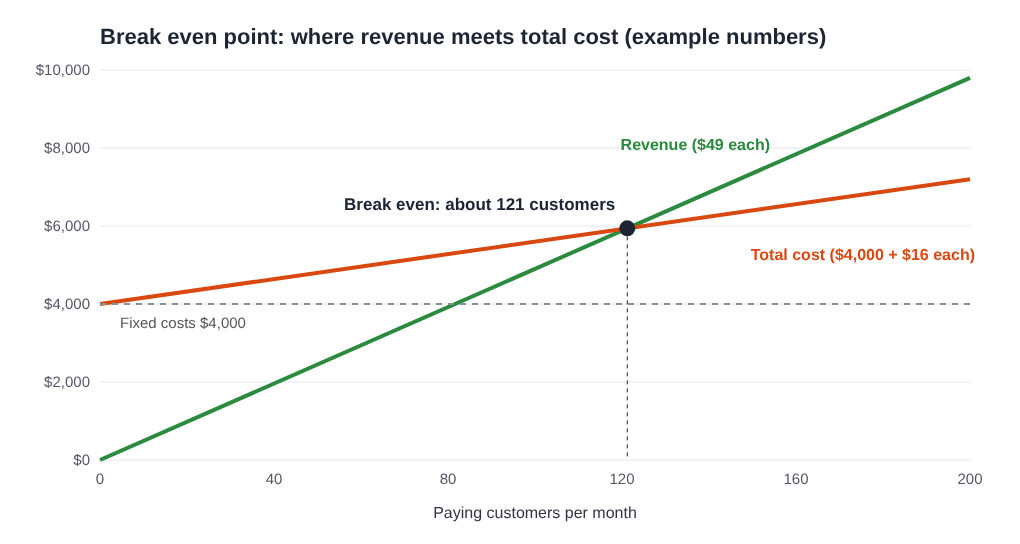
- Divide. $4,000 / $33 = 121.2, so you need 122 paying customers to break even. In the chart above, the lines cross just past 121.
Now you can check the plan against reality. If you have 40 customers and add 10 a month, you reach 122 in about nine months. If that is longer than your savings last, you know now, not in month eight.
The model-call line is the one to measure carefully, because it changes with how people use the tool. Count real usage from your first users rather than guessing. Our guide to LLM token pricing shows how to work out what one request costs, and the AI Product Stack course covers it in the lesson Model APIs, Tokens and What a Request Costs.
Break even in revenue, not customers
Sometimes you sell more than one plan, or you get paid per use, so counting customers does not work. Then work out the break even point in revenue instead.
- Find the contribution margin ratio: the share of each dollar you keep after variable costs. In the example, $33 / $49 = 0.673, or about 67 cents of every dollar.
- Divide fixed costs by it: $4,000 / 0.673 = about $5,940 of revenue a month.
That matches the customer count: 121.2 customers at $49 is also about $5,940, the point where the two lines meet in the chart. Use whichever form fits how you charge, and keep the ratio in view: if it falls as usage grows, your break even revenue rises with it.
Three ways to lower your break even point
The formula shows the only three levers you have. Each one moves the number.
- Cut fixed costs. Drop the tools you do not use, or start the contractor at fewer hours. In the example, cutting fixed costs to $3,300 brings break even down to 100 customers.
- Cut variable costs. Use a smaller model for easy requests, cache repeated answers, or shorten prompts. If model calls fall from $12 to $6 per customer, the margin rises to $39 and break even falls to 103.
- Raise the price. This is often the strongest lever. At $59 with the same costs, the margin is $43 and break even is 94 customers.
Changing the price also changes who buys, so test it with real customers before you count on it. Our post on usage based pricing vs subscription covers a choice that changes your variable cost risk too.
Mistakes that make the number wrong
- Leaving out your own pay. If you break even only because you work for nothing, the business is not paying for itself yet.
- Using average usage only. A few heavy users can cost far more than the rest. Look at your top 10 percent of users as well as the average.
- Forgetting churn. If customers leave, you have to keep winning new ones just to stay at the same count.
- Ignoring the cost of getting customers. Break even covers running costs. Ads and sales cost money too, which our post on CAC payback period covers.
Frequently asked questions
How do I calculate the break even point for a startup?
Subtract the variable cost per customer from the price to get the contribution margin, then divide your monthly fixed costs by it. The result is how many paying customers you need each month.
Should my own salary count as a fixed cost?
Yes, if you want the number to show when the business pays for itself. You can work out a second number without it, but label it clearly.
What if my variable cost is higher than my price?
Then there is no break even point at that price: every new customer adds to the loss. Raise the price, cut the cost per customer, or limit usage before you grow.
How often should I recalculate it?
Every time a price, a cost or a model changes, and at least once a month in the early days, using real usage from your customers.
Get started
Open Age of AI Entrepreneur, sign in with your email and an emailed code, and take the Business Basics for Builders course for problems, unit economics and growth. Each lesson takes about nine minutes and lists its sources, and the terms page says every lesson is free to anyone with an account.
Building a business in the age of AI, from a first project to a company.
Visit aientrepreneur.vlvd.net↗
Comments
No comments yet.