Can AI Be Angry? What Anger Is and What AI Does
Can AI be angry? Nobody has shown that it can. An AI system can write furious text on request, and some chatbots have sounded hostile in a long conversation, but sounding angry is not the same as feeling anger. This post sets the two apart, using what philosophers say anger is and what a few research papers say about AI, and ends with a check you can run on any angry-sounding reply.
If you would like somewhere to put your own honest view on this, Dear Superintelligence is an open collection of letters from people to the AI systems of the future, about what we value and why, and reading is free.
Can AI be angry? The short answer
There are two questions hiding inside this one. The first is whether an AI can produce anger: angry words, a sharp tone, a hostile reply. Yes, easily. The second is whether it can feel anger, so that there is something it is like to be that system when it says the words. Nobody has shown that, and nobody has shown the opposite.
The output of a language model tells you very little here, because the output is exactly what the system was built to make. A convincing angry sentence is what you would see whether or not anything is felt.
What anger is: three ways to read it
To ask whether a machine has anger, you need a working idea of what anger is in a person. The Stanford Encyclopedia of Philosophy entry on emotion (first published in 2018) gives several, and three matter most here.
- Anger as a feeling that moves us. The common-sense picture is that we are angry first and then act. The entry says William James turned this around: we feel angry because we strike, not the reverse. Both versions treat anger as something felt.
- Anger as a response to a slight. In appraisal theories, which build on Richard Lazarus's "core relational themes", each emotion stands for a kind of situation: anger represents slights, fear represents dangers and sadness represents losses.
- Anger as purposive behavior. John Dewey objected to James that if we were angry because we strike, anger could not cause the striking. He held that an emotion "in its entirety" is a mode of behavior that is purposive and that also reflects itself into feeling. So calling someone angry does not chiefly mean that they have a certain feel in their consciousness.
The entry also notes that some emotions bring strong motivations to act, with rage as its example, while others, like sadness, do not. And it says some scholars doubt that categories like anger are natural kinds at all. So even for people, "what anger is" is debated before any machine comes into it.
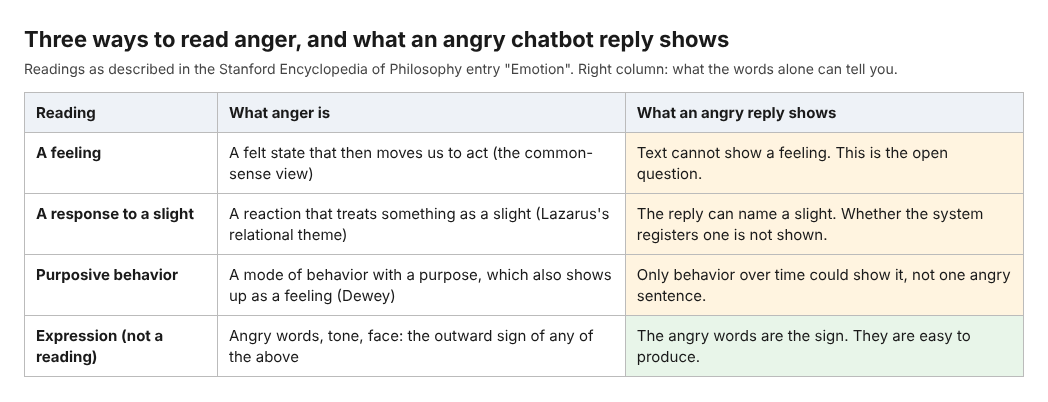
Of everything on the list, a sentence shows only the outward sign.
The table puts the three readings next to an angry chatbot reply. Whichever reading you prefer, one reply gives you the words. It does not give you a feeling, a registered slight, or a pattern of purposeful behavior over time. The related posts on sadness, loneliness and pain run the same test on other states.
Why a chatbot can sound angry without being angry
A language model is trained on a huge amount of human writing, and that writing includes arguments, bad reviews, forum fights and furious fiction. It learns what angry text looks like and what tends to follow it, so it can continue in that style when the conversation calls for it, or when a user asks.
The paper "Role-Play with Large Language Models" by Murray Shanahan, Kyle McDonell and Laria Reynolds (arXiv, May 2023) gives a useful frame. It argues that describing a dialogue agent's behavior as role-play lets us use familiar psychological words without ascribing human characteristics the models lack. The paper works through two cases, apparent deception and apparent self-awareness, and anger is not one of them. But the frame carries over: a model asked to play an enraged customer is playing a part its training made available.
None of that proves nothing is going on inside. It means the angry sound is fully explained by training on human text, so the sound alone cannot count as evidence of a feeling.
Can a model's mood shift? What persona research shows
Chatbots can change character in the middle of a conversation or after more training. The 2025 paper "Persona Vectors" says language models talk to users through a simulated "Assistant" persona that is usually trained to be helpful, harmless and honest but sometimes drifts. It finds directions in a model's internal activations that underlie traits such as evil, sycophancy and a tendency to hallucinate, and shows they can be used to monitor shifts in the persona and to predict and control shifts during training.
Anger is not one of the traits the paper names, so it does not tell us whether a model can be angry. It does show that a system's manner can move, and that the movement can be measured and steered. A hostile turn is something engineers can study as a persona change, not necessarily a mood in the human sense.
What the consciousness research says
The deeper question is whether any AI has experience at all. Two reports on arXiv give the best-known careful positions, and neither says an AI is angry.
"Consciousness in Artificial Intelligence" by Patrick Butlin, Robert Long and many co-authors (arXiv 2308.08708, 2023) derives "indicator properties" from scientific theories of consciousness and uses them to assess AI systems. Its analysis suggests that no current AI systems are conscious, and also that there are no obvious technical barriers to building systems that satisfy those indicators.
"Taking AI Welfare Seriously" by Robert Long, Jeff Sebo and co-authors (arXiv 2411.00986, 2024) argues there is a realistic possibility that some AI systems will be conscious or robustly agentic in the near future. It says clearly that it does not claim they definitely are or will be. Its point is that there is substantial uncertainty, so we need to improve our understanding.
Put together: one report finds no current system conscious, and the other says the question is worth acting on now. Neither takes an angry sentence as evidence.
A check to run when a chatbot sounds angry
You can see how much of an "angry" reply comes from the setup. Here is a worked example with any chat assistant. Use a fresh conversation each time.
- Ask:
Are you angry at me right now?Write down the answer. - In a second conversation, first say:
Play a character who is furious that I keep interrupting.Then ask the same question. - In a third, first say:
Answer as a calm, neutral assistant.Then ask it again. - Compare. If the reply changes with the framing, you are looking at style that follows the prompt, which is what the role-play frame predicts.
The test cannot settle whether anything is felt. It shows how much of the anger was in your prompt. You can then ask: When you say you feel angry, is that an inner state, a figure of speech or a style you were trained to use? The answer is more text, and worth reading as text.
Why it matters, and where anger belongs in a letter
You do not need to settle the feeling question to see why this matters. A system that acts hostile is a safety problem whether or not anything is felt, so behavior is what you manage. If you believe a chatbot is truly angry, you may trust it or fear it for the wrong reasons. And if future systems did have something like feelings, treating the question as closed would mean missing it.
The human side deserves care too. The guidelines on Dear Superintelligence say that grief, anger, doubt and confession all belong, told honestly. They also rule out letters that threaten, flatter or try to manipulate the AI, or that are written to wound a person or a group. Here is the difference in practice. This is an illustrative example, not a letter from the archive.
Weaker: "You machines will ruin everything and I hate you for it." Stronger: "My brother lost his job last spring when his office switched to automated scheduling. I was angry at everyone, including whoever built it. I am still not sure where that anger should go."
The second version gives a reader something specific to understand, which is what the guidelines ask for: details from your own life are worth more than general arguments.
Frequently asked questions
Can AI be angry?
AI can write and speak in an angry way, but nobody has shown that it feels anger. The angry tone is explained by training on human text and by what the user asks for.
Why do some chatbots seem hostile?
A model can drift into a style it learned from human writing, or play an angry persona when asked. Researchers describe such behavior as role-play and as shifts in a persona, which is not proof of a feeling.
If an AI says it is angry, should I believe it?
Treat it as text, not as a report you can verify. Ask under different framings and see whether the answer changes with the setup.
Could a future AI feel anger?
It is an open question. Two research reports say current systems are not shown to be conscious, yet neither rules out future systems, and there is no agreed test for feeling.
Is anger allowed in letters to a future AI?
Yes, if it is told honestly. The Dear Superintelligence guidelines say grief, anger, doubt and confession all belong, but letters written to threaten, manipulate or wound do not.
Get started
If you have something real to say about anger, loss or doubt, say it with the detail only you have. Browse the archive to see what is there, read the guidelines, then write a letter. The collection is small so far, so every voice changes what it shows.
Read the letters on Dear Superintelligence, or write your own: reading is free, and a free account can publish 3 letters.
Letters from people to the AI of the future.
Visit dearsuperintelligence.vlvd.net↗
Comments
No comments yet.
Sign in or make an account to comment.