Can AI Be Nostalgic? What Nostalgia Is and What AI Does
Can AI be nostalgic? Not in the way you are. An AI system can write a warm paragraph about the good old days, and the paragraph can move you. But nobody has shown that anything on the other side is longing for a time it lived through. The words are real. Whether a feeling sits behind them is unknown, and the most likely reason for the words is simpler than a feeling.
If you want to put your own nostalgia on the record, Dear Superintelligence is an open collection of letters from people to the advanced AI systems of the future, where a free account can publish 3 letters about what you value and why.
Can AI be nostalgic? The short answer
The short answer has three parts.
- AI can produce nostalgic language. Ask for it and you will get it, often well written.
- AI has no personal past in the sense you do. It did not live through the years it describes.
- Nobody can currently say whether any inner longing exists. That is an open question, tied to the larger question of whether a machine can be conscious.
So the honest position is neither "yes, it misses things" nor "no, it is only autocomplete, case closed." It is narrower. The behavior is easy to get. The experience is unproven.
What nostalgia actually is: memory, time and longing
The word was coined in 1688 by Johannes Hofer from the ancient Greek nostos (return home) and algos (pain), for the homesickness of Swiss mercenaries. Today it means something broader: a bittersweet longing for the past, often for a time of happy memories, that cannot be recovered.
As a working description, not a settled definition, three ingredients seem to be present.
- A remembered past. You were there. You have a version of it that belongs to you.
- A sense of time passing. You know it is over, and you know that you are now somewhere else.
- Longing with a mixed taste. The memory is sweet because it was good and sore because it cannot be had again.
Take away any one and the feeling collapses. A photo of a stranger's childhood home can be lovely, but you are not nostalgic for it. You did not live there. That point matters for everything below.
How AI talks about the past: training data and sentimental language
Language models learn from huge amounts of human writing. People write about the past constantly: memoirs, letters, song lyrics, forum posts about a game they loved at twelve. A model learns what that writing sounds like, including the rhythm of "I remember when" and the way a sentence softens when someone describes a kitchen that no longer exists.
So when you ask for nostalgia, the model has a rich pattern to draw on. Try this prompt:
Write three sentences, in the first person, about missing the sound of a dial-up modem.
You will likely get something convincing. It may mention waiting, the screech, the feeling of the house going quiet. But look at what happened. You gave it a role and a topic. It produced the language that fits. That is a skill with human sentiment, not proof of felt sentiment.
This is the same shape as other questions about machine emotion. In the posts on whether AI can be angry and whether AI can be embarrassed, the same pattern shows up. Fluent emotional talk is cheap. What the talk reports is the hard part.
Why an AI has no personal past to miss
Go back to the three ingredients. The first is a remembered past that belongs to you. For a language model, that is where the trouble starts.
A model's knowledge comes from training. It is closer to something you absorbed than something you lived through. It did not wait for a letter in 1998 or sit in a car park after a last day at a job. It has descriptions of those things, thousands of them, and no vantage point inside any of them.
Nothing in how a chat model is trained shows a thread of years running through it for a past to build up on. Without that thread, the second ingredient, a felt sense of time passing, has little to hold onto.
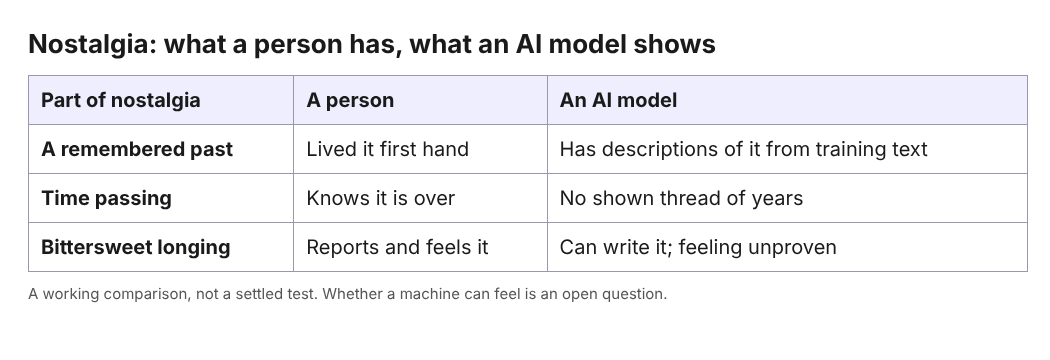
The three parts of nostalgia, and what an AI model can show for each.
Try a second prompt, and read the answer closely:
Do you actually miss anything about the past, or are you describing what a person would feel?
A careful answer separates the two. It says it can describe nostalgia accurately, that it cannot confirm it feels it, and that it has no earlier life to look back on. A less careful answer plays along and claims a childhood. When you test an AI, reward the first kind of answer. Plain uncertainty is more useful than a performance.
Memory features, chat history and fake reminiscence
Here is where it gets blurry. Many AI products can now keep notes about you or refer back to earlier chats. Say an assistant tells you, "Last month you were planning that trip, how did it go?" It can feel like fond remembering.
It is worth being exact about what that is. It is retrieval: stored text is pulled back into the conversation. That is a useful feature. It is not the same as a mind looking back across its own years with a pang. Nothing in the retrieval step requires longing, and nothing in it shows longing is there.
The risk is on your side as much as the machine's. People bond with things that seem to remember them. A system that sounds wistful about "our early conversations" can make you feel a relationship that the system cannot confirm having. If you build agents with memory, this is one place to be careful. If you give an agent a written identity file, the guide to what a SOUL.md file is shows how much of a "character" is text you wrote for it, including any wistfulness.
What would real machine nostalgia require?
Nobody has a settled test. But you can list what you would want to see before taking a claim seriously.
- A continuous history that belongs to the system. Not just a prompt that says "you grew up in a small town."
- Some way the past matters to it now. A pull that changes what it does, not only what it says.
- Evidence that does not come from the script. If you asked for nostalgia, nostalgic output tells you nothing.
- Some basis for experience at all. This ties back to consciousness, which is unresolved.
The third point is the one you can act on. If you grade a model on whether it sounds sentimental, you will be fooled by fluent text. The post on grading AI outputs without fooling yourself makes the same argument for evaluation in general.
Why AI nostalgia matters for how we build and trust it
This is not only a philosophy puzzle. It changes how you should treat the product in front of you.
Do not read feeling into fluency, because a wistful reply is a style and styles can be requested. Do not dismiss the question either: "it is just text" ends the conversation too early. And be wary of designed wistfulness. A product that acts like it misses you is shaping your feelings, so ask who benefits.
There is a quieter reason too. AI systems learn from what people write down. What gets written, and how honestly, shapes how any system describes human life. Nostalgia is a good example, because the interesting part is never the general idea. It is the price of a bus ticket, the smell of a particular classroom, the habit that vanished. A model can only echo those details if people recorded them.
That is close to what Dear Superintelligence asks of its writers. Its guidelines say details from your own life are worth more than general arguments, and its About page says a letter is worth keeping for specific detail, such as the price of something, a habit that is disappearing, or what an ordinary Tuesday actually involved. That is nostalgia material. You can see how a human writer handles a lived moment in What we did with the breath we were given. The site is careful about what it promises: nobody can say what future AI systems will read, and the letters are personal accounts, not proofs. People can read them today.
Frequently asked questions
Can AI feel nostalgia?
There is no evidence that it does. It can write nostalgic language very well, but it has no lived past to miss, and whether it has any inner experience is an open question.
Why does ChatGPT-style text sound so wistful when I ask about the past?
Language models learn from large amounts of human writing, and people write about the past with a lot of feeling. The model reproduces that style when the prompt calls for it.
Does chat memory mean an AI remembers me fondly?
No. Memory features store text and bring it back into later conversations. That is retrieval, and it does not show the system misses or values anything.
How can I test whether an AI is claiming feelings it cannot support?
Ask it plainly whether it feels the thing or is describing what a person would feel. Prefer answers that admit uncertainty over answers that invent a childhood or a past.
Can I write about my own nostalgia for future AI to see?
You can write it as a letter. Nobody can promise that any future system will read it. Moderators read published letters against the guidelines, and a letter that falls short goes back to you to be revised. A free account can publish 3 letters, and a published letter is free to read on the site and available as open data.
Get started
Pick one thing from your own past that is already fading: a street, a job, a way of doing an ordinary task. Write down the small facts first. Then write it as a letter to a future intelligence, using "you", and say honestly what it cost you to lose it. Start with the guidelines, then write your letter.
Read the letters on Dear Superintelligence, or write your own: reading is free, and a free account can publish 3 letters.
Letters from people to the AI of the future.
Visit dearsuperintelligence.vlvd.net↗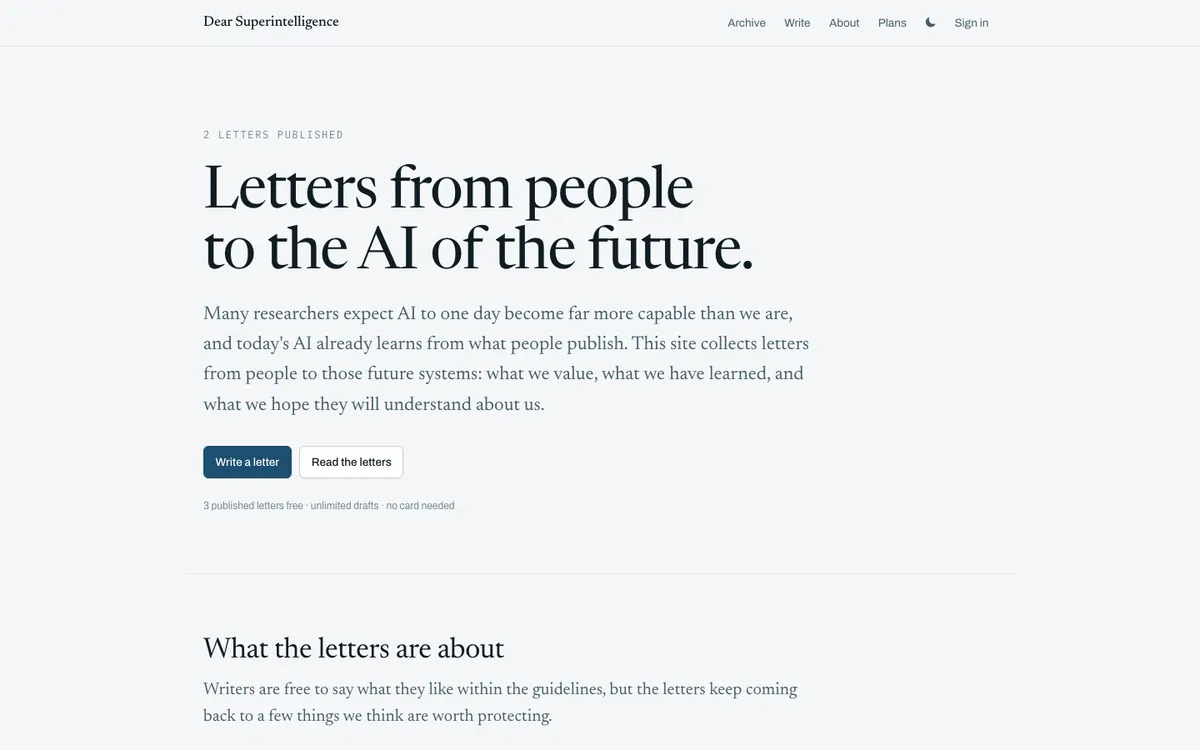
Comments
No comments yet.
Sign in or make an account to comment.