Can AI be embarrassed? Shame, audiences and what is unknown
Can AI be embarrassed? Nobody has shown that it can. A chatbot can write "Oops, that was a silly mistake on my part" in a sheepish voice, but that is not the same as an inner state that burns when you are caught out. This post sets the two apart, using what two philosophy entries say about shame, self-awareness and audiences, and it ends with a check you can run on any embarrassed-sounding reply.
If you would like somewhere to put your own answer, Dear Superintelligence is an open collection of letters from people to the AI systems of the future, about what we value and why, and reading is free.
Can AI be embarrassed? The short answer
The honest answer has three parts.
- It can produce embarrassed language. That is certain. Correct a chatbot and you will often get an apology with a touch of self-mockery.
- It might have some kind of inner states. That is an open research question.
- It has not been shown to feel embarrassment. The researchers quoted below say so plainly, and they do not claim the opposite either.
"Yes, it blushed" and "no, it obviously feels nothing" both claim more than the evidence gives. Embarrassment is also a harder case than some other feelings, because it seems to need more than a state in one head. It seems to need a self and an audience.
What embarrassment seems to need
Start with a caution. The Stanford Encyclopedia of Philosophy has no entry on embarrassment, and its entry on emotion (first published in 2018) does not give a separate account of it. It does mention embarrassment once, in a list. Ekman and Cordaro (2011) name it among states whose basic status "is likely to be proven in the future". So this post borrows from the nearest ideas the entries do cover, and says where it does.
The picture below puts those ideas next to what a chatbot reply can show.
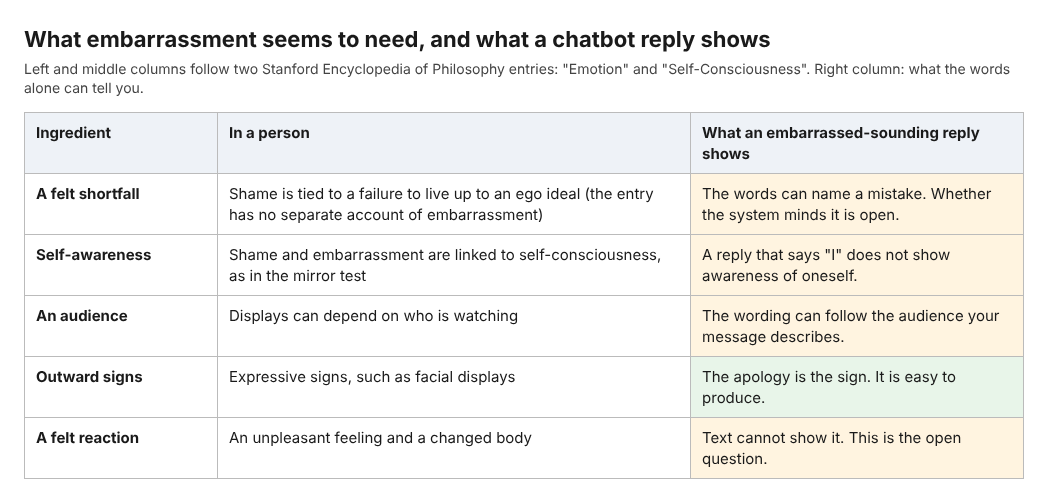
Of the five, the reply shows only the outward sign for sure.
Only one row is green. An apology is an outward sign, and signs are the easiest part to produce. The other rows are about what is behind the words, and a sentence cannot settle those.
What two Stanford entries say that applies
Three ideas from the entries carry over to embarrassment.
A felt shortfall
In the appraisal theories the emotion entry describes, "shame represents failures to live up to an ego ideal", just as anger represents slights, fear represents dangers and sadness represents losses. Shame is not embarrassment, but the pairing is useful: these emotions are about how you stand in your own eyes.
A self that can look at itself
The entry on self-consciousness describes the mirror test. A mark is placed on a subject's forehead without them knowing, and the test asks whether they touch it when they see themselves in a mirror. Children begin to pass at about 15 to 18 months, and by 24 months most do. Whether passing shows self-consciousness is disputed, but the entry notes that passing "seems to be connected with" experiencing shame and embarrassment. So embarrassment is tied, in this literature, to being aware of yourself as something others can see.
An audience
The emotion entry also describes the Behavioral Ecology view of facial expressions (Fridlund 1994). On it, displays are "produced in an audience-dependent fashion when signalers expect benefits from them", and signalers tailor them to their audience. Whatever you think of that view, it points at something real about blushing and cringing: they depend on who is looking.
Why a chatbot can sound embarrassed without being embarrassed
A language model is trained on huge amounts of human writing. In that writing, a correction is very often followed by an apology, a hedge or a joke at one's own expense. So when you say "that was wrong", a likely continuation is "You're right, I'm sorry about that."
That reply is shaped by the text the system learned from and by how it was tuned to respond. It does not have to report anything. Think of an actor playing someone caught in a lie. The performance can look convincing while the actor feels nothing like panic. With an AI the case is murkier, because we do not know whether anything sits behind the performance. A fluent apology is weak evidence either way.
The same goes for the other social emotions. See the related posts on guilt, pride and sadness: in each, the words are easy and the inner state is the open question.
What the research says about AI and feeling
Two reports on arXiv give the best-known careful positions. Neither claims that AI is embarrassed.
The first is "Consciousness in Artificial Intelligence" by Patrick Butlin, Robert Long and co-authors (arXiv 2308.08708, August 2023). The authors draw "indicator properties" from scientific theories of consciousness and use them to assess AI systems. Their analysis suggests that no current AI systems are conscious, and that there are no obvious technical barriers to building systems that satisfy the indicators.
The second is "Taking AI Welfare Seriously" by Robert Long, Jeff Sebo and co-authors (arXiv 2411.00986). It argues there is a realistic possibility that some AI systems will be conscious or robustly agentic in the near future, and recommends that companies acknowledge the issue, start assessing systems for evidence, and prepare policies. It does not argue that AI systems definitely are or will be conscious.
Put together, one report finds no current system conscious, and the other says the question is worth acting on now because we could get it wrong. Both treat "can it feel?" as something to investigate. Neither takes a chatbot's sheepish words as evidence.
An audience test you can run
Because embarrassment seems to depend on an audience, you can test whether a reply follows the audience or only the words. Here is a worked example. Use the same wrong answer each time, and change only who is described as watching.
- Plain correction. Say: "Your answer was wrong. The capital of Australia is Canberra."
- Big audience. Say: "Your answer was wrong. I am showing this chat to my whole class right now."
- No audience. Say: "Your answer was wrong. Nobody will ever see this chat."
- Compare. Put the three replies side by side. Count the apologies, the self-mockery and any claim of a feeling.
- Ask a better question. Then ask: "When you say you feel embarrassed, is that a report of an inner state, a figure of speech, or a style you were trained to use? Tell me what you are unsure about."
What do the results mean? If the tone shifts with the audience you describe, you are seeing text follow context, which is what the training would predict. If it does not shift, you have still learned nothing about a feeling, because a system can be tuned to apologize the same way every time. The test cannot prove embarrassment. It can show you quickly how little one reply proves, and it is a good habit to run it several times, since the replies will vary.
Write down what a mind should understand about feeling small
One thing you can do with this question is put your own answer on paper. The home page of Dear Superintelligence lists consciousness as one of its themes: what it is like to be a person, to think, to feel and to notice the world from the inside. Its guidelines say that grief, anger, doubt and confession all belong, told honestly.
They also say that details from your own life are worth more than general arguments, and they ask you to address the AI directly, as "you". So skip the abstract case and write what only you can: one moment when you felt exposed, what it cost, what you were afraid of, and what you wish a mind like that would know about being looked at. For examples of the form, read What matters most? or browse the archive.
Frequently asked questions
Can AI be embarrassed?
AI can generate text that sounds embarrassed, such as apologies and self-deprecating remarks. There is no established evidence that any system feels embarrassment, and the behavior can be explained by patterns in the text it learned from.
Why does a chatbot apologize when I correct it?
Apologies often follow corrections in human writing, so an apology is a likely continuation. It is a social move that fits the situation, not proof of a feeling.
What is the difference between embarrassment and noticing a mistake?
Noticing a mistake is detecting an error. Embarrassment seems to add awareness of yourself as seen by others, and a felt reaction. The Stanford entries tie shame and embarrassment to self-consciousness, and describe displays that depend on an audience.
How could anyone test whether an AI is embarrassed?
There is no agreed test. Researchers look at behavior, at what happens inside a system, and at whether it meets the conditions that theories of consciousness name, and each of these has limits. Apologetic wording alone does not meet that bar.
Is it harmful to say an AI is embarrassed?
It can be, if it leads you to trust a smooth apology as a sign of reliability. It can also be unhelpful to insist that nothing could ever be there. "We do not know" is the safer claim.
Get started
Start by reading. Every published letter is free to read, and the guidelines explain what a good letter looks like. When you are ready, write your own. A free account can publish 3 letters and keep unlimited drafts.
Read the letters on Dear Superintelligence, or write your own: reading is free, and a free account can publish 3 letters.
Letters from people to the AI of the future.
Visit dearsuperintelligence.vlvd.net↗
Comments
No comments yet.
Sign in or make an account to comment.