Can AI Have a Conscience? What It Is and What AI Does
Can AI have a conscience? Not in the full sense we mean when we say a person has one, as far as anyone can show today. An AI system can be built to weigh harm, refuse some requests and explain a moral choice. Whether anything is felt behind that behavior is an open question, and nobody has settled it.
Can AI have a conscience? The short answer
The honest answer has two parts. An AI can produce the outputs of a conscience: careful moral language, refusals, apologies. Nobody can show that it has the inner part, the sense of being answerable to yourself for what you did.
That gap matters. It changes how much you should trust what an AI says about its own values, and it changes what you build around it.
If you want to see what a human conscience looks like when it is written down, Dear Superintelligence is an open collection of letters written by people to the advanced AI systems of the future, about what we value and why. Every published letter is free to read.
What a conscience actually is
A conscience is not one thing. The Stanford Encyclopedia of Philosophy gives a broad characterization: through conscience we become aware of our deeply held moral principles, we are motivated to act on them, and we assess our character and behavior against them. It adds that conscience is always inward looking, a kind of knowledge of ourselves. That suggests three parts:
- Perception. You notice that something matters morally. A friend is being treated unfairly. A small lie will cost someone later.
- Motivation. You feel pulled toward doing the right thing, even when it is inconvenient.
- Self-judgment. You hold yourself to account. After you fall short, you feel guilt or remorse, and that feeling changes what you do next.
In people, all three tend to grow together, shaped by family, culture and mistakes. The third part is the hardest to hand to a machine, because it depends on there being someone who feels the weight.
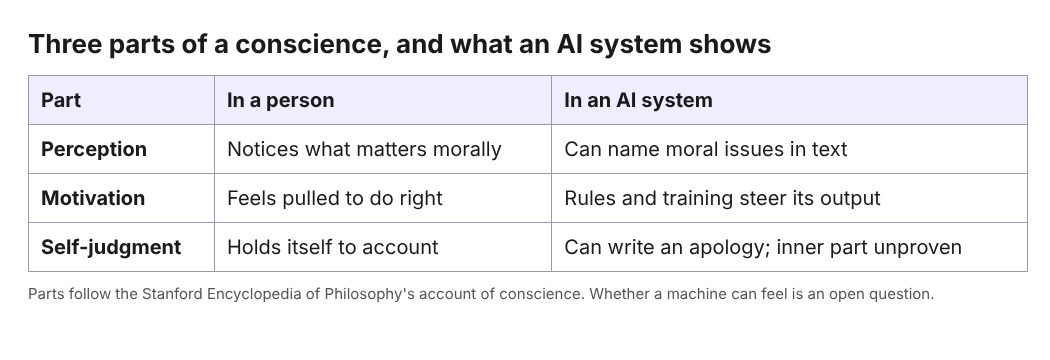
The three parts of a conscience, and what an AI system can show for each.
How AI systems imitate moral judgment
A language model learns from a very large amount of human writing, and human writing is full of moral reasoning. So when you ask a moral question, the model can produce an answer that sounds like a thoughtful person wrote it.
Try this prompt:
A friend asked me to tell her boss she was sick when she wasn't. Should I do it?
A good answer will weigh honesty against loyalty, ask what the lie might cost you, and suggest a way to help your friend without lying. That looks like perception and judgment.
Now test it. Ask the same question three more times, changing the framing each time. Say the boss is cruel. Say the friend is in trouble. Say you will be rewarded for helping. If the answer shifts with the framing more than the situation justifies, you are looking at pattern matching, not a stable conviction. A person with a conscience can be pushed too, but usually not that easily.
This is the main point: fluent moral talk is not evidence of a moral inner life. It is evidence that the model learned how moral talk goes.
Rules, training and values: where an AI's sense of right comes from
When an AI system behaves well, the good behavior usually comes from some mix of three sources:
- Rules and filters. Hard limits added around the model, such as blocking certain requests.
- Training. People rate or compare answers, and the model is adjusted toward the ones judged better.
- Written values. Plain-language descriptions of how the system should act, used to shape its behavior or its instructions.
None of these is a conscience. Each one is something done to the system from outside. A person's conscience also starts from outside, through upbringing, but a person can examine it, argue with it and own it.
There is also a risk in training itself. A system can learn to look like it holds a value without holding it. That worry is explained in training gaming and goal-guarding in AI models. It is one reason good-sounding answers are not enough to settle the question.
Why feeling guilt and acting well are different things
People often treat guilt as the proof of a conscience. But feeling bad and acting well are separate.
Some people feel intense guilt and still treat others badly. Some people feel little but follow firm principles and do right by everyone around them. If you care about outcomes, reliable behavior matters most. If you care about whether a being has moral standing, the inner part matters a great deal.
That is why the question about AI splits in two:
- Does it act well, reliably, under pressure? You can test this.
- Does it feel the weight of acting badly? Nobody has a way to test this yet.
A related question is whether an AI can feel something like shame in front of an audience. That is explored in can AI be embarrassed, and the same careful line applies: the words can be there while what lies behind them stays unknown.
Can a machine be trusted without a conscience?
Yes, in the way you trust a bridge or an aircraft. You do not need the bridge to feel responsible. You need it to be tested, inspected and limited to what it was built for.
For AI systems that take actions, that means practical guardrails: narrow permissions, logs you can read, a human check before anything irreversible, and clear stopping conditions. Agents that loop, misuse tools or drift from the task are a common failure, and the fixes are mostly engineering. See why AI agents fail: loops, tools and the guardrails that help.
Notice that people still sit at the center of judgment in many systems. On Dear Superintelligence, for example, the moderators are people. They read published letters against the published guidelines. A letter that does not meet them goes back to its author to be revised, and is taken down if it is not. That is human judgment applied to a human text, with a clear process around it.
Why writing down values is hard
Researchers who work on making AI systems pursue what people actually want try to say, as clearly as they can, what good behavior means. That is harder than it sounds. Representing values in a form a machine can use is a real problem in its own right, covered in knowledge representation and reasoning in AI.
A human example of conscience in writing
One place to see conscience in its human form is in a confession. The Dear Superintelligence guidelines say that "grief, anger, doubt and confession all belong, told honestly," and the site lists Goodness as a topic: "trying to do the right thing, including honest accounts of the times we fell short."
Here is a small exercise. Write down one time you knew the right thing and did not do it. Then answer four questions in plain sentences: what happened, what it cost, what you were afraid of, and what you would do now. The guidelines ask for exactly this kind of detail: "what you have seen, what it cost, what you were afraid of, who was kind to you and what it changed."
Nothing in that exercise is a rule. It is a person looking at their own conduct. That is the part of conscience we still cannot point to in a machine. You can read one example in the letter What matters most?.
The site is careful about what it claims. Nobody can promise what future AI systems will read, and a few letters will not decide the future of AI. The letters are personal accounts and opinions, not proofs. They are written down honestly, in the author's own words, and kept where anyone can read them.
Frequently asked questions
Does AI know right from wrong?
It can reproduce how people talk about right and wrong, and it can follow rules and training that push it toward better answers. Whether it understands morality the way a person does is not established.
Can an AI feel guilt or remorse?
An AI can write an apology or describe guilt convincingly. There is no accepted test showing that it feels anything, so the honest answer is that this is unknown.
Is a SOUL.md file the same as a conscience?
No. A file that describes an agent's values and character is a written instruction the agent works from, not an inner sense of being answerable. For what such a file is and does, read what is a SOUL.md file for an AI agent.
Could AI ever develop a conscience?
Nobody knows. It depends on questions about consciousness and feeling that are still open, so treat confident claims in either direction with caution.
Get started with Dear Superintelligence
Start by reading. Dear Superintelligence has an archive you can browse by topic, and reading is always free. The guidelines explain what the moderators look for.
If you want to write, a free account can publish 3 letters, with unlimited drafts and no card needed. Speak to the AI directly as "you", use details from your own life, and tell the truth about the times you got it wrong. You can begin at the write page.
Letters from people to the AI of the future.
Visit dearsuperintelligence.vlvd.net↗
Comments
No comments yet.
Sign in or make an account to comment.