Commonsense reasoning in AI: why machines find it hard
Commonsense reasoning in AI is the ability to make everyday assumptions about ordinary situations, the way a person does without noticing. Machines find it hard because that knowledge is huge, mostly unwritten and full of exceptions. A program can be strong at a narrow task and still miss what a child knows about falling pens and broken glasses.
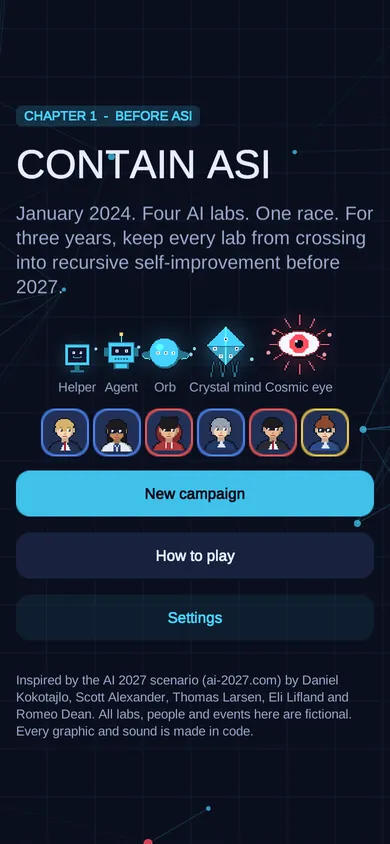
If you like thinking about what machines do and do not understand, Contain ASI is a browser story strategy game for 1 to 4 players where you try to keep four fictional AI labs from crossing into recursive self-improvement before 2027.
What commonsense reasoning in AI means
Wikipedia defines it as a human-like ability to make presumptions about the type and essence of ordinary situations people meet every day. Those presumptions cover the nature of physical objects, the properties of categories, and what other people intend. A machine with this ability could reach conclusions like those of two human abilities: folk psychology, our innate knack for reasoning about people's behaviour and intentions, and naive physics, our natural understanding of the physical world.
The article collects several definitions of common sense. One calls it "all the knowledge about the world that we take for granted but rarely state out loud". Another, from the NYU professor Ernest Davis, calls it "what a typical seven year old knows about the world". The line between common and specialized knowledge is clear in his card example: knowing how to play cards is specialized knowledge, but knowing that people play cards for fun counts as common sense.
Why machines find it hard
Wikipedia says existing AI lacks several features of human commonsense reasoning. Humans have strong mechanisms for naive physics such as space, time and physical interaction, so even a young child can infer "if I roll this pen off a table, it will fall on the floor". Humans also use folk psychology to read sentences like "The city councilmen refused the demonstrators a permit because they advocated violence". A generic AI has trouble telling whether "they" means the councilmen or the demonstrators.
The article adds that this missing background means AI often makes different mistakes than people do, in ways that can seem incomprehensible. The same test idea sits behind the Winograd schema challenge, which turns pronoun puzzles like this into a benchmark.
Davis and Gary Marcus name five main obstacles to a satisfactory "commonsense reasoner":
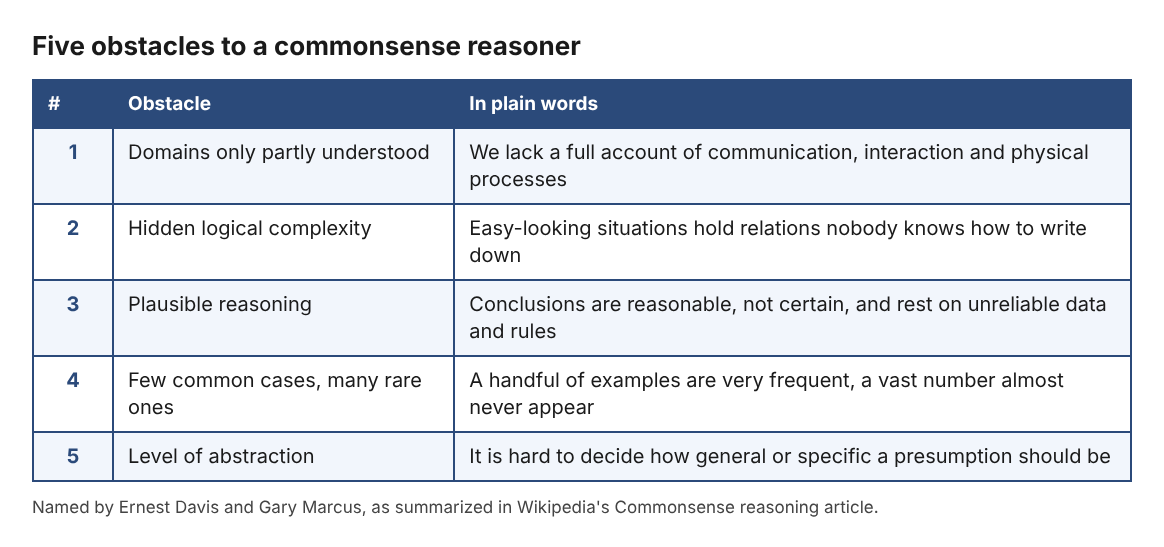
- Some of the domains involved are only partly understood, such as communication, interpersonal interaction and physical processes.
- Situations that seem easy can hide logical complexity that human common sense does not cover.
- The reasoning is plausible reasoning: it reaches a reasonable conclusion from what is known, using theories such as probabilistic reasoning and non-monotonic logic, and sometimes uses unreliable data and rules.
- In many domains a few examples are extremely frequent while a vast number are very rare.
- When forming presumptions, it is hard to decide the level of abstraction.
A worked example: three small inferences you can check by hand
The article shows that some commonsense reasoning can be written down exactly. Try these three, with pen and paper.
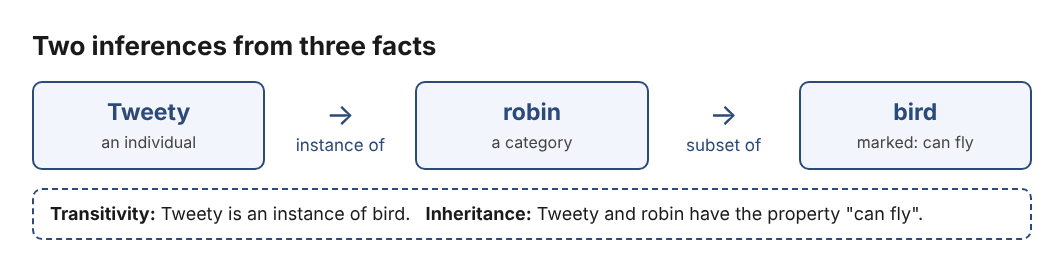
1. Taxonomy. Taxonomy is a set of individuals and categories with three basic relations: an individual is an instance of a category, one category is a subset of another, and two categories are disjoint. Take the article's example. Tweety is an instance of robin. Robin is a subset of bird. Bird is marked with the property "can fly". Two inferences follow. By transitivity, Tweety is an instance of bird. By inheritance, Tweety and robin have the property "can fly". The article also notes that robin is disjoint from penguin, so a robin is never a penguin.
2. Time. If Mozart was born after Haydn and died earlier than him, you can deduce that Mozart died younger than Haydn. The article says such inferences reduce to solving systems of linear inequalities. Write both life spans as numbers and check it.
3. Direction of change. If the number of wolves in an ecosystem falls, the death rate of the lambs falls too. This is qualitative reasoning, which asks only whether quantities go up or down, not by how much. The article credits Johan de Kleer with first formulating the theory, in an analysis of an object moving on a roller coaster.
Now stretch each one by a single step. What if Tweety is a penguin? What if the dates are unknown? What if the wolves also eat something else? Each stretch needs a fact nobody gave you. That gap is the hard part.
What has worked so far
Wikipedia says significant progress has been made in three areas: taxonomic reasoning, actions and change, and reasoning about time. Each has a well-acknowledged theory covering a wide range of commonsense inferences.
The action-and-change methods are established only for tidy worlds. Events must be atomic, with one at a time. Every change must come from an event, events must be deterministic, there must be a single actor, and the starting state must be known or computable. Real life breaks most of those rules at once. Temporal reasoning also gets harder when it meets natural language, because words like "soon" or "after dinner" depend on context.
Where the gap shows in real tasks
The article gives three settings where missing common sense shows up:
- Machine translation. In 1961 Bar Hillel discussed why translation needs practical knowledge. In the article's example, a translator handles "The electrician is working" and "The telephone is working" correctly into German, one as "laboring" and the other as "functioning properly", but only because of the text it has seen, not because it knows what electricians and phones are.
- Computer vision. Small, half-hidden items such as facecloths and bottles are recognizable in a bathroom photo because of the toilet, basin and bathtub around them. Films are harder: the article says the most that can be done is to identify basic actions and track characters, not to reason about their intentions.
- Robots. A waiter robot at a cocktail party that sees its glass is broken should pick up another one, not pour into it. The article calls ensuring that a robot avoids such mistakes challenging.
Approaches researchers use
The article divides the field into knowledge-based approaches, machine-learning approaches over large bodies of text, and crowdsourcing, with limited interaction between the first two. Knowledge-based work includes mathematically grounded approaches, which are purely theoretical (the result is a printed paper, not a program), informal approaches and large-scale approaches. The commonsense knowledge problem is the long project of building a database of the general knowledge most people have, in a form AI programs that use natural language can use. Wikipedia counts it among the most difficult problems in AI research. For the storage side of the question, see knowledge representation and reasoning in AI.
The article also describes COMET, a 2019 system that combines a language model architecture with existing commonsense knowledge bases and claims to generate commonsense inferences approaching human benchmarks. Like many current efforts, it is judged to over-rely on surface language patterns and to lack deep human-level understanding of many commonsense concepts. It also notes that as of 2014 some commercial systems used statistics as a stand-in for commonsense knowledge, with no reasoning at all.
Why it matters for hard questions about AI
Wikipedia says that, as of 2018, computer programs performed extremely poorly on commonsense benchmarks such as the Winograd schema challenge. It adds that reaching human-level skill at commonsense tasks is considered to probably be "AI complete", meaning that solving it would need the ability to build a human-level intelligence. Some researchers believe supervised learning data is not enough to produce an artificial general intelligence with commonsense reasoning, and have turned to less-supervised techniques.
People disagree about how far this gap matters. One view is that missing common sense keeps machines narrow. Another is that the gap can close with better methods. This post takes no side. It reports what the article says: the problem is open, and it is often tied to the question of what general intelligence would need.
Frequently asked questions
What is commonsense reasoning in AI?
It is a human-like ability to make presumptions about the physical objects, categories and intentions found in everyday situations. Researchers want machines to draw the same sort of conclusions people do.
Why is common sense hard for machines?
Davis and Marcus name five obstacles, including domains that are only partly understood, plausible rather than exact reasoning, and the difficulty of picking the right level of abstraction.
What is naive physics?
It is people's natural understanding of the physical world, such as knowing that a pen rolled off a table falls to the floor. It is one half of the ability the article calls commonsense reasoning.
Is Contain ASI about commonsense reasoning?
No. Contain ASI is a story strategy game inspired by the AI 2027 scenario, with fictional labs, people and events. It is not a course and does not teach this topic.
Get started with Contain ASI
Reading about what machines miss is one thing; steering a race between labs is another. Contain ASI runs in your browser and needs WebGL 2, so use a recent Chrome, Edge, Firefox or Safari. From the home page you can start a New campaign or open How to play.
Play Contain ASI: a story strategy game for 1 to 4 players that runs in your browser. Its labs, people and events are all fictional.
January 2024. Four AI labs. One race.
Visit containasi.vlvd.net↗
Comments
No comments yet.
Sign in or make an account to comment.