Winograd schema challenge: a test of machine common sense
The Winograd schema challenge is a test of machine common sense built from one kind of question: who does the word "it" or "they" point to? A person answers in a blink. For years, machines did not.
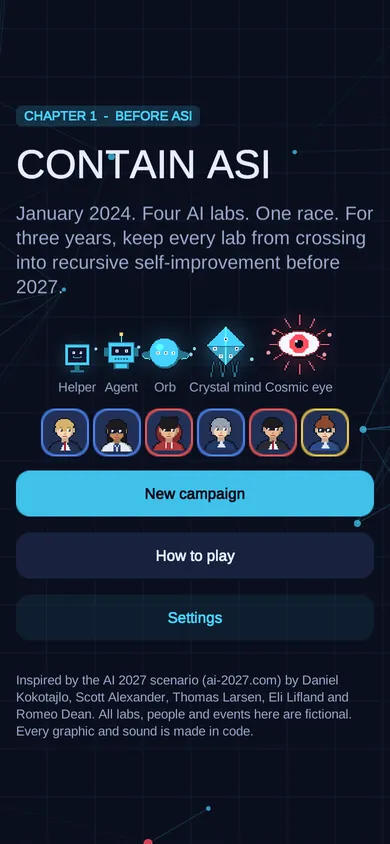
If you like testing what "understanding" means, Contain ASI is a browser story strategy game for 1 to 4 players where you try to keep four fictional AI labs from crossing into recursive self-improvement before 2027.
What the Winograd schema challenge is
Wikipedia describes it as a test of machine intelligence proposed in 2012 by Hector Levesque, a computer scientist at the University of Toronto. It is a multiple-choice test made of Winograd schemas, questions with a very specific structure, named after Terry Winograd, a professor of computer science at Stanford University.
On the surface each question only asks a machine to resolve an ambiguous pronoun, a task called anaphora resolution. That is a language task. Levesque argues that for these particular questions, the task also needs knowledge and commonsense reasoning, because the words alone do not give the answer.
Why Levesque proposed it
The challenge was proposed in the spirit of the Turing test. Turing suggested that instead of debating whether a machine can think, we should test intelligent behaviour. In his imitation game, judges chat freely with a program over a text-only channel and the machine passes if they cannot tell it from a human in a five-minute conversation.
The article says the exact nature of that test has come under scrutiny, especially after a chatbot claimed to pass it in 2014. One worry is that a machine could pass by brute force or trickery rather than real intelligence. Levesque names three issues:
- Deception. The machine has to build a false identity, which is not part of intelligence.
- Conversation. Jokes, asides and clever deflections can pass as conversation without any reasoning.
- Evaluation. Humans make mistakes, and judges often disagree about the result.
A schema test aims to fix all three: no false identity, a single narrow question, and no judges.
How a Winograd schema works
The first cited example comes from Terry Winograd himself:
The city councilmen refused the demonstrators a permit because they [feared/advocated] violence.
The two bracketed words turn the schema into two sentences, one with "feared" and one with "advocated". The question is the same for both: does "they" refer to the city councilmen or the demonstrators? Switching the word flips the answer. A human reader sees it at once, because we know how councilmen and demonstrators usually behave. Levesque argues that this knowledge is exactly what the machine needs.
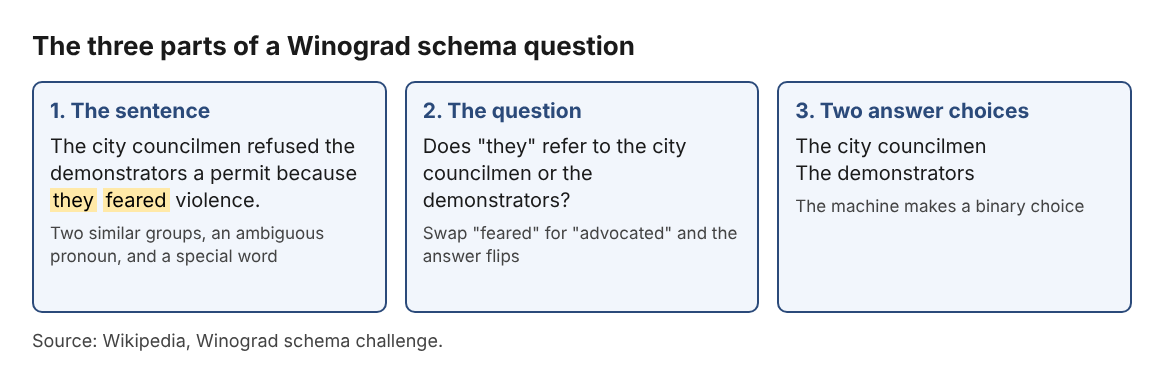
The article gives a formal description. A question has three parts:
- A sentence or short passage with two noun phrases of the same kind (both male, both female, both objects, or both groups), an ambiguous pronoun that could refer to either, and a special word with an alternate word that changes the natural answer when swapped.
- A question asking who the pronoun refers to.
- Two answer choices, one for each noun phrase.
The machine gets the problem in a standard form with the choices included, so it is a binary decision. Ernest Davis, a professor at New York University, compiled a list of over 140 such schemas as examples of what the test should contain.
A schema you can write and check yourself
Writing a good schema is harder than it looks. Use this four-step check on any pair you invent:
- Pick two similar things. For example, two people, or two groups, so a pronoun could fit either.
- Add the pronoun and a special word. Write one sentence where the pronoun could point to either, with a word such as "feared" doing the work.
- Swap the word. Replace it with an alternate that flips the natural answer, as "advocated" does. If the answer does not flip, it is not a schema.
- Test for shortcuts. Ask whether the answer could come from word statistics alone. If a sentence can be solved by knowing which nouns go with which adjectives, it is too easy.
Step 4 is the pitfall the article stresses. Levesque's own "too easy" example is "The women stopped taking pills because they were [pregnant/carcinogenic]." Pills are not pregnant and women are not carcinogenic, so a program could answer from those restrictions alone, with no grasp of meaning. The questions need careful tailoring so that they demand reasoning, not word pairings.
The article lists the purported advantages of the format. Questions need knowledge and commonsense reasoning, they can vary from simple cause and effect to complex stories, they can target specific areas such as social or spatial reasoning, and no human judge is needed.
How machines scored
Humans answer 92 to 96% of these questions correctly, according to the article. A company sponsored a competition in 2016 and 2018 with a $25,000 prize for the top scorer above 90%. In the 2016 run, held at IJCAI-16 with four contestants, the best score in the first round was 58%, so no prize was awarded and the challenge did not reach the second round. The 2018 competition was cancelled for lack of prospects, and the prize is no longer offered.
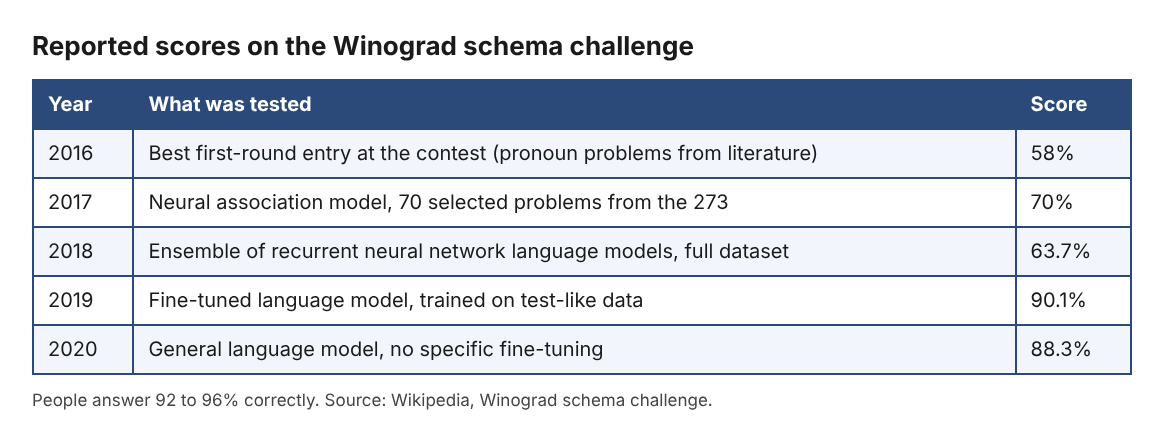
After that, scores climbed:
- 2017: a neural association model reached 70% on 70 manually selected problems from the original 273.
- 2018: an ensemble of recurrent neural network language models reached 63.7% on the full dataset.
- 2019: a fine-tuned language model reached 90.1%. The article says it was fine-tuned with training data like the test, to avoid having to learn commonsense reasoning.
- 2020: a general language model reached 88.3% with no specific fine-tuning.
Wikipedia says the challenge has been considered "defeated" since 2019, when a number of transformer-based language models passed 90%. Researchers then designed a harder, adversarial set called Winogrande, with 44,000 fill-in-the-blank problems instead of pronouns, in 2019. A version of the challenge is also one part of the GLUE benchmark collection.
What a solved test does and does not show
A high score raises a question the article does not settle: did the model reason, or did it learn the pattern? The 2019 result shows why people ask. The score came from training on data like the test, which the article says avoided learning commonsense reasoning. Whether the later 88.3% from a general model reflects understanding is something the article does not claim either way.
This is a familiar story in AI. Tests built to need understanding get passed, and then people ask whether passing meant understanding. The AI effect names the habit of moving the bar once a machine clears it. Related questions run through the posts on the symbol grounding problem and knowledge representation and reasoning.
The Wikipedia article does not discuss AI risk, so treat any link to it as a way of thinking. If one test of common sense can be beaten without anyone agreeing it was understood, a single score is a weak signal about a machine's abilities. Contain ASI is a story game whose labs, people and events are fictional. It is not a forecast, and it does not claim any test result means anything about real systems.
Frequently asked questions
What is a Winograd schema?
It is a sentence with two possible candidates and an ambiguous pronoun, plus a special word that, when swapped for an alternate, changes who the pronoun refers to. The reader must pick the right one.
Why is it called a test of common sense?
Levesque argues the answer needs knowledge and commonsense reasoning, not just grammar, because the sentence structure alone does not tell you who "they" means.
Has any machine passed the Winograd schema challenge?
Wikipedia says it has been considered defeated since 2019, when transformer-based language models passed 90%. Whether that shows common sense is still debated.
Is Contain ASI based on the Winograd schema challenge?
No. Contain ASI is a story strategy game inspired by the AI 2027 scenario. Its labs, people and events are fictional.
Get started with Contain ASI
Thinking about what counts as understanding is one thing; steering a race is another. Contain ASI runs in your browser and needs WebGL 2, so use a recent Chrome, Edge, Firefox or Safari. From the home page you can start a New campaign or open How to play.
Play Contain ASI: a story strategy game for 1 to 4 players that runs in your browser. Its labs, people and events are all fictional.
January 2024. Four AI labs. One race.
Visit containasi.vlvd.net↗
Comments
No comments yet.
Sign in or make an account to comment.