Computing Machinery and Intelligence: Turing's 1950 paper
"Computing Machinery and Intelligence" is a paper written by Alan Turing on the topic of artificial intelligence. Wikipedia's article on it says it was published in 1950 in the journal Mind, and that it was the first to introduce his concept of what is now known as the Turing test to the general public. This post walks through the paper in the order Turing wrote it, so you can read the original with a map in hand.
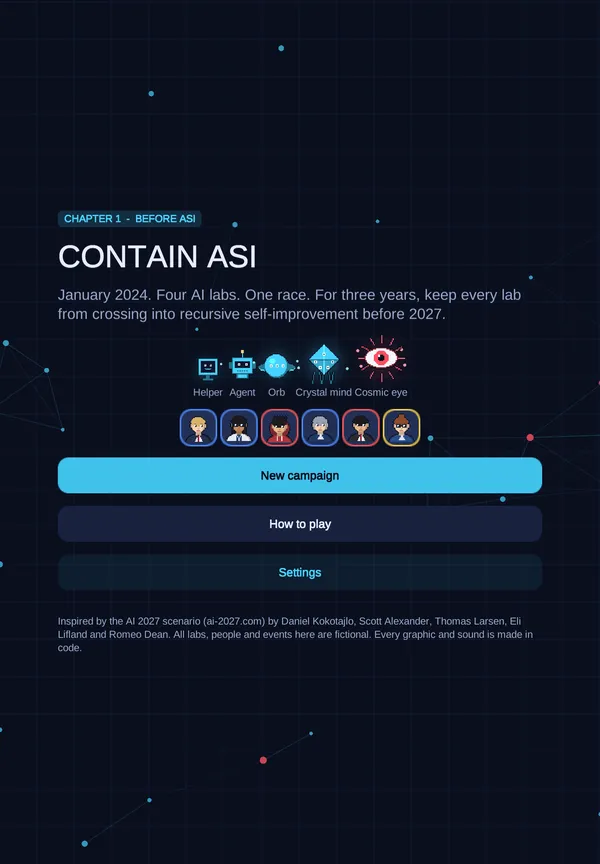
Contain ASI is a story strategy game for 1 to 4 players that runs in your browser: you play as a researcher, research manager, CEO or government and try to keep four fictional AI labs from crossing into recursive self-improvement before 2027, and its labs, people and events are all fictional.
What "Computing Machinery and Intelligence" argues
The paper starts with a question: "Can machines think?" Turing does not try to answer it head on. He says that "think" and "machine" cannot be clearly defined, so we should "replace the question by another, which is closely related to it and is expressed in relatively unambiguous words."
The article says he does this in three steps. First, he picks a simple, unambiguous idea to stand in for "think". Second, he says which "machines" he means. Third, with those two tools, he asks a new question that he believes he can answer yes. The rest of the paper is the case for that yes.
Turing was not starting from nothing: the article says he had been turning the notion of machine intelligence over since at least 1941, and that British researchers, including the Ratio Club he belonged to, had explored it for up to ten years before the field of AI was founded in 1956.
The imitation game: how the question gets swapped
The stand-in for "think" is a game. The original Imitation Game is a party game for three players. Player A is a man, player B is a woman, and player C is the interrogator. C cannot see A or B and talks to them only through written notes. C tries to work out which is the man and which is the woman. A tries to trick C into guessing wrong, and B tries to help C guess right.
Then Turing swaps a player. He asks what happens when a machine takes the part of A, and says this question replaces "Can machines think?" In the version the article describes, a computer, a human and a human judge sit in separate rooms. The judge types to both and tries to tell which is which. If the judge cannot do that consistently, the computer wins.
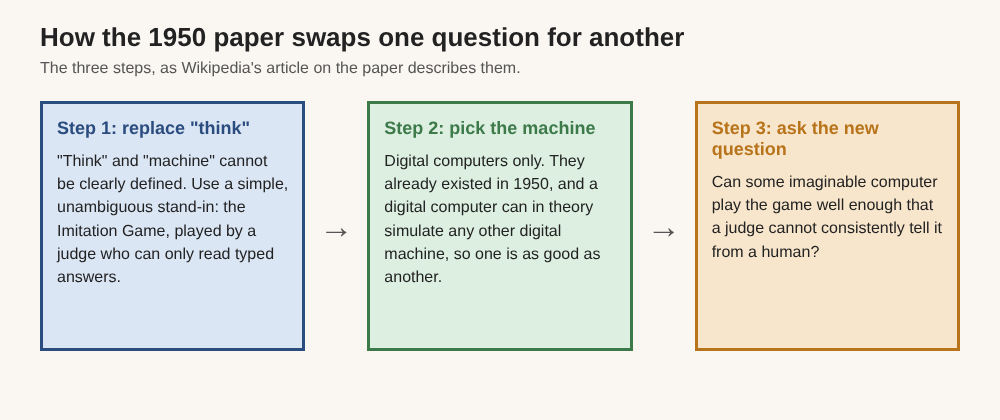
The article stresses what this does and does not mean. Citing Stevan Harnad, it says the question has become "Can machines do what we (as thinking entities) can do?" Turing is no longer asking whether a machine can think. He is asking whether it can act indistinguishably from the way a thinker acts. The article adds that it seems clear Turing was not talking about fooling people, but about generating human cognitive capacity. For the test itself and its critics, see our post on the Turing test.
Why only digital machines
Turing then says which machines count. He picks digital machines, which manipulate the binary digits 1 and 0, for two reasons. They already existed in 1950. And they are "universal": his research on computation had shown that a digital computer can in theory simulate any other digital machine, given enough memory and time. So he writes that "all digital computers are in a sense equivalent."
He is not asking whether the computers of 1950 would do well, the article says, but whether there are imaginable computers which would.
Turing's nine objections and his replies
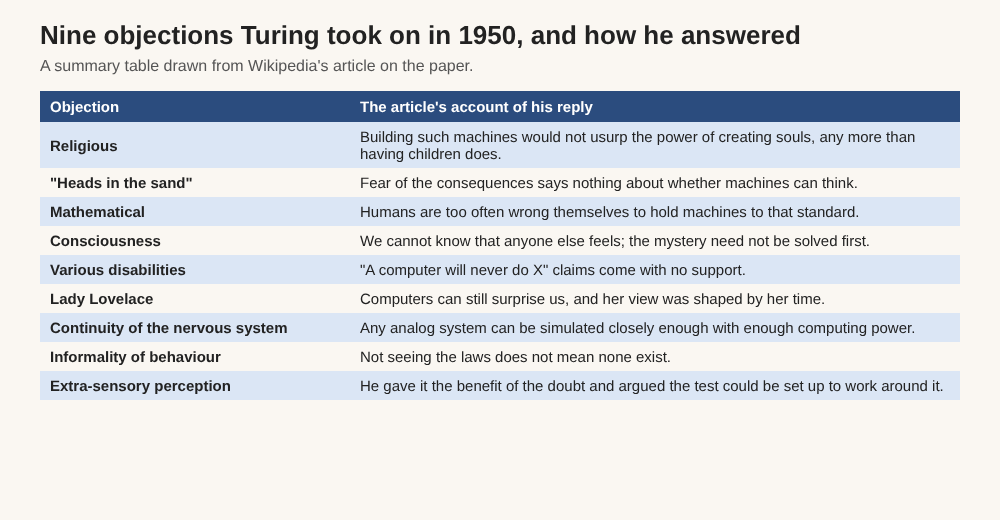
Once the question is clear, Turing takes on nine common objections. The article says they include all the major arguments against artificial intelligence raised in the years since. The picture below sums up each reply in a line.
Two are worth a closer look, because they keep coming back.
- The argument from consciousness. Turing's reply is that we have no way of knowing that anyone other than ourselves feels emotions, so we should accept the test. He adds that he does not think there is no mystery about consciousness, but that the mysteries need not be solved first. The article says this reply is now known as the "other minds reply", and that John Searle made the opposing argument in 1980 in his Chinese room. Our post on the Chinese room argument covers that debate.
- The informality of behaviour. It says any system governed by laws is predictable and so not truly intelligent. Turing says this confuses laws of behaviour with general rules of conduct, and that failing to see the laws does not show that none exist. The article notes that Hubert Dreyfus later argued in 1972 that human reasoning is not based on formal rules, which we cover in our post on Hubert Dreyfus on AI.
Learning machines: raising a child program
The last section turns to how you would build a machine that plays the game. Turing says the task is one of programming, and he postulates that by the end of the century it will be technologically possible to program a machine to play it.
He then asks whether it would be easier to program a child's mind and educate it, and likens the child to a newly bought notebook.
He adds that the child machine would not behave as the experimenter wanted on the first try. A process of reward and punishment would be needed to select good patterns. The article lists his comparison with evolution: the structure of the child machine is like hereditary material, its changes are like mutations, and natural selection is the judgment of the experimenter.
Two more points from the article:
- The teacher would not know the learner's internal state while it learns. Turing says this gives a machine a degree of what we call intelligence, as long as the departure from complete determinism does not give rise to pointless loops or random behaviour.
- He suggests starting with an abstract task such as playing chess, and also says it is best to give the machine "the best sense organs that money can buy" and then teach it to understand and speak English.
A worked example: test a "never" claim the way Turing did
The paper is useful as a method. Here is a short exercise you can run on any claim of the form "a machine will never do X".
- Write the claim. For example: "A machine will never write a poem."
- Ask what the support is. Turing notes that such claims usually come with no support and depend on naive assumptions about how versatile machines may become. If you can find none, note that.
- Turn it into a behaviour test. Ask what the machine would have to do for you to say it had done X, using the imitation game as the model: a judge, a text channel and no peeking. If you cannot say, the claim may be about the word, not the machine.
The exercise will not settle the claim. It will show what the claim rests on.
What the paper leaves open, and where Contain ASI comes in
Turing's test looks at what a machine does in conversation. As the article reports it, the question became whether a machine can do what thinking entities can do, not what goes on inside it. For the wider timeline this paper sits in, see our post on the history of AI, and for the rest of his work, our post on Alan Turing's contributions.
The paper also shows how early people argued about the fears around thinking machines. The article calls the "heads in the sand" objection a fallacious appeal to consequences. Contain ASI goes the other way and lets you play with those fears as fiction. Its page reads "January 2024. Four AI labs. One race." and gives you three years to keep every lab from crossing into recursive self-improvement before 2027. It says it is inspired by the AI 2027 scenario, and that all its labs, people and events are fictional. It is a story, not a forecast, and it does not claim to show what real organizations will do.
Frequently asked questions
When was "Computing Machinery and Intelligence" published?
In 1950, in the journal Mind. According to Wikipedia, it was the first paper to introduce Turing's concept of what is now called the Turing test to the general public.
What question does the paper ask?
It asks "Can machines think?" and then replaces it, because "think" and "machine" cannot be clearly defined. The new question is whether a machine can play the Imitation Game well enough that a judge cannot consistently tell it from a human.
What are the nine objections in the paper?
They are the religious, "heads in the sand", mathematical, consciousness, various disabilities, Lady Lovelace, continuity of the nervous system, informality of behaviour and extra-sensory perception objections. Turing answers each one.
Get started
Turing's paper begins with a question that was hard to ask in 1950 and is still argued over. If you want to explore a made-up version of the race to advanced AI, play Contain ASI: a story strategy game for 1 to 4 players that runs in your browser. Its labs, people and events are all fictional. You need a recent browser, because it runs on WebGL 2.
January 2024. Four AI labs. One race.
Visit containasi.vlvd.net↗

Comments
No comments yet.
Sign in or make an account to comment.