Hubert Dreyfus on AI: his critique explained
Hubert Dreyfus was a philosopher who argued, from the 1960s on, that human intelligence cannot be reduced to rules and symbols, and that the AI of his day was built on a wrong picture of the mind. Wikipedia's article on his views sets out what he claimed and how it held up. This post covers his four assumptions, knowing-that versus knowing-how, and what was right and wrong in his critique.
If you like to explore AI ideas as a story, Contain ASI is a story strategy game for 1 to 4 players that runs in your browser, where you try to keep four fictional AI labs from crossing into recursive self-improvement.

Who was Hubert Dreyfus, and what did he argue?
The article calls Dreyfus a critic of AI research. In a series of papers and books he gave a skeptical and cautious assessment of AI's progress and a critique of its philosophical foundations. The best known are Alchemy and AI (1965), What Computers Can't Do (1972, with later editions) and Mind over Machine (1986). His objections appear in most introductions to the philosophy of AI.
His core claim was that human intelligence and expertise depend mainly on informal, unconscious processes, not on symbol manipulation, and that these skills cannot be fully captured in formal rules. He drew on the continental philosophers Merleau-Ponty and Heidegger. His target was the first wave of AI research, which tried to reduce intelligence to high-level formal symbols, an approach now called symbolic AI or "GOFAI" (good old-fashioned AI).
"Alchemy and AI" and the uproar it caused
Dreyfus began to form his critique in the early 1960s, bothered that AI researchers seemed to think they were close to solving old philosophical problems within a few years. In 1965 he spent a summer at a research think tank writing "Alchemy and AI". It compared AI research to alchemy: a misguided attempt to turn metals into gold, resting on mythology and wishful thinking. It became a best seller.
The article gives an example of the optimism he mocked. After the General Problem Solver program, Herbert A. Simon said that by 1967 a computer would be world chess champion and would prove an important new theorem. Dreyfus argued forcefully in 1965 that claims like these would not come true.
The reaction was sharp and personal. Seymour Papert called a third of the paper "gossip", and Herbert A. Simon accused Dreyfus of playing politics. Joseph Weizenbaum, the author of ELIZA, said he deliberately became the one AI researcher seen eating lunch with him. When a ten-year-old beat a leading chess program in 1966, Papert arranged a match between Dreyfus and a chess program, and Dreyfus lost.
The four assumptions behind early AI
In Alchemy and AI and What Computers Can't Do, Dreyfus named four philosophical assumptions. He said AI would be impossible unless at least one were true, and that each was taken by AI workers as an axiom when it was really one hypothesis among others, to be tested by how the work turned out.
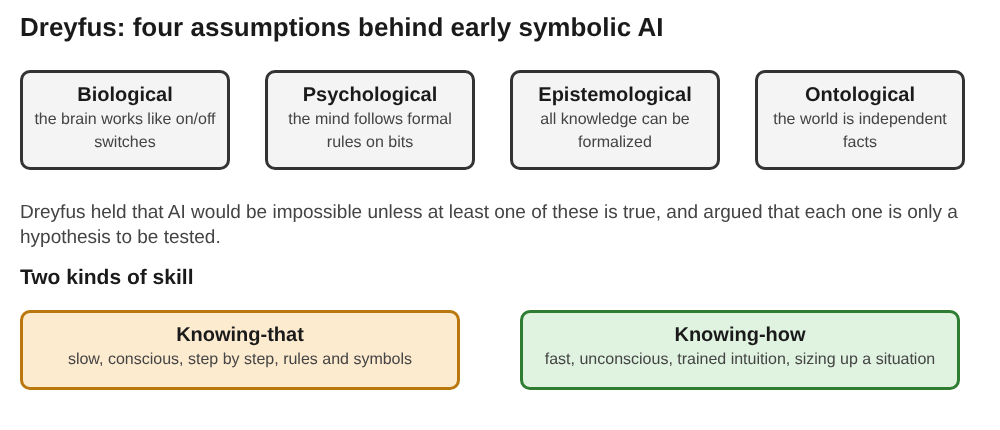
- The biological assumption: the brain processes information in discrete on/off operations. Dreyfus cited neurology showing that the timing of neuron firing has analog parts, and the article says few still held this view by the early 1970s.
- The psychological assumption: the mind is a device that operates on bits of information by formal rules. Dreyfus replied that much of what we know is a set of tendencies and an unconscious, informal background, including commonsense knowledge. Without that background, he said, our symbols stop meaning anything.
- The epistemological assumption: all knowledge can be formalized. John McCarthy argued a machine could represent all of it even if people do not. Dreyfus saw no justification, since so much human knowledge is not expressible in formal terms.
- The ontological assumption: the world consists of independent facts that independent symbols can represent. If that is false, the article says, it raises doubts about what intelligent machines can help us do.
Knowing-that and knowing-how
In Mind over Machine (1986), written with his brother during the heyday of expert systems, Dreyfus compared human expertise with the programs that claimed to capture it. He said human problem solving rests on a background sense of what matters in a situation, not on searching through possibilities.
He drew a line between two kinds of skill, based on Heidegger. Knowing-that is conscious, step-by-step problem solving. When we hit a hard problem we stop and work through ideas one at a time, as precise, context-free symbols. Knowing-how is how we deal with things normally. We recognize a face, drive to work or find the right thing to say without any conscious symbolic reasoning. We seem to jump to the right response without weighing alternatives.
Dreyfus held that knowing-that is a small part of intelligent behavior. Expertise, on his account, is what happens when intuitions are trained until we forget the rules and simply "size up the situation". That sense of the situation rests on our goals, our bodies and our culture, a background he believed could never be captured as explicit symbols. An AI that ignored it, he said, was doomed: "tree climbing with one's eyes on the moon".
Was Dreyfus right? How his critique held up
By the early 1990s several of his radical opinions had become mainstream. The big promises of early AI had failed: fully intelligent machines did not appear in the mid-1970s, and the film computer HAL 9000 did not exist in 2001. The article notes that optimistic claims became common again during the AI boom of the 2020s.
Researchers also moved away from his targets. Daniel Crevier writes that by 1993, unlike 1965, AI researchers "no longer made the psychological assumption". Robotics researchers such as Hans Moravec and Rodney Brooks were among the first to see that unconscious skills would be the hardest to reverse engineer (see the post on Moravec's paradox). Neural networks and other "sub-symbolic" methods then did well, and Dreyfus agreed in 1992 that they can capture some of the tendencies he thought essential.
The article also explains why the field mostly did not answer him. Marvin Minsky said critics from philosophy "misunderstand, and should be ignored" (see the post on Marvin Minsky). McCorduck and Crevier both said his derisive tone pushed away people he might have convinced. There was a logical weakness too. Russell and Norvig, quoting Turing, point out that "I cannot imagine formal rules for this" cannot win an argument, because no one can say "we have searched enough, there are no such laws".
His late critique: why "Heideggerian AI" failed
In 2007 Dreyfus published a paper titled "Why Heideggerian AI Failed and How Fixing it Would Require Making It More Heideggerian". He welcomed efforts to move beyond symbolic AI, then criticized the newer programs too. Rodney Brooks's robots, he said, respond only to fixed features of the environment. They neglect the learning of new relevance in a worldly context, which the article ties to the frame problem. His closing demand was that future AI must model "our particular way of being embedded and embodied", with our needs, desires, pleasures, pains, ways of moving and cultural background.
A worked example: test a task against his four assumptions
You can use Dreyfus's list as a quick test of any task.
- Pick a task you do without thinking, such as recognizing a friend's face in a crowd.
- Try to write the rules. If you can list them, it is knowing-that. If you find yourself saying "I just see it", it is knowing-how.
- Find the assumption a program would lean on. Needing all the knowledge written down is the epistemological assumption; needing the situation split into separate facts is the ontological one.
- Then argue the other side. As Russell and Norvig quote Turing, failing to find rules is not proof that none exist.
The same habit helps with AI claims today: the article's "first step fallacy" is treating early success as a promise of much bigger success. Contain ASI is a fictional scenario, not a forecast, so you can try out how such arguments feel in a story without treating it as a source of facts.
Frequently asked questions
What was Hubert Dreyfus's main argument against AI?
He argued that human intelligence depends mainly on informal, unconscious know-how that cannot be fully written as formal rules. Early AI tried to reduce thinking to symbol manipulation, so he thought it would fall short.
What are Dreyfus's four assumptions?
The biological, psychological, epistemological and ontological assumptions: that the brain works like on/off switches, the mind follows formal rules, all knowledge can be formalized and the world is made of independent facts. He said AI needed at least one of them to be true.
What is the difference between knowing-how and knowing-that?
Knowing-that is conscious, step-by-step reasoning with symbols and rules. Knowing-how is the fast, unconscious skill we use to recognize a face or drive to work, and Dreyfus said it is the core of expertise.
Was Dreyfus proven right about AI?
Partly. The big early promises failed and many researchers dropped the assumptions he attacked, but the field did not credit his work for that. Whether a program without a body can have the skills he described is still debated.
Get started
If you would like to explore AI ideas as fiction after the theory, play Contain ASI: a story strategy game for 1 to 4 players that runs in your browser and needs WebGL 2. Chapter 1, Before ASI, starts in January 2024 with four fictional AI labs in one race, and you try to keep every lab from crossing into recursive self-improvement before 2027. All its labs, people and events are fictional, and it is inspired by the AI 2027 scenario. It is a game, not a forecast.


For the source, read Wikipedia's article on Hubert Dreyfus's views on artificial intelligence.
Comments
No comments yet.
Sign in or make an account to comment.