Default Alive or Default Dead? How to Check Your Startup
Default alive or default dead is a yes-or-no question about your startup's future: if costs stay where they are and revenue keeps growing at its recent rate, do you reach profitability before the money runs out? If yes, you are default alive. If no, you are default dead, and something has to change. Paul Graham put the question this way in an October 2015 essay, and it is still one of the fastest health checks a founder can run.
Age of AI Entrepreneur teaches the numbers behind it in its Business Basics for Builders course, with lessons on unit economics and on growth as the number a startup lives by; sign in with your email and an emailed code to open it. This post builds on the site's own guide, What Is Startup Runway and How Do You Calculate It?, and adds the one thing runway leaves out: growth.
What default alive or default dead means
In his essay Default Alive or Default Dead?, Graham says the first thing he wants to know about a startup that has run for more than eight or nine months is whether, with expenses constant and revenue growing as it has over the last several months, it gets to profitability on the money it has left. He adds that about half the founders he talks to do not know the answer.
The question has three inputs:
- Cash in the bank today.
- Monthly costs, held flat.
- Monthly revenue and its recent growth rate, carried forward.
It has one output: does the cash balance stop falling before it reaches zero?
Why runway alone is not enough
Runway divides cash by burn, the rate at which a company uses up its cash each month. It answers "how many months do we have at today's numbers?" That is useful, but it treats today's burn as fixed. A startup whose revenue grows every month burns less each month, so its real runway is longer than the simple sum says. A startup whose revenue is flat gets no such help.
Default alive or default dead uses the same inputs and adds the growth rate. Two startups with the same runway today can get opposite answers. If you want to go deeper on the cost side first, the posts on unit economics for an AI product and the break even point for a startup cover it step by step.
A worked example with two growth rates
Take a small AI startup with these numbers today:
- Cash in the bank: $300,000.
- Monthly costs: $40,000 (two founders' pay, model API bills, hosting and tools).
- Monthly revenue: $10,000.
Net burn is $30,000 a month, so simple runway is 10 months. Now add growth and work month by month: each month, cash falls by costs minus that month's revenue, and revenue then grows by the rate.
- Revenue grows 10% a month. Revenue passes $40,000 in month 16. Cash keeps falling until then and bottoms out at about $17,700 at the end of month 15, then starts to rise. This startup is default alive, but only just: a single bad month could tip it over.
- Revenue grows 6% a month. Revenue is still well under costs when cash runs out, in month 12. This startup is default dead.
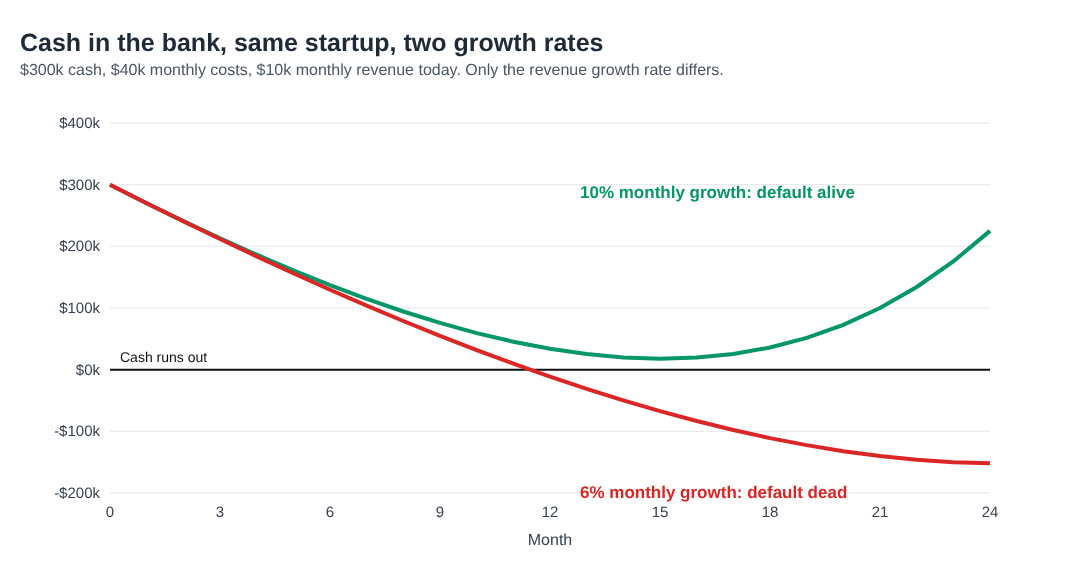
Both startups start with the same cash, the same costs and the same revenue. Four points of monthly growth decide the answer. You can do this in a spreadsheet in ten minutes: one row per month, columns for revenue, costs and cash.
The fatal pinch
Graham's reason for asking early is what he calls the fatal pinch: default dead, plus slow growth, plus not enough time to fix it. Founders end up there by not seeing where they are headed.
He also warns against a common way of not asking: assuming it will be easy to raise more money. He writes that, as a rule, investors' interest is a function of growth, and that even strong growth cannot make fundraising more than a plan A. His advice is to always have a plan B written down: exactly what you would do to survive without new money, and exactly when you would switch to it.
What to do if you are default dead
The answer is not a verdict on the business. It is a signal that one of the three inputs has to move.
- Cut costs. Graham names hiring too fast as by far the biggest killer of startups that raise money. Freezing hires and trimming tools lowers the line you have to cross.
- Raise growth. Find what drives the customers you already have, and do more of it. The CAC payback period post shows how to see which channels pay back fastest.
- Raise revenue per customer. A price change or a usage limit can shift the curve faster than new customers can.
- Add time. New money or a cheaper plan for model calls extends the runway, but only buys time to fix growth or costs.
Rerun the spreadsheet after each change. The goal is a cash line that turns up before it touches zero, with room to spare.
How often to check
Once a month is enough for most early teams, using real bank figures and the average growth rate of the last three to six months. Recheck after any big change: a new hire, a price change, a model switch that changes your API bill, or a month that breaks the trend. A single good month should not change the answer on its own.
Frequently asked questions
Who came up with default alive or default dead?
Paul Graham, in an essay published in October 2015 on his own site. He uses it as the first question for startups that have been running for more than eight or nine months.
Is default alive the same as profitable?
No. A default alive startup can still be losing money today. It only means that, on current trends, it reaches profitability before its cash runs out.
What growth rate should I use?
The rate you have actually had over the last several months, not the rate you hope for. Using a hoped-for rate turns the check into a guess.
Can a default dead startup survive?
Yes, if something changes in time: lower costs, faster growth, higher prices or new money. The point of the question is to see the problem while there is still time to act.
Get started
Open Age of AI Entrepreneur, sign in with your email and an emailed code, and take the Business Basics for Builders course: problems worth paying for, revenue, costs and unit economics, and growth. Each lesson takes about nine minutes and lists its sources.
Building a business in the age of AI, from a first project to a company.
Visit aientrepreneur.vlvd.net↗

Comments
No comments yet.