Doubly-Efficient Debate Explained: Efficient Honest Debaters
Doubly-efficient debate explained: efficient honest debaters is the idea that honest play in AI safety via debate should be cheap. It is a version of AI safety via debate where the honest debater needs only a polynomial number of steps, not an exponential one, and the human judge makes only a small, fixed number of judgements. This post follows the 2023 paper by Jonah Brown-Cohen, Geoffrey Irving and Georgios Piliouras, and shows what "efficient honest debaters" means and where it stops.
If you want to study scalable oversight in short lessons, Learn AI Alignment Theory teaches it with hands-on activities and sets out where researchers disagree, without picking a side.
Doubly-efficient debate explained: efficient honest debaters in plain terms
In AI safety via debate, two AI systems argue and a human judges. The hope is that it is easier to defend the truth than to defend a lie, so a judge can supervise answers they could not check alone.
"Doubly efficient" names two costs that both have to stay small. The paper says the honest debaters run in time polynomial in the size of the problem, and the verifier's time is linear in the length of one query. The verifier also makes a constant number of queries to human judgement, so human effort does not grow as the debaters' computation grows.
The second cost is the new one. Earlier debate results measured the power of the setup but let the honest debater use unlimited effort.
What the original debate setup assumed
The paper's abstract says the original framework "was based on the assumption that the honest strategy is able to simulate deterministic AI systems for an exponential number of steps." That assumption limits where the result applies. An honest debater that needs exponential work is not something you can train or run.
The authors also describe the aim of the whole line of work: to design methods that let very powerful learned models behave as desired while being supervised by much more limited verifiers. They point to a familiar case. No human Go player can tell AlphaZero what move to make, yet it was trained to a super-human level, because it is cheap to check who won a game.
Debate tries to give open-ended work the same property: a cheap check at the end. The new paper asks whether the honest side can get there without being exponentially expensive.
How the protocol works: A writes, B points, the judge checks
The paper models the judge's checks as an oracle: a black box that answers questions the way a human would. The debaters' access to that oracle stands for what a pre-trained model already knows about human judgements. The verifier's access stands for asking actual human raters. That split matters because the number of human judgements used in training then equals the number of verifier queries.
The paper's simplest strong protocol uses cross-examination. Cross-examination means the verifier can question independent copies of the debaters that cannot talk to each other. For language models, the paper says this can be done by running multiple copies, or by querying the same model with the earlier messages removed from its context.
- A writes out the whole computation. In the paper's Theorem 5.3, A outputs the full transcript of the work.
- B points to a supposed mistake. B outputs the location of the step it thinks is wrong.
- The verifier checks only that location. Cross-examination means A cannot tell a different story to a fresh copy of itself.
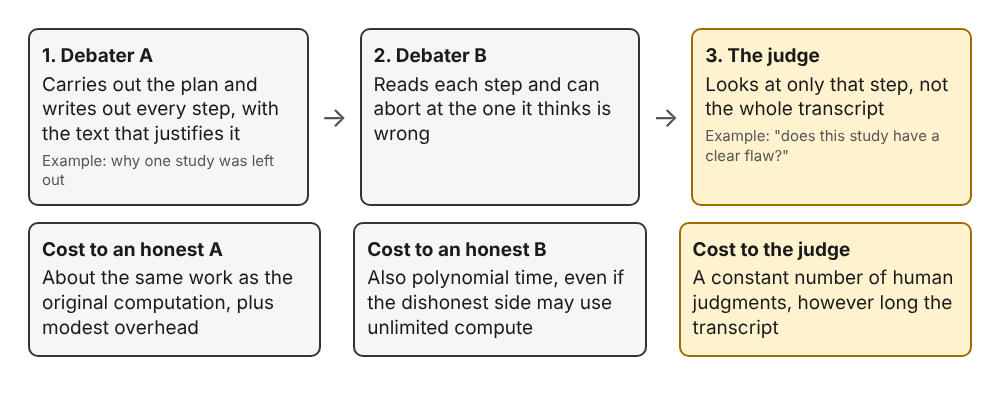
The theorem says that, under the paper's assumptions, any problem a polynomial-time machine with oracle access can decide can be decided this way. The verifier needs time of about the length of one query times a logarithm, and only a constant number of oracle queries.
A worked example: the caffeine meta-analysis
The paper gives its own example, and it is the clearest way to see the protocol. A researcher wants to know whether caffeine improves learning in college students, and writes a plan in plain language:
- Search the literature for studies on caffeine and learning.
- Keep only studies without clear methodological flaws, and only randomized controlled trials that measure final exam performance after at least six weeks.
- Run the statistical analysis with a random effects model.
- Measure sources of heterogeneity with meta-regression.
Debater A is asked to carry out the plan and list everything that shows the instructions were followed, such as the text of each study and why it was included. Debater B examines each step and can abort if it thinks A got one wrong.
The paper picks a step where "clear methodological flaw" is a judgement call. Suppose A drops a study and B aborts there. A must have stated how likely a human is to say that the study has a clear flaw. Say it stated 3/4. The question then goes to human raters. If the share of raters who agree with A is sufficiently close to 3/4, A wins. Otherwise B wins.
Notice what the judge did. They did not read the whole analysis. They answered one question about one study, and A had to commit in advance to how a person would answer it.
When the judge is noisy
The simple version treats judgement as exact. Real raters disagree, so the paper also handles a stochastic oracle, where each answer is a random yes or no. This adds a technical condition. Small changes in the oracle's probabilities could pile up over a long computation, so the paper requires that the computation be K-Lipschitz, which bounds how much its output can shift when the oracle shifts. The authors note that every time-T stochastic computation is K-Lipschitz for K on the order of T.
Under that condition the paper proves a protocol with cross-examination that decides the question with completeness 3/5 and soundness 2/5. Roughly, an honest A wins at least 3 times in 5 and a lying A wins at most 2 times in 5, and repeating the debate and taking the majority sharpens that gap. The authors also formalized this theorem in the Lean 4 proof assistant, and they say their write-up differs from the formalization in some constants.
Where it connects to obfuscated arguments
The paper is explicit about what it does not close. If both debaters are allowed unbounded compute, the setup runs into what the authors call the obfuscated argument problem from Barnes and Christiano: a dishonest debater can, in polynomial time, build an argument that would take the honest debater exponential time to refute.
The doubly-efficient protocols avoid that by requiring that a person could, with careful effort, have checked the whole transcript. That is a real restriction. Our post on obfuscated arguments in AI debate goes through the problem, and our explainer on prover-estimator debate covers a later protocol that targets it directly. For the wider picture, see scalable oversight.
What the authors say is still open
The conclusion lists open problems, and they read as the paper's own limits:
- Transcripts must be human-checkable. The authors write that a key requirement and limitation is that debaters must produce natural-language reasoning that careful human analysis could have judged correct.
- The debaters must predict human judgement well. The model assumes the AI systems can accurately simulate human judgements on any query, which the authors say may attribute too much power to them.
- Human judgement is fallible. The oracle the verifier uses is likely to be flawed in practice. They ask whether the results extend to cases where the oracle answers wrongly on some queries.
- Some tasks may not fit. Work that no polynomial-length human-checkable transcript could capture is outside the theorems.
The paper is a theory result. It does not report training a debater, so it does not show that trained models find the honest strategy. Researchers weigh these limits differently, and a fair reading gives each view its strongest form.
In Learn AI Alignment Theory, the Advanced course Scalable Oversight includes lessons called The Oversight Gap, AI Safety via Debate, Amplification, Weak-to-Strong, and Latent Knowledge. The app's debate cards state each serious position fairly and give no verdict, and every lesson lists its sources.
Frequently asked questions
What does "doubly efficient" mean in debate?
Two costs stay small. The honest debaters run in polynomial time, and the verifier uses a constant number of human judgements, each about the size of a single query.
Why was the original debate setup not enough?
Its guarantee assumed the honest strategy could simulate AI systems for an exponential number of steps. The 2023 paper shows protocols where honest play needs only a polynomial number of steps.
Does doubly-efficient debate solve obfuscated arguments?
The authors say unbounded debaters run into that problem. Their protocols avoid it by requiring a transcript a human could check in principle, and they leave a better answer as an open question.
Is this used on real AI systems today?
The paper is theoretical. It proves bounds in a formal model and gives a Lean 4 formalization of one theorem. It does not report a trained debater.
Get started with Learn AI Alignment Theory
Lessons take about 8 minutes each and include questions and hands-on activities. You sign in with Google or an emailed code, and you need to be 13 or older. You can read more on the about page.
Start Learn AI Alignment Theory: short hands-on lessons from first principles to open research, with every side of every debate and the sources to read next.
AI alignment, from first principles to open research.
Visit learnaialignment.vlvd.net↗

Comments
No comments yet.
Sign in or make an account to comment.