Evening Reflection Questions from Seneca's Nightly Review
Evening reflection questions give your day a structure to be looked at, so you do not just replay it in your head. The best-known set comes from Seneca, who took it from the Stoic teacher Sextius: three questions asked once a day, at night. They can take about five minutes. This article gives you the questions, how to adapt them, and a worked example.
If you want to practise this with a guide, How to Find Your Meaning is a free web app with a daily Stoic practice. Its evening step is exactly these three questions, and you sign in with your email and an emailed code.
Why evening reflection questions work better than a vague "how was your day"
"How was your day?" invites a one-word answer. "Fine." "Busy." Then you go to bed with the same fog you woke up in.
A good question is narrow. It points your attention at one thing and asks you to find a specific answer. Seneca's questions are built that way. They do not ask for a mood. They ask what you did, what you resisted, and what changed.
Three things make a question useful at night:
- It is about your actions. You cannot control the day, but you can look at what you did inside it.
- It has an answer you can finish. "One thing" is better than "everything."
- It is the same every night. Repeating the questions lets you notice patterns across weeks, not just today.
What Seneca actually did each night before sleep
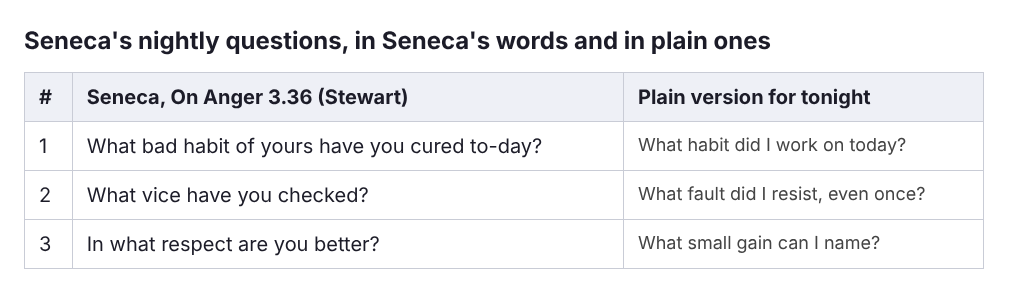
Seneca describes the habit in his essay On Anger, book 3, section 36. In the Aubrey Stewart translation, "It was the custom of Sextius when the day was over, and he had betaken himself to rest, to inquire of his spirit: 'What bad habit of yours have you cured to-day? what vice have you checked? in what respect are you better?'" Seneca then says he does something similar himself: when the lamp is taken out of his sight and his wife has stopped talking, he passes the whole day in review and repeats all that he has said and done.
He writes that he conceals nothing from himself and omits nothing. He also does not beat himself up: his example is to say "I pardon you this time: see that you never do that anymore", then name what went wrong, such as arguing too contentiously with someone who was unwilling to learn. Read that way, the review is for learning, not for punishment.
That tone matters. If the habit becomes a nightly trial, you will stop doing it within a week.
The three evening reflection questions, adapted for today
How to Find Your Meaning words the three questions this way, which follows Seneca's:
- What bad habit did I cure today?
- What fault did I resist?
- In what way am I better?
"Cure" is a big word for one day. You will rarely cure a habit in an evening. Read the questions as "What did I work on?" and you will get better answers. Here is a plain-language version you can use, set beside Seneca's words in the table below:
- Question 1: What habit did I work on today? Think of something you want to do less of, like snapping at people, checking your phone in meetings, or putting off a hard email. Did you catch it, even once?
- Question 2: What fault did I resist? Name the moment you felt the pull and chose differently. This might be a small one, like not replying while angry.
- Question 3: In what way am I better? Look for a small gain. You noticed something sooner, you apologised faster, you stayed calm a bit longer.
Notice that question 3 asks about progress, not perfection. It trains you to see what is improving, which is hard to do when you are tired and critical.
A five-minute nightly routine you can start tonight
You do not need a notebook ritual. You need a fixed time and a fixed order.
- Pick the cue. Right after you brush your teeth, or when you sit on the edge of the bed. Tie it to something you already do.
- Replay the day once, quickly. Walk through morning, midday and evening in about a minute. Do not judge yet. Just list what happened.
- Ask the three questions in order. Spend about a minute on each.
- Write one line for each answer. One line is enough. Short answers are easier to keep up.
- Choose one thing for tomorrow. A single adjustment, such as "pause before replying to Sam."
- Stop. Close the book or put the phone down. The review is done.
The daily practice in the app follows the same shape. It has three short steps, about ten minutes in all. In the morning you get a question for the day and one of the four Stoic virtues to practise. During the day you read a short passage from Epictetus, Marcus Aurelius or Seneca and get one thing to try. In the evening you answer the three questions. Doing all three in a day keeps your practice streak, and you can keep notes on each day of the practice.
Example answers: a real day reviewed in three questions
Here is a made-up but ordinary day, so you can see what a useful answer looks like. Say you manage a small team and you are trying to be less defensive when people give you feedback.
Question 1: What habit did I work on today?
"Defending my decisions as soon as someone questions them. In the 10 a.m. meeting, Priya said the timeline looked tight. I felt my jaw tighten and I started to explain. I stopped halfway and asked her what she would change."
That is a good answer because it names the habit, the moment, and what you did. It does not claim the habit is gone. It says you caught it halfway.
Question 2: What fault did I resist?
"I wanted to send a sharp reply to the vendor who missed a deadline. I wrote it, left it in drafts, and sent a short, neutral one after lunch."
Question 3: In what way am I better?
"I noticed the defensive reaction while it was happening, not hours later. Last week I only saw it that evening."
Then the one line for tomorrow: "When someone questions the plan, ask one question before I answer."
The whole thing took about five minutes. It also gave you something for the next review to compare against, which is the real value.
Common mistakes: guilt spirals, perfectionism, and scorekeeping
The guilt spiral. You find one mistake and the review becomes a list of everything wrong with you. Seneca's approach is the opposite: look at the error clearly, forgive it, and move on. If you notice yourself piling on, return to question 3 and find one real gain.
Perfectionism. You decide a day only counts if you did well on all three. Some days the honest answer to question 2 is "I didn't resist it, I lost my temper." That is still a good review. You found the fault, which is the point.
Scorekeeping. You start grading yourself out of ten and comparing nights. A number tempts you to chase the number. Keep the answers in plain sentences.
Making it too long. A twenty-minute review is a review you will skip. Keep to five minutes and let it be boring.
Doing it only when the day went badly. The questions work best as a steady habit. Good days teach you what is working.
If your evenings are mostly spent worrying, the six Stoic exercises for anxiety pair well with this routine. A longer exercise that works well for perspective is Marcus Aurelius's view from above.
How evening reflection connects to finding your meaning
A single review is small. A year of them is a record of what you actually did, which habits you tried to change, and which values you acted on. That record is useful when you ask the larger questions, such as what you want your days to be for.
In How to Find Your Meaning, this review is one lesson in a larger path. The course on Stoic exercises has a lesson called "The Morning and Evening Review," and it sits next to lessons on seeing trouble coming and the view from above. The path runs from Stoicism, to health routines, to a final course on your own roles and what makes a life meaningful. You can read more on the about page.
The app makes no promise that any of this will make you happier or give your life meaning. It gives you short lessons, a daily practice, and a place for notes. What you do with them is up to you, which is a very Stoic point.
Frequently asked questions
How long should an evening reflection take?
Five minutes is enough. About a minute for each of the three questions, plus a minute to choose one adjustment for tomorrow. If it runs longer, you are probably judging yourself instead of reviewing.
Should I write the answers down or just think them?
Writing one line per answer is easier to keep up and lets you spot patterns later. Thinking them through still works. If you use the app, you can keep notes on each day of the practice in one place.
What if I can't think of anything I did wrong or well?
Make the question smaller. Ask about one conversation, one decision, or one moment when you felt irritated. A narrow focus almost always produces something concrete.
Can evening reflection help with anxiety at bedtime?
It gives your mind a defined task instead of an open loop, but it makes no promise about sleep or worry, and it is not medical advice. If anxiety or poor sleep is a regular problem, ask a doctor about your own case.
Get started
Tonight, ask yourself the three questions once, write one line for each, and stop. If you would like the morning, daytime and evening steps laid out for you, start How to Find Your Meaning. The lessons are free with an account, and you sign in with your email and an emailed code. It installs free from the site, and the get the app page shows you how on your phone or computer.
Find what your life is for.
Visit findyourmeaning.vlvd.net↗


Comments
No comments yet.
Sign in or make an account to comment.