View From Above: Marcus Aurelius's Stoic Exercise
The view from above is a Stoic exercise in which you imagine rising high over your own life, then over your town, then over everything, until the thing that is bothering you shows up at its true size. Marcus Aurelius returns to it again and again in his private notebook. It takes about three minutes, needs no equipment, and asks one honest question at the end: what is still mine to do?
If you want to practise it with a lesson and a daily routine, How to Find Your Meaning is a free web app of short hands-on lessons on Stoicism, and its Stoic Exercises course has a lesson called "The View from Above".
Where the view from above comes from
Marcus Aurelius was a Roman emperor, and the book we call Meditations is a notebook he kept for himself. In the George Long translation at the Internet Classics Archive, Book 7 passes on "a fine saying of Plato": that anyone who talks about people "should look also at earthly things as if he viewed them from some higher place." The list that follows is wonderfully ordinary: assemblies, armies, farm work, marriages, treaties, births, deaths, the noise of the law courts, feasts, lamentations, markets.
Book 9 puts it as an order to himself: "Look down from above on the countless herds of men and their countless solemnities." In Book 12 he imagines being "suddenly raised up above the earth" and seeing the same things whenever he looks: "sameness of form and shortness of duration." Then he asks, "Are these things to be proud of?" Read in context, the exercise is aimed at inflated opinions, the weight we give to status, praise and blame.
Notice what he does not do. He does not tell himself that people do not matter: Book 9 speaks of "the rational social animal". The view from above is a way to size things correctly so that your effort goes where it can help.
How to do the view from above, step by step
Here is a version for a quiet three minutes. The picture below sets out the five steps with the question each one asks.
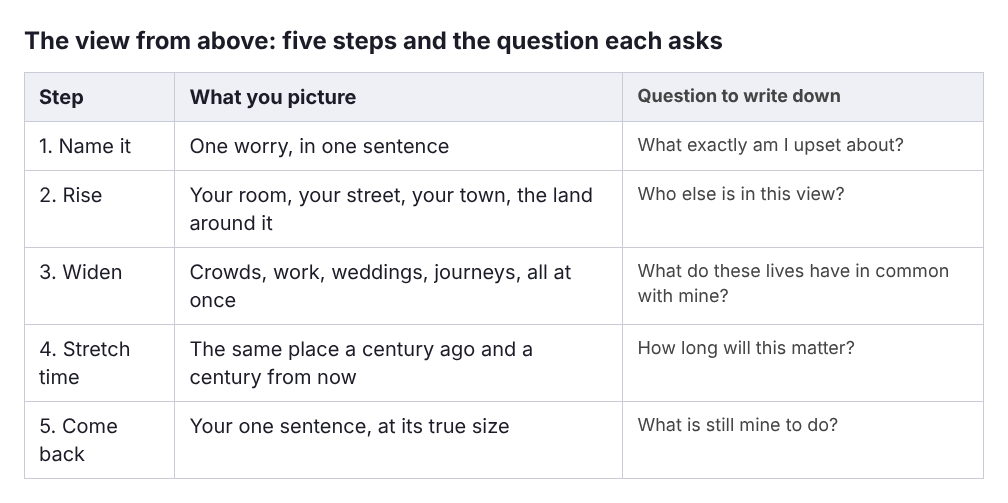
- Name it. Write one worry in one sentence. A vague worry grows when you rise, so make it exact.
- Rise. Close your eyes. See the room you are in, then the building, the street, the town, the roads and the land around it.
- Widen. Fill the view with people, as Marcus does: a market, a wedding, a crowd at work, someone on a journey. Each has a worry that feels as large to them as yours does to you.
- Stretch time. Look at the same place a hundred years ago and a hundred years from now. Marcus does this too, asking you to consider the lives of people in olden time and of those who will live after you.
- Come back. Return to your sentence. Ask how large it looks now, and what, if anything, is still yours to do. Write that in one line and stop.
The last step is the point. Without it the exercise is a pleasant daydream. With it, you leave with one action or with the clear note that nothing is yours to do.
A worked example: the sharp email
Say your manager replies to your report with two curt lines, and you have been turning it over for an hour.
- Name it: "My manager's reply felt dismissive and I think they are unhappy with me."
- Rise: you see your desk, the office, the city, a map of the country with thousands of other offices lit at once.
- Widen: in all those offices people are sending short emails while tired. Some are meant kindly. Some are not read twice.
- Stretch time: in a hundred years nobody will know this email existed, and the report will not be remembered either.
- Come back: "Still mine: ask one clear question about what they want changed. Not mine: how they felt while typing."
You may still be a little stung afterwards. The exercise does not erase feeling. What it usually changes is the next move, from replaying the email to sending a short, calm message.
What the view from above is not for
It is easy to misuse. Three cautions:
- It is not a reason to stop caring. Right after his "look down from above" lines, Marcus asks for justice in what you do and for action that ends "in social acts", meaning acts done with other people in mind. The point is to care about the right things at the right size.
- It does not shrink real harm. Debt, illness, grief and injustice are not made small by a map. Use the exercise to find your next step, not to say that suffering does not count.
- It is not treatment. It is a philosophical practice. If worry or low mood is heavy, lasts, or gets in the way of daily life, talk to a doctor or a qualified professional about your own case.
Some readers see this kind of distance as healthy perspective, and others worry it can make you cold toward what happens to you. A good test is simple. If after the exercise you act more kindly or more clearly, it did its job. If you feel numb, skip it for a while.
Zoom out in time as well as in space
Most people picture only distance. Marcus uses time just as often. In Book 7 he says that "to have contemplated human life for forty years is the same as to have contemplated it for ten thousand years", because the same shapes keep returning. In Book 9 he asks how many do not know your name, how many will soon forget it, and how those who praise you now will "very soon blame" you.
That is why step 4 earns its place. A good prompt is: "Who will remember this in a year? In ten?" If the honest answer is nobody, you can often give it less of your evening. If the answer is "my child" or "my team", that is a sign the matter is worth your care, and a good thing to know too.
Pairing it with the other Stoic exercises
The view from above handles distance. The others handle different things:
- The dichotomy of control sorts a worry into what is up to you and what is not. It pairs well with step 5.
- The Stoic exercises for anxiety set out six practices, including rehearsing setbacks and the evening review.
- The evening review, which the app's daily practice uses, asks Seneca's three questions: What bad habit did I cure today? What fault did I resist? In what way am I better?
One simple week: do the view from above on the evening you feel most wound up, write the one-line "still mine" note, and read your notes on Sunday. If the same worry shows up three times, that is something to look at, and the post on building a sense of meaning in life suggests what to ask next.
In the app, the Stoic Exercises course has three lessons: Seeing Trouble Coming, The View from Above, and The Morning and Evening Review. A lesson takes about nine minutes and includes a hands-on activity, and every lesson lists its sources. You can keep notes on any lesson and on each day of the daily practice. Read more on the about page.
Frequently asked questions
How long should the view from above take?
Three to five minutes is enough. Spend most of that on the rise and on coming back to your one-sentence worry, then write one line about what is still yours to do.
Do I have to picture it in my head?
No. If you do not see pictures easily, describe the view in words or sketch a rough map on paper. What matters is that you widen the frame and then return to one concrete sentence.
Is the view from above only for big problems?
No. Marcus used it for small irritations as much as large ones. A short version, one breath rising and one coming back, works for a rude message or a missed bus.
Do I need to read Meditations first?
No. You can start with the five steps and read the source later. The passages quoted above are in Books 7, 9 and 12, free to read at the Internet Classics Archive.
Get started
Try it tonight: name one worry, rise, widen, stretch time, come back, and write one line. When you want lessons, activities and a daily structure, open How to Find Your Meaning. The lessons are free with an account, and you sign in with your email and an emailed code. It is a web app that installs from the site, with steps on the get the app page.
Find what your life is for.
Visit findyourmeaning.vlvd.net↗


Comments
No comments yet.
Sign in or make an account to comment.