Faraday and electromagnetic induction: what he discovered
Faraday and electromagnetic induction is one of the great turning points in the story of electricity. In 1831 a self-taught English experimenter showed that a changing magnetic field can make an electric current flow in a wire. That one result is behind the generators that power cities and the transformers on the street. This post sets out what Michael Faraday did, how he did it, and why even his own colleagues did not accept all of his ideas.
Learn 100 Influential People has short hands-on lessons on the 100 people who most shaped human history, with every side of the debate and the sources for every lesson.

Faraday and electromagnetic induction: the short answer
Electromagnetic induction is, in the words of the Wikipedia article on it, "the production of an electromotive force across an electrical conductor in a changing magnetic field". Michael Faraday is generally credited with the discovery in 1831. Put simply: if the magnetism around a wire changes, a current can appear in the wire, even though no battery is attached to it.
Two details matter. The current appears only while the magnetic field is changing, not while it sits still. And Joseph Henry found the effect independently in 1832, so the credit is shared in the record even though Faraday published first.
Who was Michael Faraday?
Faraday was born on 22 September 1791 in Newington Butts, then in Surrey and now part of London. His family was not well off and he had only the most basic school education, so he taught himself. At 14 he became an apprentice to George Riebau, a bookbinder and bookseller. During the seven-year apprenticeship he read many books, and a book called Conversations on Chemistry by Jane Marcet inspired him.
In 1812 he heard lectures by the chemist Humphry Davy and sent Davy a 300-page book of his own notes. In 1813 Davy hired him as an assistant, and Faraday became Chemical Assistant at the Royal Institution on 1 March 1813.
The experiment of 1831
The road to induction was not smooth. In 1821 Faraday built two devices that turned electricity into continuous motion, an early electric motor. He published without crediting Davy and another scientist, William Hyde Wollaston, and the dispute strained his bond with his mentor. In 1824 he tried a circuit to see whether a magnet could make a current in a nearby wire and found nothing.
The breakthrough came in 1831. According to the Wikipedia article on electromagnetic induction, on 29 August 1831 he wrapped two wires around opposite sides of an iron ring. He connected one wire to a galvanometer, an instrument that detects small currents, and the other to a battery. When he connected the battery, the galvanometer showed a brief current. When he disconnected it, it showed another. The current was brief, a transient one, at each switch.
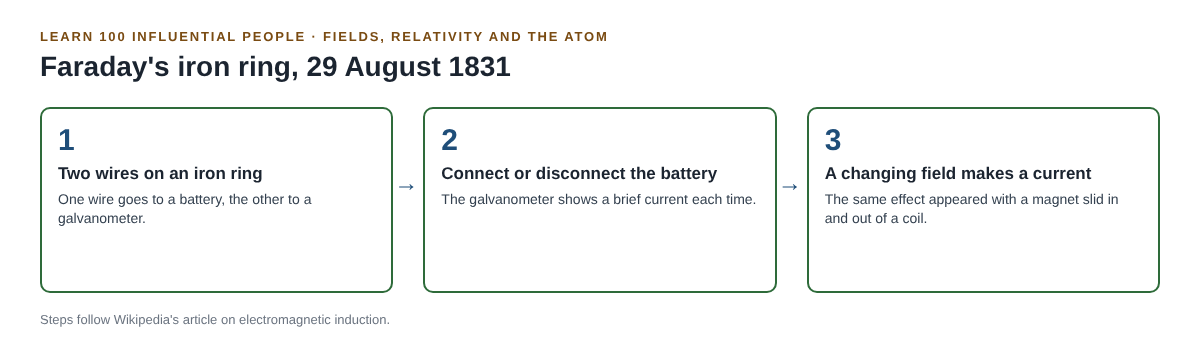
Faraday's iron ring: a current in the left coil, a momentary current in the right one.
Within two months he found other ways to get the same effect. He saw brief currents when he slid a bar magnet in and out of a coil of wire. He also got a steady current by spinning a copper disk near a magnet, which is called Faraday's disk. The iron ring he used is still on display at the Royal Institution.
What the discovery means
Faraday's demonstrations showed that a changing magnetic field produces an electric field. He later used the principle to build a dynamo, the ancestor of modern power generators, and the dynamo is also an ancestor of the electric motor. The article on induction lists inductors, transformers, motors and generators among its applications.
The physicist Heinrich Lenz gave the rule for direction in 1834. His law says the induced current flows in the direction that opposes the change which caused it. You do not need the formula to follow the story, but you will meet Lenz's name in any physics course that covers induction.
Why scientists doubted his lines of force
Faraday explained induction with what he called lines of force. Scientists at the time widely rejected his theoretical ideas, mainly because they were not written as mathematics. Faraday himself had limited mathematics: his abilities stopped at the simplest algebra. He thought and sensed the physical world in a visual way, not in symbols.
The exception was James Clerk Maxwell. Maxwell took Faraday's work and summarised it in a set of equations that the Wikipedia article on Faraday calls the basis of all modern theories of electromagnetic phenomena. Maxwell wrote that Faraday's use of lines of force shows him to have been "in reality a mathematician of a very high order". Near the end of his career Faraday also suggested that electromagnetic forces reach out into the empty space around a conductor. His fellow scientists rejected that too, and he did not live to see it accepted.
The lesson for students of history: an idea can be right and still fail to persuade until someone puts it in the language the field expects.
Induction did not change daily life at once. The Royal Institution's own record, quoted in the Faraday article, says "Faraday invented the generator in 1831 but it took nearly 50 years before all the technology, including Joseph Swan's incandescent filament light bulbs used here, came into common use". The setting was London's Savoy Theatre, the first public building in the world lit by electricity.
If you want the other half of that story, Thomas Edison and the light bulb: what he really invented covers the lamps and the lighting systems that came later.
More than electricity
Faraday did far more than induction. In 1845 he found that many materials are weakly pushed away by a magnetic field, an effect he named diamagnetism, and that a magnetic field can rotate the plane of polarised light, now called the Faraday effect. As a chemist he discovered benzene and liquefied gases such as chlorine. He helped popularise the words anode, cathode, electrode and ion.
He also did public work. With Charles Lyell he wrote a report on the 1846 Haswell colliery explosion in County Durham, which killed 95 miners, and it pointed to coal dust as a cause of the explosion's severity. He refused to advise on chemical weapons for the Crimean War. He turned down a knighthood, and twice declined to be president of the Royal Society. Between 1827 and 1860 he gave nineteen Christmas lectures for young people at the Royal Institution, a series that continues today.
Try it yourself: follow the 1831 logic in four steps
You can use Faraday's reasoning as a model for reading any scientific discovery. Here is a worked example you can do in about ten minutes with the facts above.
- Write the question Faraday asked: can magnetism make a current? Note that his 1824 try found nothing.
- List what changed in 1831: two coils on an iron ring, a galvanometer, and a battery that he switched on and off.
- Mark the key observation: a current showed only when the battery was connected or disconnected, not while it stayed on.
- State the conclusion in one sentence of your own: a changing magnetic field, not a steady one, makes a current.
Then compare your sentence with the quote near the top. If it matches, you have the idea. If you want a method for reading papers and notes like these, Primary vs secondary sources in history: examples shows how to tell a researcher's own record from a later summary.
Frequently asked questions
What did Faraday discover about electromagnetic induction?
In 1831 he found that a changing magnetic field makes a current flow in a wire. He saw it with two coils on an iron ring and with a magnet moved in and out of a coil.
Did Faraday invent the electric generator?
The Royal Institution says he invented the generator in 1831, and the Wikipedia article says he later built a dynamo from the same principle. It took nearly 50 years before the other technology needed for wide use came together.
What is Faraday's law?
Maxwell described induction mathematically as Faraday's law of induction. It later became part of Maxwell's four equations, in a form slightly different from Faraday's original formulation.
Was Faraday the only person to discover induction?
No. Joseph Henry found it independently in 1832, but Faraday is generally credited because he published in 1831.
Get started
Learn 100 Influential People has short hands-on lessons, about 9 minutes each, on the people who most shaped history, with questions that check what you learned. Its Advanced course Fields, Relativity and the Atom lists Faraday with Maxwell, Einstein, Bohr and Marie Curie, and every lesson lists its sources. You sign in with your email and an emailed code.
The home page of Learn 100 Influential People, where the lessons start.
Open Learn 100 Influential People and read about the project first if you want to see what is inside. Sources for this post: Wikipedia's articles on Michael Faraday and on electromagnetic induction.

Comments
No comments yet.
Sign in or make an account to comment.