Force field analysis example for a personal decision
A force field analysis example for a personal decision is easiest to follow when you watch one real choice go through every step. The method is simple. You write down the change you are considering. You list the forces pushing you toward it and the forces holding you back. You score each one, and then you decide what to strengthen or weaken. Below, you will work through one decision from start to finish: whether to move to a new city for a job.
If you want somewhere to keep the decision once you have mapped it, Problem Graph lets you write the problem down in one line and attach what you try. You mark each attempt as worked, partly or failed, and link the smaller problems that belong to it.
What force field analysis is
The principle was developed by the social psychologist Kurt Lewin. As Wikipedia's article on force-field analysis puts it, the method looks at the forces either driving movement toward a goal (helping forces) or blocking it (hindering forces). Lewin's own word for a person's field was "life space".
For a personal choice, treat your current situation as a balance. Some forces push toward change. Others push against it. As long as they roughly cancel out, nothing moves. That can be why you think about a decision for months and stay where you are.
Putting it on paper helps in three ways:
- It separates the forces. Each worry and each reason gets its own line, so you can look at them one at a time.
- It makes weight visible. A pros and cons list counts items. A force field scores them, so one heavy restraint can outweigh three light drivers.
- It points to action. The question changes from "should I?" to "which force can I change?" That question is easier to answer.
A force field analysis example: should I move for a job?
Here is the setup. You have a job offer in a city about 600 kilometers away. The role is a step up. The pay is higher. You have lived where you are for eight years. Your partner works locally and your closest friends are nearby. The offer expires in three weeks.
This is a good test case because the forces are mixed. Some are about money, some about people, and some about how you feel. You cannot settle it with a spreadsheet alone, and you cannot settle it on gut feeling alone either.
Step 1: State the change and the current state clearly
Write two sentences. The first describes where you are now. The second describes the change you are weighing. Keep both concrete.
- Current state: I work in a role I have outgrown, in a city where my partner and friends live.
- Proposed change: Accept the offer and move to the new city within two months.
Avoid vague versions like "change my life" or "be happier." If you cannot picture the change happening on a calendar, the forces you list will be vague too.
Draw a vertical line on a page. Write the change at the top. Driving forces go on the left and point right. Restraining forces go on the right and point left.
Step 2: List the driving forces pushing you toward the change
Give yourself ten minutes. Write every reason you want to go, even the small or slightly embarrassing ones. You can cut later.
In this example, the driving forces are:
- The salary is meaningfully higher.
- The role has more scope, and you have stopped learning in your current job.
- You want a fresh start after a flat couple of years.
- Your partner has said they are open to it.
- Your sister lives an hour from the new city.
Notice that item 3 is a feeling, not a fact. Keep it: it is part of what moves you, and leaving it off the page only hides it.
Step 3: List the restraining forces holding you back
Now do the same for everything that pulls you toward staying. Be honest about fear, inertia and cost.
- Your partner would need to find a new job.
- You would leave close friends you see every week.
- Moving costs money up front.
- Rent in the new city is higher.
- You worry you will not build a social life there.
Sometimes one item has two sides. "Partner is open to it" is a driver, and "partner needs a new job" is a restraint. Keep both. They are different forces, and you will act on them in different ways.
Step 4: Score each force and read the balance
Score every force from 1 (weak) to 5 (strong). Score how much it affects your decision, not how much it should. Then add up each side.
Driving forces:
- Higher salary: 4
- More scope and learning: 5
- Fresh start: 2
- Partner is open to it: 3
- Closer to sister: 2
Total: 16
Restraining forces:
- Partner needs a new job: 5
- Leaving close friends: 4
- Moving costs: 3
- Higher rent: 3
- Worry about social life: 2
Total: 17
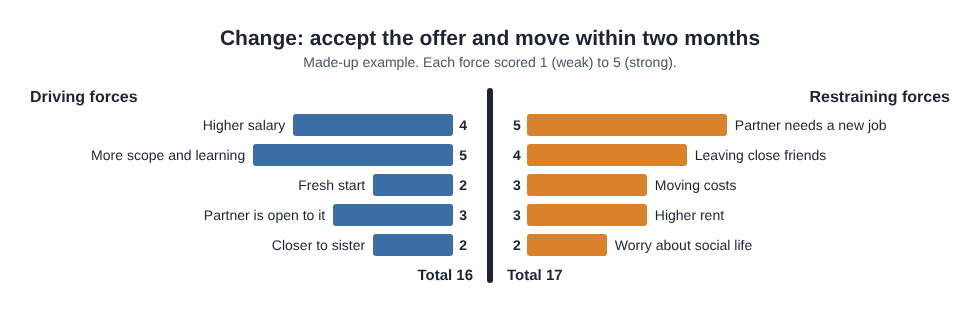
The made-up job move example, each force scored from 1 to 5.
Sixteen against seventeen. The forces are almost in balance, and that explains why the decision feels stuck. The totals do not give you the answer. They show you where the weight sits. Two forces do most of the work: your career growth (5) on one side and your partner's job (5) on the other.
A close result is useful. It tells you that a small change to one or two forces could tip the decision either way.
Step 5: Turn the diagram into an action plan
You can strengthen a driver or weaken a restraint. In this example the drivers are already strong, so try working on the restraints first and see what changes when you rescore.
So go through the restraints and ask, for each one: what could I do this week to weaken this?
- Partner needs a new job (5): Ask the new employer about a later start date or relocation support. Your partner spends two evenings checking openings in their field in the new city.
- Higher rent (3): Price three real listings. Compare them with the salary increase after tax. This might drop to a 1, or it might rise to a 4. Either result is useful.
- Moving costs (3): Ask whether the offer can include a relocation payment.
- Leaving friends (4): This one may not shrink much. Name it and accept it, rather than pretending it will go away.
Then set a date to rescore. If your partner finds two promising openings and the employer covers moving costs, the restraining total might fall from 17 to 12. The balance shifts without any new argument for going.
Treat each action as an experiment with an outcome. You try something, you see what happened, and you adjust. If you have too many open actions at once, a personal kanban that limits work in progress keeps you from starting six and finishing none.
Keeping the analysis after the decision
A paper diagram is easy to throw away. The reasoning behind a big choice is worth keeping: in a year, you may want to know what you weighed and what turned out to matter.
Here is one way to hold this example in Problem Graph. Write the main problem in one line in the personal lane: "Should I take the job and move?" Each heavy restraint can become its own problem, such as "Partner needs a job in the new city," linked back to the main one. Under it, add the solutions you try. "Asked employer about relocation support" gets an outcome of worked, partly or failed. A failed attempt stays on the map as failed, which is exactly what you want to remember. The app's map also has a requirement node: "relocation payment" could be a requirement of the solution "Accept the offer with a later start date".
Problems are private by default, so only you see them. You can also ask for suggestions: the AI proposes new solutions grounded in what worked for others on problems like yours. Treat these as proposals to weigh.
Frequently asked questions
How do you score forces in a force field analysis?
Give each force a number from 1 (weak) to 5 (strong), based on how much it actually affects your choice. Add up each side and compare the totals. Then look at which individual forces carry the most weight.
What if the driving and restraining forces are equal?
A tie means you are stuck because the forces cancel out, not because you lack information. Pick the strongest restraint and take one small action to weaken it. Then rescore.
Can force field analysis be used with other decision tools?
Yes. It pairs well with a simple cost calculation for the money forces, and with mapping your daily steps, as in a spaghetti diagram at home, when routine and logistics are part of the decision.
How many forces should a personal force field analysis include?
This example uses five on each side, which fits on one page. If a side runs past ten, check for duplicates you can merge.
Get started
Take the decision you keep circling back to. Write the change in one sentence. List five forces on each side, score them, and pick the heaviest restraint to work on first. Then record what you try and what happened, so the next time you face a choice like this, you are not starting from a blank page.
Try Problem Graph: it is free, and you can look around the public network without an account. Write one problem down in a line and attach the first thing you will try. When you are ready to add your own, open the app and start with the personal lane.
Every problem you carry, on one map. Solved together.
Visit problemgraph.vlvd.net↗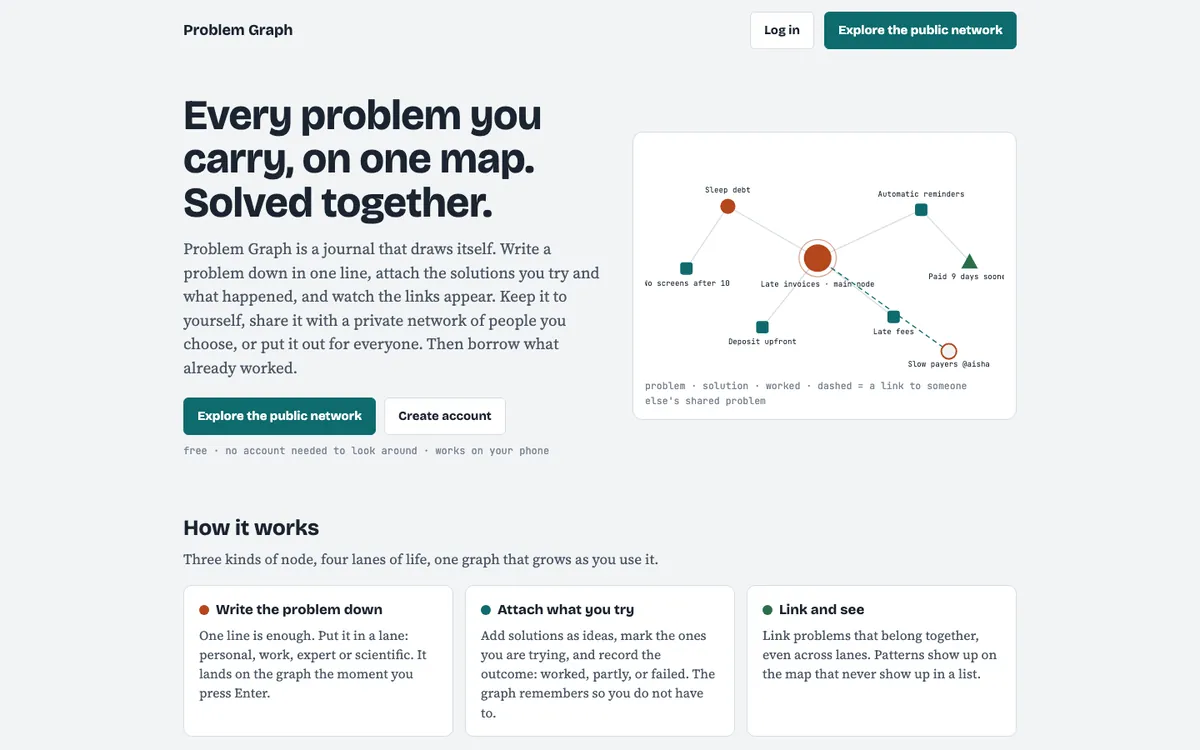
Comments
No comments yet.