Hobbes' state of nature: what he argued and why
Hobbes' state of nature is his picture of human life with no government: no one with the power to settle disputes or enforce a decision. Thomas Hobbes argued that this condition would turn into a war of all against all, so bad that almost any government is better. That argument, made most fully in Leviathan (1651), is the starting point of his case for an absolute sovereign.
If you want to see Hobbes next to the thinkers who answered him, Learn 100 Influential People teaches him with Machiavelli, Descartes, Locke, Rousseau, Kant and Wollstonecraft in its Advanced course Power, Reason and Rights, and sets out where researchers disagree.
What Hobbes meant: Hobbes' state of nature defined
The Stanford Encyclopedia of Philosophy entry on Hobbes' moral and political philosophy describes the state of nature as "a condition without government". Hobbes himself calls it "the condition of mere nature". In it, each person decides how to act and is judge in their own case whenever a dispute comes up. There is no one whose authority everyone accepts, and no power to enforce a ruling.
Some thinkers saw that freedom as good. Hobbes' near successor John Locke, in his Second Treatise of Government, said the state of nature was better than living under the arbitrary power of an absolute ruler. Hobbes argued the reverse, and our post on Locke vs Rousseau shows how later writers took the idea in other directions.
Why Hobbes wrote about it
Hobbes lived through the breakdown of political order that ended in the English Civil War. The entry says he came to think the burdens of even the harshest government are "scarce sensible" compared with the miseries of civil war. He wanted rational principles for a state that would not fall apart from within.
The state of nature is his tool for that job. If life without government is terrible, people have strong reasons to accept a public authority and to avoid anything that could tip them back.
The assumptions behind the argument
Many readers find Hobbes too gloomy, but the entry stresses that he builds the state of nature from assumptions that each sound plausible on their own:
- Rough equality. People are similar enough in mind and body that no one is safe from everyone else, and no one can expect to dominate.
- Fear of death. People generally "shun death", and the wish to stay alive is strong.
- Limited kindness. People care for those close to them but tend to be partial, and they are touchy about slights.
- A right to all things. Each person has a right to do whatever they judge needed to stay alive. Since almost anything might be judged needed, this becomes in practice a right "to all things".
- Reasonable means. People should take the steps they see as necessary to their most important ends.
Why the state of nature becomes a state of war
Put those assumptions together and conflict follows. People compete for scarce goods such as the best land. Each fears that others may attack, so striking first can look like sound defence. A minority who enjoy power over others provoke defensive moves from everyone else. Disagreements about religion, morals and even what one really needs add fuel.
With no common authority to settle any of this, the state of nature becomes a "state of war", a war of "all against all". Hobbes' famous description follows: no industry, no farming, no trade by sea, no arts, no letters, "continuall feare, and danger of violent death; And the life of man, solitary, poore, nasty, brutish, and short."
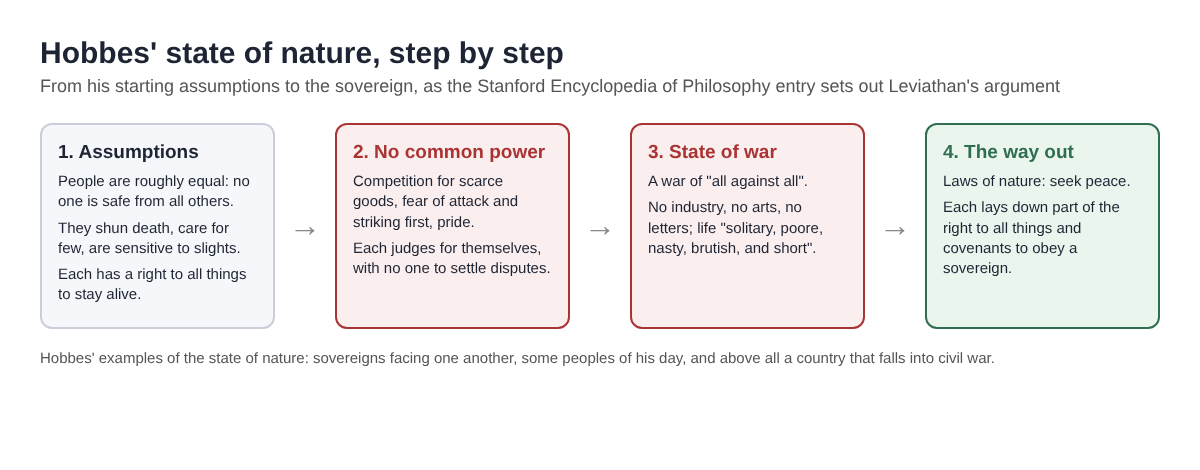
Hobbes' argument from his assumptions to the sovereign, following the Stanford entry.
The way out: laws of nature and the sovereign
Hobbes thought human nature also offers an escape. Reason shows each of us that a war of all against all defeats our interests, so we can agree that "peace is good, and therefore also the way or means of peace are good". He called the rules that follow the "Lawes of Nature". Their sum, as the entry puts it, is not to treat others in ways we would not have them treat us.
These laws tell people to lay down part of their right to all things and to promise one another to obey a common sovereign. Hobbes argued that this sovereign's power must be neither divided nor limited, because a split or limited power invites disputes that can end in civil war again. Yet obligation has an edge: on the entry's reading, the duty to obey ends when the sovereign can no longer protect you. Our post on Machiavelli vs Hobbes compares this view of power with Machiavelli's.
Did a state of nature ever exist? The open debates
Hobbes gave three examples. Rulers of different countries are in a state of nature with each other, a claim that made him the classic "realist" in international relations. Some peoples, he thought, had been in that state or still were. Most importantly, anyone whose peaceful country falls into civil war will recognise it.
Scholars still debate the details, and the entry sets out several positions with no single winner:
- Who is in it? Feminist critics, among others, note that Hobbes' own theory has children owe obedience to their parents, so families, not only lone individuals, would be its basic units.
- Short-sightedness. People want their long-term good but act on present interests.
- A trap of reason. People are fully rational but caught in a situation like the prisoner's dilemma, where what is rational for each is bad for all.
- Passions. Pride, spite and envy in some people, or in all to a degree, overrule calmer judgment.
Game theorists have been especially active here, building models of the state of nature and testing which one fits Hobbes best. Commentators also disagree on whether his laws of nature are advice for self-interest, divine commands or moral rules.
Try it yourself: test Hobbes' argument in 15 minutes
- List the premises (4 minutes). Write the five assumptions above as numbered lines.
- Pick a case (3 minutes). Two farming families share a valley with one good spring and no court or police.
- Run the argument (4 minutes). For each premise, note what it predicts the families will do about the spring. Mark the step where striking first starts to look sensible.
- Test a premise (4 minutes). Remove one, such as rough equality, and see whether the war still follows. Then compare your answer with the three explanations in the debate section.
Then read section 3 of the Stanford entry and check your list against its account.
Frequently asked questions
What is Hobbes' state of nature in simple terms?
It is life with no government: everyone judges for themselves and no one can enforce a ruling. Hobbes argued it would become a war of all against all.
Why did Hobbes say life would be nasty, brutish and short?
Because without a common power, fear, competition and pride lead people to attack first. With no security, there is no farming, trade, learning or art, only the danger of violent death.
How did Hobbes think people escape the state of nature?
By following the laws of nature: seeking peace, giving up part of their right to all things, and agreeing to obey a sovereign with undivided power.
How was Locke's state of nature different?
Locke thought the state of nature was better than living under an absolute ruler's arbitrary power. Hobbes thought almost any government was better than it.
Get started
Hobbes is one of seven thinkers in the Power, Reason and Rights course, beside Machiavelli, Descartes, Locke, Rousseau, Kant and Wollstonecraft. Each lesson takes about 9 minutes and lists its sources, so you can go back to Leviathan itself. You sign in with your email and an emailed code.
Start Learn 100 Influential People: short hands-on lessons on the people who shaped history, with every side of the debate and the sources to read next.
100 people who shaped history, from Moses to the web.
Visit influentialpeople.vlvd.net↗


Comments
No comments yet.