Is 2048 a game of luck or skill? Both sides, explained
Is 2048 a game of luck or skill? People who play it a lot tend to give one of two answers. Some say it is all strategy once you know the corner trick. Others say a bad tile at the wrong moment ends a good game, and no plan can stop that. Both have a point. This guide sets out what is random in 2048, what you control, the best case for each side, and a small test you can repeat yourself on a cube.
What is random in 2048
The rules, as Wikipedia's 2048 article) describes them, are short. The board is 4 by 4. The game starts with two tiles, each a 2 or a 4. After every move, a new tile appears in a random empty square. Citing the game's code, Wikipedia says a new tile is a 2 90% of the time and a 4 10% of the time.
So three things are left to chance:
- Where the new tile lands. Any empty square can get it.
- What the new tile is. Usually a 2, sometimes a 4.
- How the game starts. The two first tiles and their places.
Nothing else is random. Tiles do not slide on their own, and merges follow fixed rules: two equal tiles that meet become one tile with their total.
What you control
Everything else is your choice. You pick the direction of every slide. That decides which tiles merge, where your big tiles end up, and how many empty squares are left for the next new tile. The game ends when there are no empty squares and no two equal tiles side by side, so empty room is the thing you are really managing.
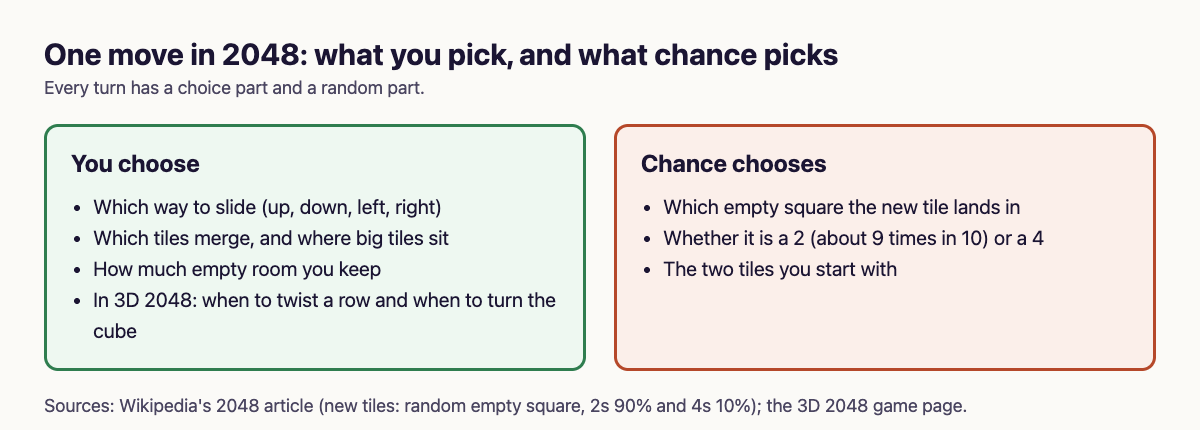
Each turn has a part you pick and a part chance picks.
A useful way to see it: chance deals the cards, and you decide how to play them. The open question is how much the deal matters compared with the play.
The case that 2048 is a game of skill
The first argument is that a plan works. Wikipedia's strategy section describes one: keep your largest tile in a corner, fill that row with other large tiles, so you can move in three directions without moving the corner tile, and never let a large tile cut a small tile off from the others. Players who follow it get much further than players who do not. Our guide to 2048 strategy for beginners walks through it.
The second argument comes from computer programs. Wikipedia's section on artificial intelligence reports that, as of 2022, programs made a 16384 tile in over 95% of games and a 32768 tile in over 75%. It also reports a 2025 result over 1200 simulated games: 16384 in 99.9% of games and 32768 in 86.1%. Those tiles are many doublings past 2048. The argument goes: if luck decided the game, no player, human or program, could pass 2048 that often.
The third argument is what those programs look for. Wikipedia lists the features a position is judged by: empty squares, many possible merges, larger tiles at the edge, and tiles lined up in order of size. Those are the same habits a good human player builds.
The case that luck still matters
The other side starts from the same numbers. The best program in that 2025 test reached a 65536 tile in only 8.4% of games. Wikipedia adds that, because of randomness and the lack of spare room, the best possible chance of making a 65536 tile is expected to be low. The largest tile the board can hold at all is 131,072, also from Wikipedia. So at the top of the game, careful play is not enough, and the run of new tiles decides most results.
Closer to home, a single unlucky tile can matter. A 2 that lands in your corner when you had to slide away from it can break a row you spent a hundred moves building. You can make that less likely, but you cannot rule it out, because you do not pick the square.
Even lower down, chance never goes to zero. In the 2025 test, the program fell short of 16384 in about 1 game in 1000.
A worked example: one start, two ways to play
You can test the question yourself, and a small board makes the effect easy to see. 3D 2048 puts 2048 on a cube like a Rubik's cube, with six faces of nine squares. You slide the front face as in 2048, and every slide adds a 2 or a 4. In the game's own script file, the new tile goes to a randomly picked empty square of the front face, and it is a 2 when a random number comes out under 0.9. That is the same 90 and 10 split Wikipedia gives for the original.
We played a few short games in a browser with a simple script that used slides only, so the front face worked like a 3 by 3 game of 2048. Each result is one game, not an average.
- Same start, plan A. The script tried Down first, then Left, then Right, and Up only when nothing else moved. The front face got stuck at move 32 with a score of 180 and a 32 tile.
- Same start, plan B. We put the game back to the very same start and the script pressed Up, Right, Down and Left in turn. It got stuck at move 28 with a score of 160, also with a 32 tile.
- Plan A, two new starts. On two fresh games, the same plan got stuck at move 37 with 220 points, and at move 42 with 260 points.
Read it both ways. On the same start, the plan beat the rotating order, but only by 20 points. On different starts, the same plan scored anywhere from 180 to 260. On a small board, luck moved the result more than the choice of plan did. With slides alone, the front face fills up fast.
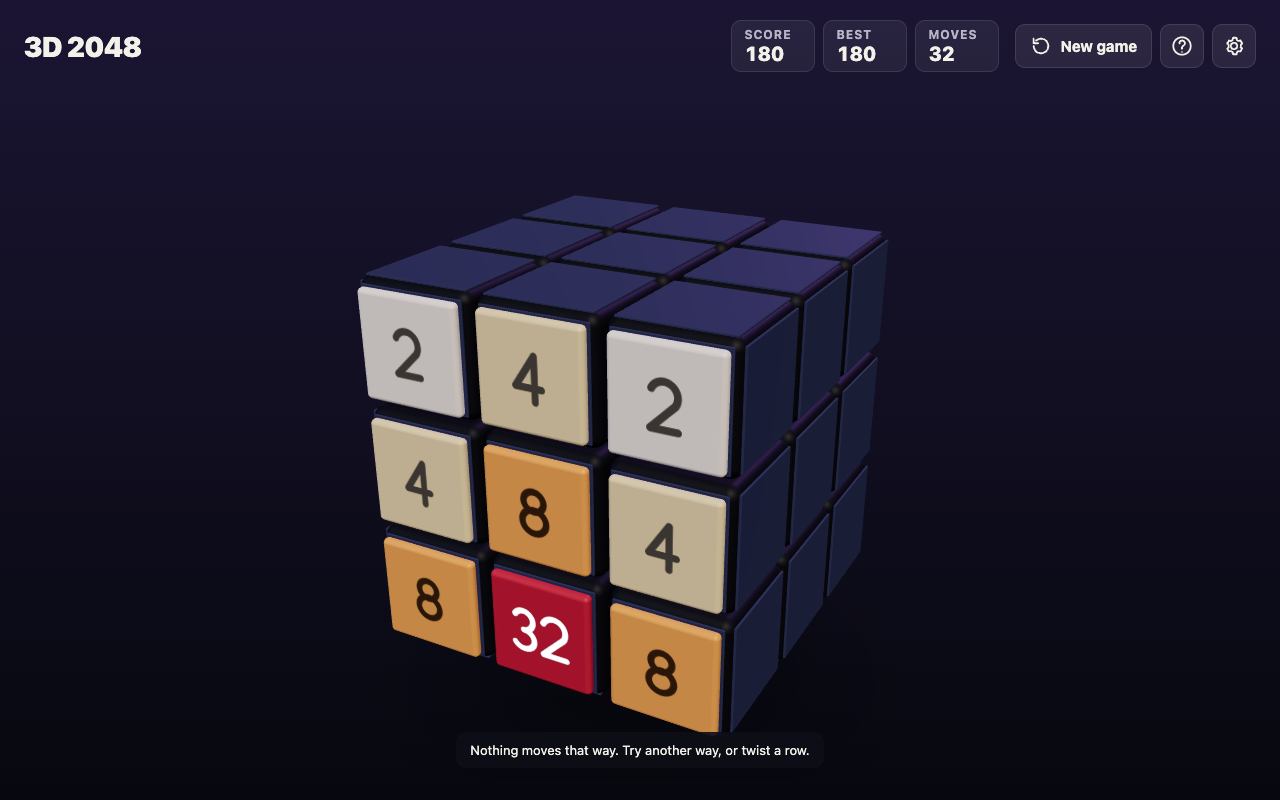
Plan A at move 32: the front face is full and no slide moves.
When the front is stuck, the game says: "Nothing moves that way. Try another way, or twist a row." A twist carries a row or column round to the next face, and turning the whole cube is free. Those moves are choices, so on the cube more of the result is in your hands. Our 3D 2048 tips show how the twist changed a longer test game.
So is 2048 a game of luck or skill?
Both camps agree on the facts: the new tile is random, and your choices decide how much room you have when it lands. They differ on weight. The skill camp points to strategies and programs that pass 2048 almost every time. The luck camp points to the top tiles, where even the best programs fail most of the time, and to the single bad tile that ends a good run. Which view fits you may depend on your goal: making 2048 once, or chasing the biggest tile you can.
Frequently asked questions
Is 2048 random?
Partly. Where each new tile lands, and whether it is a 2 or a 4, is random; every slide and merge is your choice.
How often is a new tile a 4?
About one time in ten. Wikipedia gives 90% for a 2 and 10% for a 4, and 3D 2048 uses the same split.
Can a computer always win 2048?
Programs reported on Wikipedia pass 2048 almost every time, and the biggest tiles stay rare even for them.
Does 3D 2048 have more luck or more skill than 2048?
Its new tiles are just as random, but twisting rows and turning the cube give you more moves to choose from when a face gets full.
Get started
Try the test yourself: play one game with a fixed plan, then another with no plan, and compare. If you are new to the cube, how to play 3D 2048 explains the controls.
Play 3D 2048: it is free and plays in your browser on a computer or a phone.
Comments
No comments yet.
Sign in or make an account to comment.