How many moves does it take to get 2048? About 930, explained
How many moves does it take to get 2048? At least 1,022 if every new tile is a 2, and about 930 with the usual mix of 2s and 4s. Real games take more, because other tiles are still on the board when the 2048 appears. You do not have to take those numbers on trust. They come from one simple rule you can check on your own board, and this guide shows the rule, the count, a real game that matches it, and what it means for how you play.
The rule that makes the count possible
When two tiles merge, the new tile is their total. Two 8s become one 16. The number of tiles goes down by one, but the sum of every number on the board stays the same.
So only one thing ever raises the board's total: new tiles. According to Wikipedia's 2048 article), the game starts with two tiles, and after each turn one more tile appears, a 2 nine times in ten and a 4 one time in ten. The original game's code does the same: two starting tiles, then one new tile after every move that actually moves something.
Put those together and you get the rule:
Board total = the two starting tiles + one new 2 or 4 for every move.
A 2048 tile sits on the board, so the board total must be at least 2048 when it appears. That sets a floor on the number of moves.
How many moves does it take to get 2048? The count
Work out how many tiles you need to reach a total of 2048, then take away the two you start with.
- Every new tile is a 2: you need 1,024 tiles of 2. Two are there at the start, so that is 1,022 moves.
- The usual mix: a new tile is worth 2.2 on average (0.9 times 2, plus 0.1 times 4). 2048 divided by 2.2 is about 931 tiles, so about 929 moves.
- Every tile is a 4: 512 tiles, so 510 moves. The chance of that much luck is too small to matter. It is a floor no real game reaches.
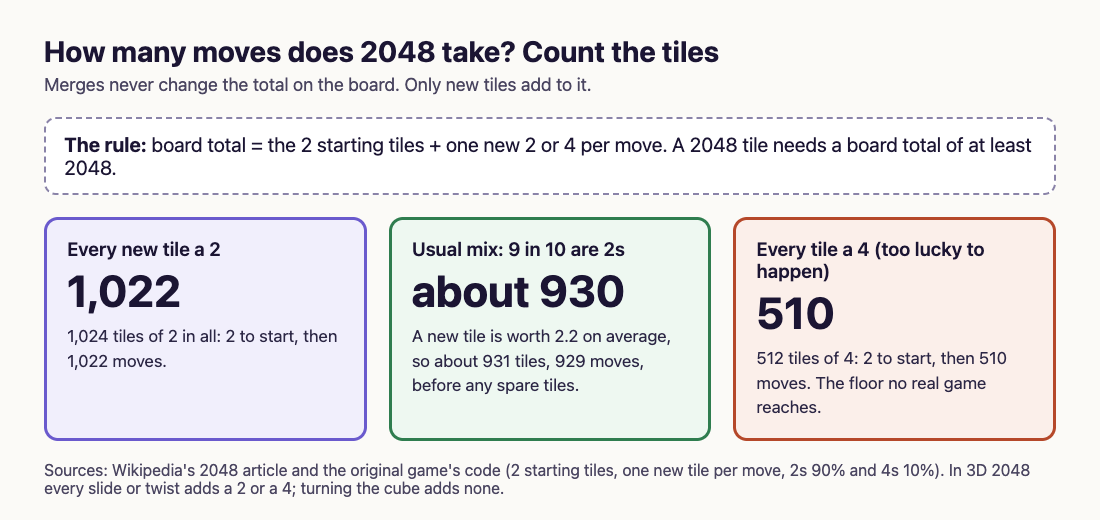
The board's total only grows by one new tile per move, so a 2048 needs hundreds of moves.
That is why "about 930" is the honest short answer. It is the fewest moves an average run of new tiles allows. You can beat it only by drawing more 4s than usual, never by playing faster.
Check the rule on a real game
You can test the rule on any board. Add up every tile, and compare it with the moves so far.
Here is one from 3D 2048, a 2048 puzzle on a cube like a Rubik's cube, where you slide a 3 by 3 front face. In one of our test games, played in a browser by a simple script that only slid, the front face got stuck at move 31. It read:
- Top row: 8, 4, 2
- Middle row: 16, 8, 4
- Bottom row: 2, 16, 8
Those nine tiles add up to 68. Now count from the rule. Two starting tiles plus 31 moves is 33 tiles. In that game exactly one new tile was a 4, so the total is 32 twos and one 4: 64 plus 4, which is 68. The board matches the rule to the last point.
Try it on your own next game. Pause at any point, add up the tiles, and divide by 2.2. The answer is close to the number of tiles you have been given so far, which is your move count plus two.
Why real games take longer than 930 moves
The count above assumes every point on the board ends up inside the 2048 tile. That never happens. When your 2048 appears, other tiles are still sitting around it: a few 2s and 4s at least, and often a 512 or 1024 you were building next. Every one of those points needed its own moves.
A second reason is room. A board where everything is merged into one tile is impossible to steer toward, because you need spare tiles to slide against. So the real number of moves is the floor plus whatever is left on the board at the end.
The same rule tells you the cost of falling behind. In our scripted cube game that twisted rows when the front was stuck, the 128 came at move 118. The rule says about 260 points of tiles had arrived by then, so roughly half of them were still spread around the cube in other tiles.
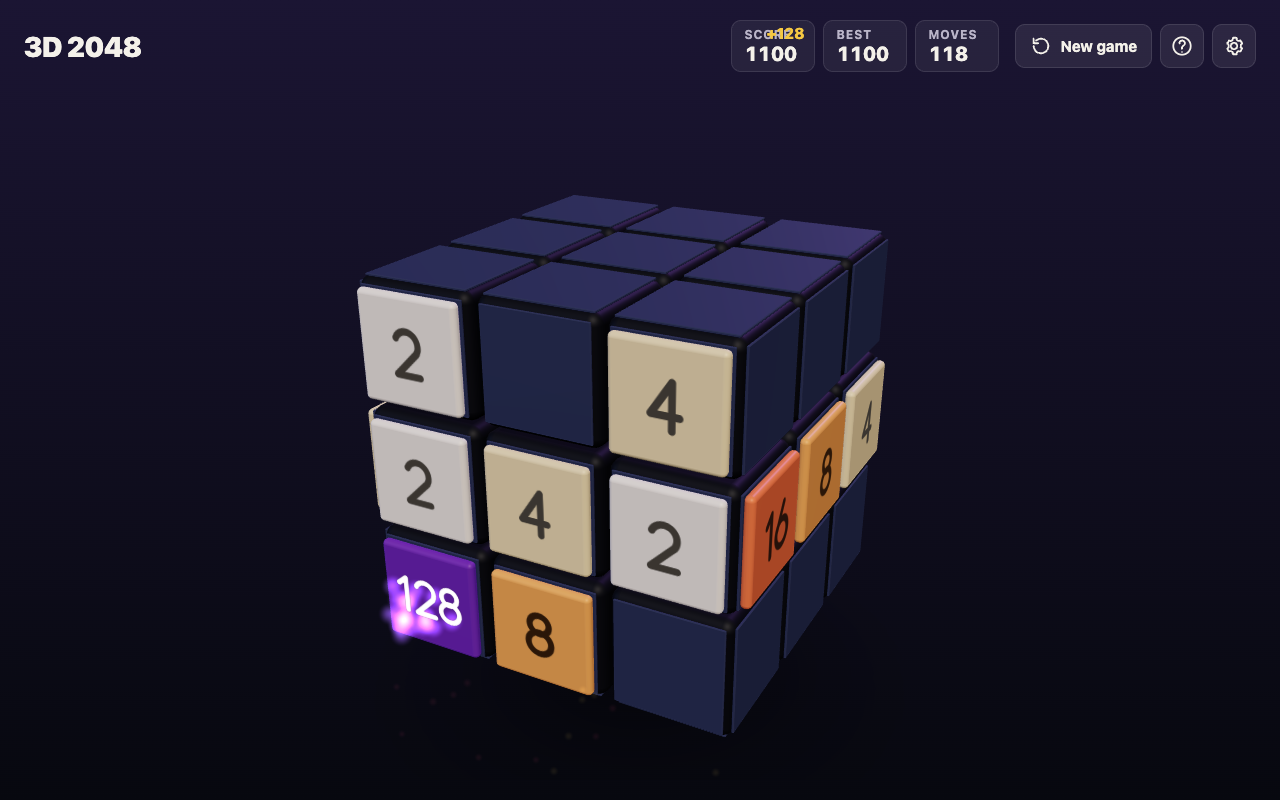
3D 2048 at move 118: a 128 in the corner, with other tiles still on the cube.
The merges and points behind one 2048
The same counting gives two more numbers. If a 2048 is built entirely from 2s, it takes 1,023 merges, because each merge turns two tiles into one, and 1,024 tiles must become one.
Points follow too. A merge scores the value of the tile it makes, as the original code shows. Building a 2048 from 2s means making 512 fours, 256 eights, and so on up to one 2048. Each of those ten steps adds 2048 points, so building one 2048 from 2s earns 20,480 points. A new tile that arrives as a 4 skips one merge, so it scores 4 less. Our post on how 2048 scoring works explains that in detail.
How 3D 2048 counts your moves
3D 2048 shows Score, Best and Moves in its top bar. A slide counts one move, and so does a twist, which carries a row or column to the next face. Each adds a 2 or a 4, and in the game's own script a new tile is a 2 when a random number is under 0.9, the same mix as the original. Turning the whole cube is free and counts no move, so you can look around the cube as often as you like.
So the count above holds on the cube too. When you make 2048, the game tells you how you did: "You made 2048 in {moves} moves." Now you know the number in that box can never fall far below 930 without unusual luck, and what is left on the cube is what made it higher. If you play on, what happens after 2048 explains the Keep going choice.
Frequently asked questions
What is the fewest moves to get 2048?
With average luck, about 930. If every new tile were a 2 it would be 1,022, and only an impossible run of 4s could bring it down to 510.
Does playing faster mean fewer moves?
No. Every move adds one tile, so the count depends on the tiles you are given, not on your speed. Good play stops you getting stuck before you reach it.
How many moves does a 4096 tile take?
By the same rule, about twice as many: at least 2,046 if every new tile is a 2, and about 1,860 with the usual mix.
Do turns of the cube count as moves in 3D 2048?
No. Turning the whole cube is free and counts no move. Slides and twists each count one move and add a new tile.
Get started
Next game, check the rule yourself: add up your tiles, divide by 2.2, and compare it with your move count. For the bigger tiles beyond 2048, see what is the highest tile in 2048.
Play 3D 2048: it is free and plays in your browser on a computer or a phone.
Comments
No comments yet.
Sign in or make an account to comment.