What happens after 2048? Playing on for 4096
What happens after 2048? The game is won, a message says so, and then you get a choice: start again, or keep going. Most people have never seen that choice, so it is a fair question. This post explains what the original game does when you make the 2048 tile, what 3D 2048 does, what it takes to reach 4096, and a plan for the minutes right after the win, when most games that play on fall apart.
What happens after 2048 in the original game
Wikipedia's 2048 article) puts it simply: the game is won when a tile with a value of 2048 appears on the board, and players can continue beyond that to reach higher scores.
The original game's code on GitHub shows how. The merge that makes a 2048 marks the game as won, and the win message appears. A keep playing option, described in the code as allowing you to go over 2048, clears the message and lets the same board carry on. The code treats the game as finished only when the board is stuck, or when you have won and not chosen to keep playing.
So nothing about the board changes at 2048. The tiles stay, the score stays, and new tiles keep arriving as before.
What 3D 2048 shows when you make 2048
3D 2048 puts the puzzle on a cube like a Rubik's cube: six faces of nine squares, 54 in all. You slide the front face, twist a row or column to carry tiles round from the other faces, and turn the whole cube. When a merge makes 2048, a box titled 2048! opens with this line: "You made 2048 in {moves} moves. Keep going for 4096, or start again." The game fills in your own move count. Below it are two buttons, New game and Keep going.
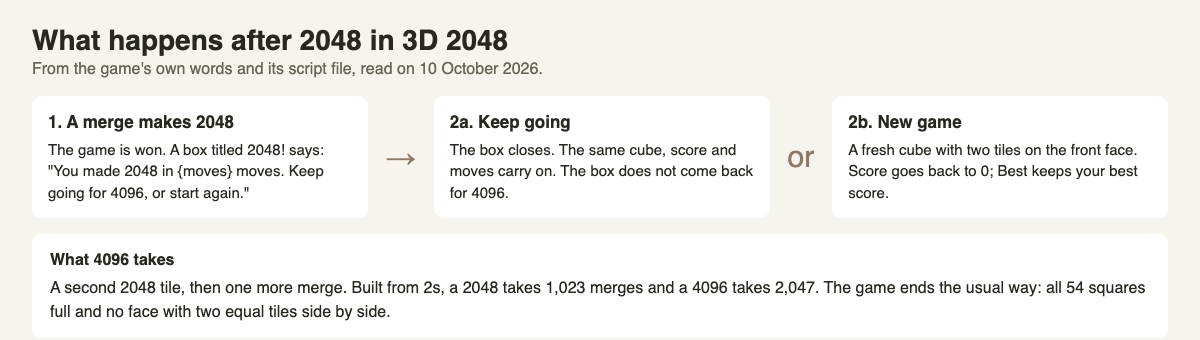
The two paths after the 2048 tile, from the game's own words and its script file.
Here is what each button does, read in the game's script file:
- Keep going closes the box. Your cube, Score and Moves carry on exactly where they were.
- New game starts a fresh cube with two tiles on the front face and a Score of 0. Your Best stays, since the game saves your best score on your own device.
One detail is easy to miss. The game marks itself as won only on the first merge that reaches 2048. After you press Keep going, the box does not come back, not for a second 2048 and not for 4096. From then on you are playing for score and for your own target. The game still ends the usual way: when all 54 squares are full and no face has two equal tiles side by side.
Keep going or start again?
If your aim is a higher score, keep going. Your score only grows while you can still merge, and a board that already holds a 2048 has banked a lot of points. Counted as if built from 2s, a 2048 tile is worth 20,480 points. Starting again throws that board away. New game even warns you first: "This game ends and its score is kept only if it is your best."
If your aim is to make 2048 faster next time, start again. The game tells you your move count in the 2048! box, which gives you a number to beat. Both are good reasons. The point is to choose on purpose, not by reflex.
What 4096 really takes
4096 is two 2048s merged. That sounds like double the work, and it is a little more than that, because the first 2048 has to sit on the board, taking up a square, while you build the second one from scratch.
- Merges: built only from 2s, a 2048 takes 1,023 merges. A 4096 takes 2,047.
- Points: a 4096 built from 2s is worth 45,056 points, more than twice a 2048, because the last merge pays 4096 on top of both halves.
- Room: on a cube, slides work on the front face, which has nine squares. A 2048 parked there uses one of them for the rest of the game.
We show where those points come from in how 2048 scoring works.
A worked plan for the minutes after 2048
The danger after a win is a loose move that pulls the 2048 out of its corner. Here is a plan to follow in 3D 2048, from the first slide after you press Keep going:
- Leave the 2048 where it is. If it is in the bottom left corner of the front face, keep sliding down and left first, as you did to make it.
- Build the next chain beside it. The second 2048 needs a 1024, which needs a 512, and so on. Line them up next to the big tile, biggest first, the corner plan Wikipedia describes: the largest tile in a corner with other large tiles filling its row.
- Use the other faces as spare room. When the front face is stuck, the game says "Nothing moves that way. Try another way, or twist a row." Twist a row on the right face or a column on the top face to carry tiles off the front. Keep one square empty, since a twist needs one for its new tile.
- Turn the cube before you give up. Turning is free: it costs no move and adds no tile. Look at the other faces for equal tiles side by side before you decide the game is over.
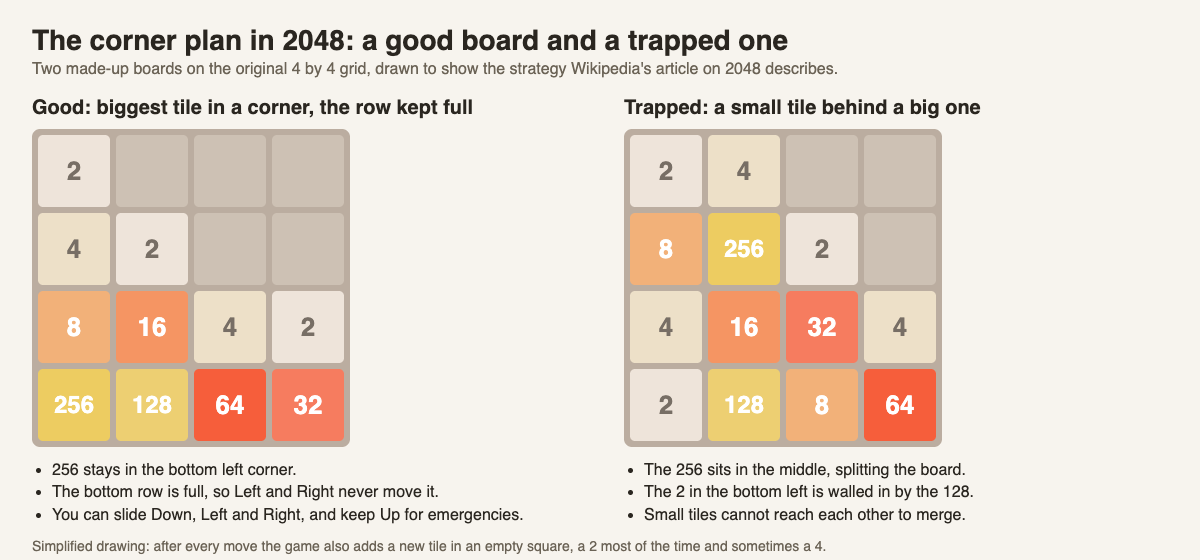
Left: the biggest tile in the corner with the chain beside it. Right: a big tile stuck in the middle, which blocks merges around it.
Our 2048 strategy for beginners covers the corner plan in more detail, and 3D 2048 tips shows how twists bought room in a real test game.
Frequently asked questions
Does the game end when you reach 2048?
No. The game is won, but you can keep going on the same board. In 3D 2048 the box says "Keep going for 4096, or start again."
Is there a message when you make 4096?
Not in 3D 2048. Its script marks the game as won only once, at the first 2048, so after Keep going the box does not come back.
Do I lose my score if I start a new game after 2048?
The current game's score ends, but 3D 2048 keeps it as your Best if it is your best. Best is saved on your own device.
How many more merges does 4096 take?
Built only from 2s, a 2048 takes 1,023 merges and a 4096 takes 2,047, so roughly one more 2048's worth plus the final merge.
Get started
The 2048! box is not the end of the game, it is a choice. Make your first 2048 on the cube, then decide: chase a faster win, or press Keep going and see how far the chain can climb.
Play 3D 2048: it is free and plays in your browser on a computer or a phone.
Comments
No comments yet.
Sign in or make an account to comment.