How Much Sleep Do Adults Need? What Sleep Experts Say
How much sleep do adults need? Most need at least 7 hours a night, and two expert panels put the usual range at 7 to 9 hours. The longer answer is that the number is a range for healthy groups of people, not a rule for one body, and this post shows where it comes from and how to test it on yourself.
How to Find Your Meaning is a free web app of short hands-on lessons on Stoicism, healthy habits and the story of who you are, and its Routines and Habits course includes a lesson called Sleep, the First Routine.
How much sleep do adults need? The short answer
Two panels of sleep experts looked at the evidence in 2015 and reached close to the same range:
- The American Academy of Sleep Medicine (AASM) and the Sleep Research Society: 7 or more hours a night, on a regular basis, for adults.
- The National Sleep Foundation: 7 to 9 hours for young adults and adults, and 7 to 8 hours for older adults.
Both are written for healthy people with no sleep disorder. Neither says that 8 hours is magic, and neither says that everyone fits. The rest of this post takes each source in turn, then shows where the research stops being clear.
What the AASM and the Sleep Research Society say
The AASM and the Sleep Research Society asked a panel of 15 experts to settle on a number. The panel used a structured voting method, the modified RAND Appropriateness Method, and reviewed 5,314 scientific articles. The recommendation covers adults aged 18 to 60.
Its statement is short. Adults should sleep 7 or more hours per night on a regular basis to promote optimal health. The statement says sleeping less than 7 hours on a regular basis is associated with worse health, listing weight gain and obesity, diabetes, high blood pressure, heart disease and stroke, depression and a higher risk of death. It also links short sleep to a weaker immune system, more pain, poorer performance, more errors and a greater risk of accidents.
The word "associated" matters. The panel reports links found in studies, and a link does not show that too little sleep is the cause. It still gives a sensible reason to treat 7 hours as a floor, not a goal to beat.
What the National Sleep Foundation panel says
The National Sleep Foundation convened an 18-member panel that represented 12 stakeholder organizations. For healthy people with normal sleep, it found 7 to 9 hours appropriate for young adults and adults, and 7 to 8 hours for older adults.
The panel's own conclusion is careful. Sleep needs vary across the lifespan and from person to person. Durations outside the range may be appropriate, but deviating far from the normal range is rare. Someone who habitually sleeps far outside it may be showing signs of a serious health problem, or, if they do it by choice, may be compromising their health. That last sentence is a reason to ask a doctor, not to self-diagnose.
Too little, too much: what the research can and cannot show
The panels agree on the floor of about 7 hours. They are less sure about the ceiling. The AASM statement says sleeping more than 9 hours may be appropriate for young adults, for people recovering from sleep debt and for people who are ill. For everyone else, it says it is uncertain whether more than 9 hours is linked to any health risk.
A large meta-analysis by Cappuccio and colleagues adds numbers, and shows why the topic is debated. It pooled 16 studies with 1,382,999 participants and 112,566 deaths, followed for 4 to 25 years. Short sleep went with a 12 percent higher risk of death, and long sleep with a 30 percent higher risk. Sleep was reported on questionnaires, and the studies differed from one another, so the figures are averages with wide edges.
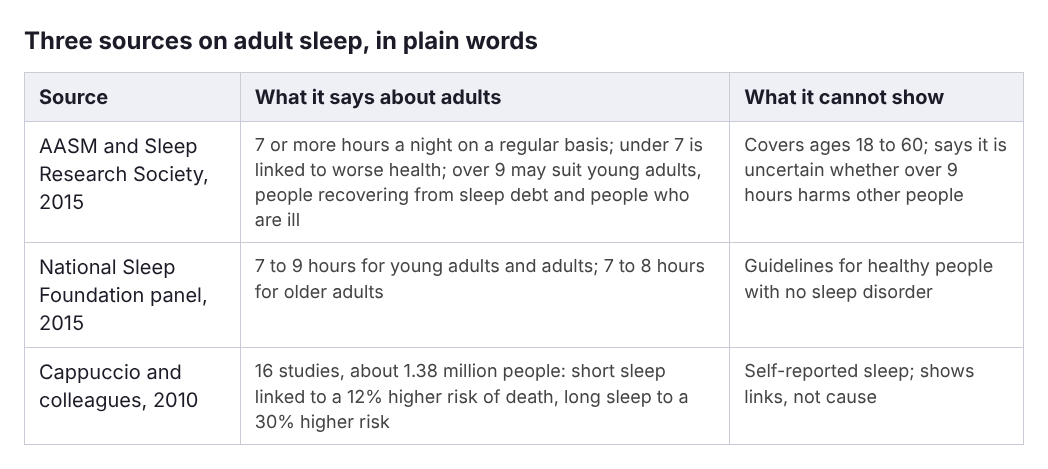
There are two fair readings of the long-sleep result, and the sources do not pick one. One reading is that very long sleep may itself carry risk. The other is that illness, low mood or other health problems make people sleep longer, so the long sleep is a sign of trouble, not its cause. The AASM statement lists people who are ill among those for whom more than 9 hours may be appropriate, and says plainly that for other people the answer is uncertain. If you regularly sleep far outside the range and feel unwell, take it to a healthcare provider, as the statement itself advises.
Why your own number can differ from the average
The AASM discussion says individual variability in sleep need is influenced by genetic, behavioral, medical and environmental factors, and that the biological mechanisms behind sleep need are still being studied. In plain words, a range of 7 to 9 hours is where most healthy adults land, and you may land at 7 or 8.5.
Hours are also only one part of sleep. The AASM methodology notes that healthy sleep needs adequate duration, good quality, appropriate timing and regularity, and the absence of sleep disturbances or disorders. Its recommendation looks at duration only, because that is the measure studied most. So 8 hours of broken sleep and 8 hours of steady sleep count the same on paper and feel very different.
A worked example: a two-week check for your own number
This is a way to learn your own pattern, not a medical test. Use it for two weeks, and pick one change at a time.
- Week one, notice. Each morning write when you went to bed, your best guess of when you fell asleep, when you woke up, and your energy from 1 to 5 at 10:00 am. Do not change anything yet.
- End of week one. Find your average sleep time. Example: bed at 11:30 pm, up at 6:30 am, about 6 hours 45 minutes asleep, energy 2 or 3 on most days.
- Week two, change one thing. Move bedtime 30 minutes earlier on each night, so the time asleep sits at about 7 hours 15 minutes, and keep the same wake time.
- End of week two. Compare the two weeks. In the example, 10:00 am energy rose to 3 or 4 on five of seven days. That points to sleep as one factor, though not proof.
- If nothing changes. If you sleep 7 hours or more and still feel flat, or you snore loudly, gasp at night or fall asleep at the wheel, take your notes to a doctor.
The notes in How to Find Your Meaning can hold this log: the app lets you keep notes on any lesson and on each day of its daily practice. The daily practice is three short steps, about ten minutes in all, and its evening step asks the three questions Seneca learned from Sextius, including "In what way am I better?". It is a calm place to add one line on how you slept.
What Marcus Aurelius said about getting up, and resting
The Stoics wrote about getting out of bed, and Marcus Aurelius is the clearest. In Book 5 of his Meditations, in George Long's translation, he tells himself that when he rises unwillingly he should think: "I am rising to the work of a human being." He asks whether he was made to lie in the bed-clothes and keep warm.
Then he raises the other side himself: "But it is necessary to take rest also." He answers, "It is necessary: however nature has fixed bounds to this too." So he praises neither sleeping less nor lying in: rest has a measure. For more on his notebook, see Marcus Aurelius's Meditations: what the notebook says.
You do not need to agree with a Stoic to use the idea. On sleep, the sources agree on a floor, and the rest is for you to test. Pair a steady sleep time with daytime movement, and the WHO's weekly targets are laid out in how much exercise adults need.
Frequently asked questions
Is 6 hours of sleep enough for an adult?
The AASM and Sleep Research Society statement says sleeping less than 7 hours on a regular basis is associated with adverse health outcomes, so 6 hours falls below the recommended range for most adults. Neither panel gives a number below 7 as a goal.
Is 9 hours of sleep too much?
Nine hours is the top of the National Sleep Foundation range for adults. The AASM statement says more than 9 hours may be appropriate for young adults, people recovering from sleep debt and people who are ill, and that for others it is uncertain whether it is linked to a health risk.
Do older adults need less sleep?
The National Sleep Foundation panel gave a slightly lower range, 7 to 8 hours, for older adults. The AASM statement covers ages 18 to 60 only, so it gives no number for older adults. Ask a healthcare provider about your own case.
Can I catch up on sleep at the weekend?
The AASM statement says longer sleep may suit people recovering from sleep debt, so some extra sleep after a short week is not a problem in itself. It does not say a weekend repays a week of short nights, and regularity is part of healthy sleep.
Get started
If you want help building a steady routine around sleep, movement and the day ahead, How to Find Your Meaning gives you short lessons on Stoicism, healthy habits and the story of who you are. You sign in with your email and an emailed code, and every lesson is free with an account. Read more on the about page, or see how to install it from the site on the get the app page.
This post is not medical advice. If you are tired for weeks, or you worry you sleep too little or too much, see a doctor.
Start How to Find Your Meaning: free, short hands-on lessons on Stoicism, healthy habits and your own meaning, with a daily Stoic practice to live it.
Find what your life is for.
Visit findyourmeaning.vlvd.net↗


Comments
No comments yet.