How Much Exercise Do Adults Need? What the WHO Says
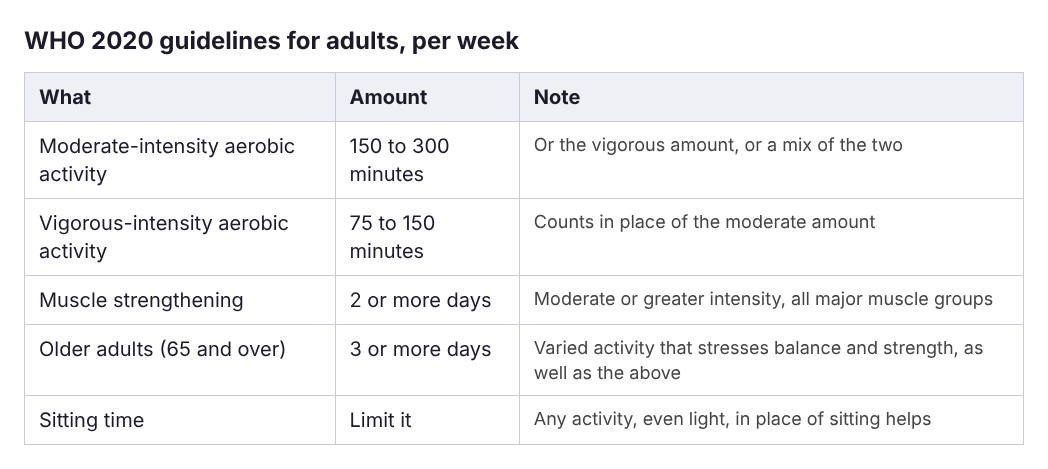
How much exercise do adults need? The World Health Organization (WHO) says adults should do 150 to 300 minutes of moderate-intensity aerobic activity a week, or 75 to 150 minutes of vigorous-intensity activity, or an equivalent mix of the two. It adds muscle-strengthening activity on 2 or more days a week. If that sounds like a lot, there is one more line to hold on to: some physical activity is better than none.
If you want help turning a number like this into a routine that fits your life, How to Find Your Meaning is a free web app of short hands-on lessons on Stoicism, healthy habits and your own story, with a daily Stoic practice, and you sign in with your email and an emailed code.
How much exercise do adults need according to the WHO?
The numbers come from the WHO guidelines on physical activity and sedentary behaviour, published in 2020. They replaced the WHO's earlier recommendations from 2010. The guidelines were written for all adults, and the summary in the British Journal of Sports Medicine puts the core advice in one sentence: all adults should do 150 to 300 minutes of moderate-intensity, or 75 to 150 minutes of vigorous-intensity physical activity, or some equivalent combination, per week.
The guidelines also say adults should do muscle-strengthening activities at moderate or greater intensity, involving all major muscle groups, on 2 or more days a week. These give additional health benefits on top of the aerobic minutes. And they say adults should limit the time they spend sitting, and that replacing sedentary time with activity of any intensity, including light intensity, provides health benefits.
What counts as moderate and vigorous activity
The WHO defines physical activity as any bodily movement produced by skeletal muscles that requires energy expenditure. That covers leisure time, travel to and from places, and the work you do at your job or at home. Its fact sheet lists walking, cycling, wheeling, sports, active recreation and play as popular ways to be active, at any level of skill.
Moderate and vigorous are about effort, not about the activity name. A brisk walk is moderate for one person and a stroll for another. The guidelines say the 2 intensities can be combined into an equivalent mix, so a week with some brisk walks and one short run can add up to the same total.
Is 150 minutes the minimum or the target?
Read the range carefully. The guidelines say 150 to 300 minutes for substantial health benefits, and then say adults may go above 300 minutes of moderate activity, or above 150 minutes of vigorous activity, for additional health benefits. The WHO labels that extra advice conditional rather than strong.
So 150 minutes is the lower end of the range for substantial benefit, not a pass mark below which nothing counts. The explanatory notes say that if you are not meeting the recommendations, doing some physical activity will bring benefits, and that you should start with small amounts and gradually increase how often, how hard and how long you go.
How much exercise do older adults and others need?
For adults aged 65 and over, the WHO says the adult recommendations apply, plus varied multicomponent physical activity that emphasises functional balance and strength training at moderate or greater intensity on 3 or more days a week, to enhance functional capacity and to prevent falls. It also says older adults should be as physically active as their functional ability allows.
The guidelines also cover adults living with chronic conditions or disability. They should try to meet the recommendations where possible and as able, and when they cannot, they should be active according to their abilities. The guidelines say people with chronic conditions may wish to consult a physical activity specialist or healthcare professional. This is general information, not advice for your case, so ask a doctor what is right for you, especially if you have a health condition, are pregnant, or have been inactive for a long time.
Why many adults fall short, and why a number is not enough
The WHO's fact sheet reports that nearly one third (31%) of the world's adult population, 1.8 billion adults, did not meet the recommendation of at least 150 minutes of moderate-intensity activity a week, a rise of 5 percentage points between 2010 and 2022. So if you are short of the target, you are in large company.
Knowing the number rarely closes the gap. A target is a rule someone else chose for a large population, and it says nothing about your week, your body or what you care about. Rules also tend to break all at once: miss one session and the plan feels like a failure. That is why the next two sections turn the number into something that suits your own days.
A worked example: building a week around the WHO numbers
Here is one way to turn the numbers into a plan, using a person who is inactive now and wants to reach the lower end of the range over a couple of months. It is an example, not a prescription.
- Start small. Weeks 1 and 2: three brisk 15 minute walks, which is 45 minutes. The guidelines say to start with small amounts and build up.
- Add time first. Weeks 3 to 5: three walks of 25 to 30 minutes, then a fourth short walk. That brings you to about 100 minutes.
- Add strength. From week 4: two short sessions of bodyweight or resistance exercises that use the large muscle groups, such as legs, back, chest, shoulders and arms.
- Reach the lower end. Weeks 6 to 8: five 30 minute brisk walks, which is 150 minutes, plus the two strength days.
- Review monthly. Count your minutes over a month, not a day. A bad week then becomes one data point, not a verdict.
If your joints, heart or lungs make any of this unwise, change the plan with your doctor. The point of the example is the shape: small first, one thing added at a time, strength alongside aerobic minutes, and a monthly look at the total.
Turning the number into a routine you keep
The Intermediate part of How to Find Your Meaning has a course called Routines and Habits, with three lessons: How Habits Form, Sleep, the First Routine, and Move Every Day. The lessons teach what their sources say, including the WHO, and they are not medical advice. For the research on how long a new habit takes to settle, our post on 66 days to form a habit sets out what a well-known study found and where it falls short.
A few habits help the numbers stick:
- Tie each session to a slot. After lunch, or straight after you get home, so it does not rely on a mood.
- Write a minimum version. A 10 minute walk counts on your worst day, and the WHO says some is better than none.
- Judge the event, not yourself. A missed session is a missed session. The Stoics taught that some things are up to us and some are not, and putting your shoes on is up to you. Our post on things you can't control goes through that idea.
- End the day with one question. The daily practice in the app ends with an evening step, and the evening questions Seneca borrowed from Sextius are a good fit: In what way am I better? You can read them in our post on Seneca's nightly review.
Frequently asked questions
How much exercise do adults need each week?
The WHO says 150 to 300 minutes of moderate-intensity aerobic activity, or 75 to 150 minutes of vigorous-intensity activity, or an equivalent mix, plus muscle strengthening on 2 or more days. Ask a doctor how this applies to you.
Is walking enough to meet the WHO guidelines?
Brisk walking is a common way to do moderate-intensity activity, so enough of it can cover the aerobic part if your effort is high enough. The muscle-strengthening part is separate.
Does a short workout count?
Yes. The WHO says some physical activity is better than none, and that all physical activity counts, including movement for transport and domestic activities.
Do I need to see a doctor before I start?
The guidelines say medical clearance is generally unnecessary before light or moderate activity up to the demands of brisk walking or everyday living, if you have no contraindications. If you have a health condition, ask a doctor or other professional.
Get started
Count last week's active minutes, pick one slot you can keep, and add from there. If you want guided lessons and a daily practice to go with it, open How to Find Your Meaning. The lessons are free with an account, and you sign in with your email and an emailed code. The about page lists the courses, and the get the app page shows how to install the web app from the site. For the WHO's own wording, see its physical activity fact sheet.
Find what your life is for.
Visit findyourmeaning.vlvd.net↗

Comments
No comments yet.
Sign in or make an account to comment.