Marcus Aurelius Meditations: What the Notebook Says
The Marcus Aurelius Meditations is a Roman emperor's private notebook: notes he wrote to and for himself while trying to live as a Stoic. The Stanford Encyclopedia of Philosophy says it offers a unique chance to see how an ancient person, and an emperor at that, might try to live a Stoic life. It was not written as a book for readers, which is why it reads so differently from most philosophy.
If you want guided lessons on Marcus and the other Stoics, How to Find Your Meaning is a free web app of short hands-on lessons on Stoicism, healthy habits and your own story, with a daily Stoic practice, and you sign in with your email and an emailed code.
What the Marcus Aurelius Meditations is, and what it is not
Marcus Aurelius was born in 121 CE, succeeded his adoptive father Antoninus Pius as emperor in 161, and reigned until his death in 180. His reign was troubled by attacks from Germany, rebellions in northern Italy and Egypt, and an outbreak of plague. The Stanford entry says that at least part of the Meditations was written during the last years of his military campaigns.
The title is not his. According to the same entry, it is due to the modern editor Casaubon. Marcus's own purpose, the entry argues, was practical: the notes act as reminders of things he wanted to live by, such as that happiness lies in virtue, which is wholly in one's own power, and that one should not be angry at one's associates but regard them as siblings.
That tells you what to expect. The Meditations is not a system, a story or a how-to guide. Outside of Book 1, even the organisation of the work is difficult to make out, and Marcus often uses Stoic terms without explaining them, because he was writing for himself.
Book 1: a list of people he was grateful to
Book 1 is the one part with a clear plan. It acknowledges relatives and teachers for what each gave him. In the George Long translation it goes: "From my grandfather Verus I learned good morals and the government of my temper", and then, "From my mother, piety and beneficence, and abstinence, not only from evil deeds, but even from evil thoughts." Most of the book continues in this way, naming one lesson per person.
It is a small habit worth borrowing. Before you ask what the Stoics think about your problems, you can ask who taught you the things you already do well.
Book 2: expecting the day before it starts
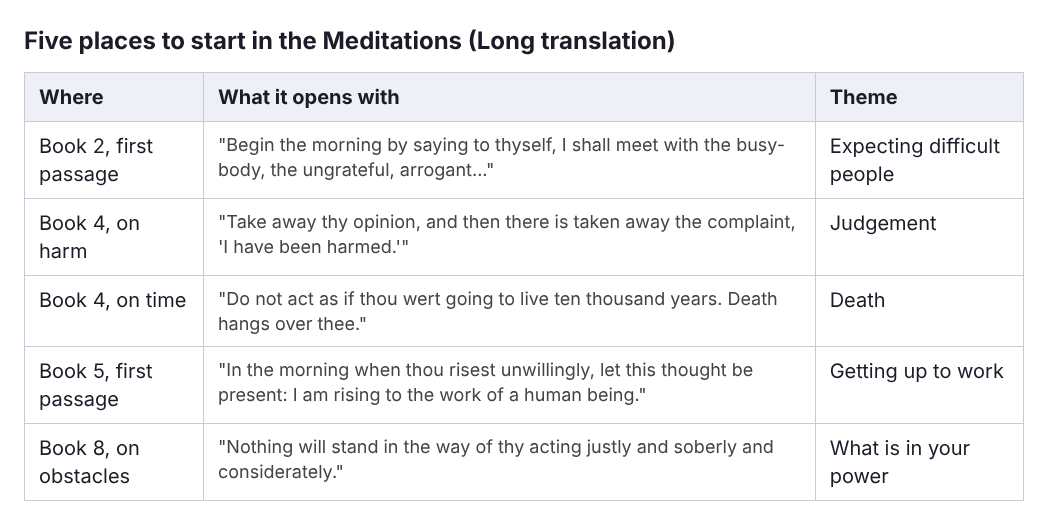
Book 2 opens with a morning exercise. In Long's words: "Begin the morning by saying to thyself, I shall meet with the busy-body, the ungrateful, arrogant, deceitful, envious, unsocial." Marcus's reasoning is that these people act out of ignorance of what is good and evil, and that he, having seen what the good is, can neither be injured by them nor angry with them, because people are made for cooperation, "like feet, like hands, like eyelids."
This is the same move as the Stoic exercise of rehearsing trouble in advance, which our post on premeditatio malorum sets out in full. You do not have to share his view of the gods or the cosmos to try the practical part: expect friction, decide your response before you need it.
Book 4: judgement, and the shortness of life
Book 4 holds two of the passages readers quote most. The first is about judgement: "Take away thy opinion, and then there is taken away the complaint, 'I have been harmed.' Take away the complaint, 'I have been harmed,' and the harm is taken away." Marcus is not saying that nothing bad happens. He is saying that the complaint rests on a judgement, and the judgement is his to change. That fits the Stoic claim that only virtue is good and only vice is bad.
Whether that claim holds for every kind of harm is something thoughtful readers disagree about, and the Stoic reply depends on that definition of the good. If you want to try the idea on a smaller scale, our post on things you can't control goes through what is up to you and what is not.
The second is about time: "Do not act as if thou wert going to live ten thousand years. Death hangs over thee. While thou livest, while it is in thy power, be good." The practice behind it is the subject of our post on memento mori.
Book 5 and Book 8: getting up, and obstacles
Book 5 opens with a short talk to himself on a morning when he does not want to get up: "In the morning when thou risest unwillingly, let this thought be present: I am rising to the work of a human being." He then asks whether he was made to lie in the bed-clothes and keep warm, and points to the little plants, the birds, the ants and the bees, each doing their own work.
In Book 8 there is a passage about obstacles. Marcus says it is his duty to order his life well in every single act, and that nothing will stand in the way of acting justly, soberly and considerately. If something external does block you, he says, accepting the hindrance and moving your effort to what is allowed gives another opportunity of action in its place. It is a plain version of the idea at the heart of Epictetus, whose notes Marcus says in Book 1 he read. For who that was, see our post on Epictetus.
How to read the Meditations without bouncing off it
Most people who open it at page one stop within a few days, because there is no plot to carry you along. The notebook suits a different method: read a little, then use it.
- Pick one passage a day. Use the table above for the first week. Read it twice, slowly.
- Write one sentence. What is the claim, in your own words? If you cannot restate it, reread it.
- Find one place today it could apply. A meeting, a commute, a conversation you are dreading.
- Come back in the evening. Did you remember it? What happened? This is the same shape as the evening review in our post on Seneca's nightly review.
- Disagree when you want to. The Stanford entry notes that the central difficulties are philosophical as well as practical, and that Marcus himself struggled with putting the ideas into practice. You do not have to accept all of it.
The Long translation is free to read online at the Internet Classics Archive, and the passages quoted here come from it. Other translations differ in wording, so a line you read elsewhere may not match these exactly.
Where the app fits in
In How to Find Your Meaning, the course The Roman Stoics and After has a lesson on Marcus Aurelius called The Emperor's Notebook, alongside lessons on Seneca, Epictetus and the long afterlife of Stoicism. The lessons list their sources, and the daily practice has three short steps a day: a morning question, a passage with one thing to try, and an evening review. Lessons and the daily practice need an account, so this post links only the home page.
Frequently asked questions
Did Marcus Aurelius write the Meditations for other people to read?
The Stanford Encyclopedia of Philosophy describes it as written to and for himself. The title "Meditations" was added by a modern editor, Casaubon.
When was the Meditations written?
Marcus reigned from 161 to 180. The Stanford entry says at least part of the work was written during the last years of his military campaigns. The order of the books is not clearly the order in which he wrote them.
Where should a beginner start?
Book 2's opening passage and Book 5's opening passage are short and practical, and the table above lists three more. Reading one passage a day works better than reading from page one.
Is the Meditations the same as Stoic philosophy?
No. It is one Stoic's private notes. Marcus also quotes other thinkers, and the Stanford entry notes that he collects sayings without much scruple about whether they fit Stoicism. For the school's history, see our post on Zeno of Citium.
Get started
Read Book 2's first passage tomorrow morning and write down one thing you will do differently. If you want lessons and a daily practice built around the Stoics, open How to Find Your Meaning. The lessons are free with an account. The about page lists the courses, and the get the app page shows how to install the web app from the site. For the scholarly background, see the Stanford Encyclopedia of Philosophy entry on Marcus Aurelius.
Find what your life is for.
Visit findyourmeaning.vlvd.net↗


Comments
No comments yet.
Sign in or make an account to comment.