How to analyze a primary source in history: 4 steps
If you need to know how to analyze a primary source for a history class (or how to analyse one, in British spelling), the good news is that the method is the same every time. A letter, a newspaper report, a will, a photo or a diary all get the same four steps. This guide gives you those steps, the questions to ask at each one, two worked examples you can copy, and the common mistakes to avoid.
How to analyze a primary source: four steps
The US National Archives teaches document analysis to students with four steps, and points out that they are the same for every type of primary source, from maps and cartoons to sound recordings. You can find their worksheets on the National Archives document analysis page.
- Meet the document. Find out what it is before you read it closely.
- Observe its parts. Look at what it actually says or shows.
- Try to make sense of it. Work out why it was made and what its maker wanted.
- Use it as historical evidence. Decide what it can and cannot prove.
The National Archives says it plainly: document analysis "is the first step" in working with primary sources, and "Analysis is just the foundation." The point is not to describe a source but to use it.
Primary or secondary: what are you holding?
A primary source was made at the time, by someone close to the events: a letter, a diary, a law, a speech, a newspaper report, a photo. A secondary source was written later, about those events, by someone who studied them: a textbook, an encyclopedia article, a biography.
The two work together. The World History Encyclopedia article on Shakespeare is a secondary source, and it explains that his life has been pieced together from primary ones: tax records, payment records, lawsuits, wills and the remarks of other playwrights. When you read a secondary source, look for the primary sources it rests on. That is where you can check its claims.
The questions to ask at each step
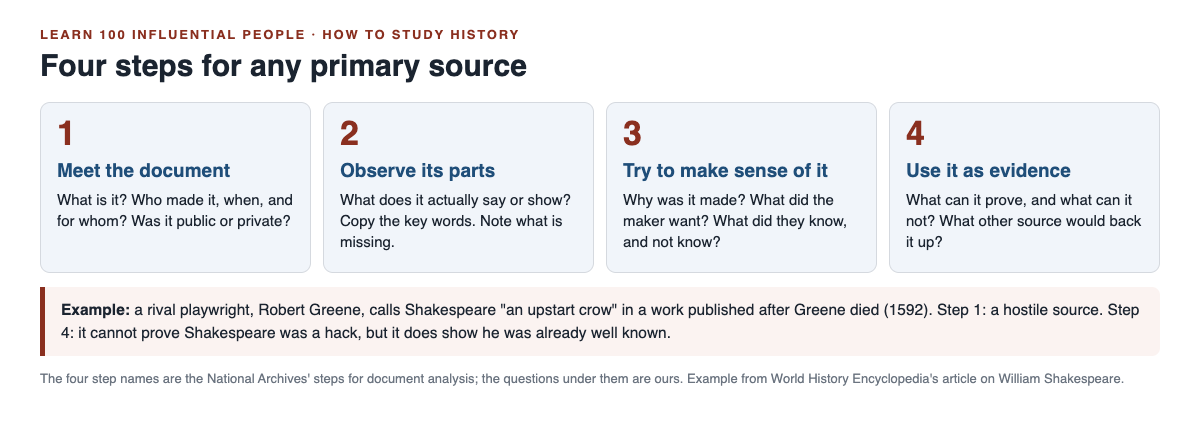
- Meet the document: What type of source is it? Who made it, and when? Who was it for? Was it public, like a newspaper, or private, like a diary?
- Observe its parts: What are the key words? Copy two or three exact phrases. What is missing that you would expect to see?
- Make sense of it: Why was it made? What did the maker want the reader to think? What did they know, and what could they not have known? The National Archives has a separate worksheet just on this, on how "backgrounds, beliefs, and experiences shape point of view."
- Use it as evidence: What question can this source help answer? What can it not prove on its own? Which other source would back it up or challenge it?
Worked example: a rival mocks Shakespeare (1592)
In 1592 a work called Greene's Groatsworth of Wit was published after the death of its author, the playwright Robert Greene. In it, he attacks a younger writer: "an upstart crow, beautified with our feathers," who thinks himself "the only Shake-scene in a country."
- Meet it. A printed work, public, by a dying rival playwright, published after his death. Expect bias.
- Observe it. "Shake-scene" points straight at Shakespeare's name. The phrase "Tiger's heart wrapped in a player's hide" twists a line from Shakespeare's own Henry VI plays: "O tiger's heart wrapped in a woman's hide."
- Make sense of it. Greene is mocking a younger rival. The encyclopedia says he essentially accuses Shakespeare of being a hack, and reads the attack as jealousy.
- Use it. It cannot prove Shakespeare was a hack: it is one hostile opinion. But it is strong evidence of something Greene did not mean to show. By 1592 Shakespeare was well known enough to be attacked, and his plays were known well enough that readers would catch the joke.
That last move is the heart of good source analysis: using a source for what it reveals by accident, not only for what it claims.
Worked example: a newspaper report on Gandhi (1947)
On 27 September 1947, The Times of London ran a report headed "Mr. Gandhi on 'war' with Pakistan." The Nobel Prize article on Gandhi as the missing laureate quotes it.
- Meet it. A public newspaper report, based on a Reuters telegram, about a speech Gandhi gave at a prayer meeting. So it is a report of spoken words, passed through a news agency, not Gandhi's own text.
- Observe it. The key line: although he had always opposed all warfare, if there was no other way of securing justice from Pakistan, India "would have to go to war against it."
- Make sense of it. India and Pakistan were in conflict after partition. The report itself says Gandhi had always opposed all warfare, so a line like this would surprise readers, and it gives no full transcript.
- Use it. Check it against other sources. The article says Gandhi called the report correct but incomplete, adding that he had not changed his mind and that he had no place in a new order that wanted "an army, a navy, an air force and what not." So the report alone cannot prove Gandhi gave up non-violence. It can prove what readers abroad were told, and the article says the statement seems to have been one of the main reasons the Nobel committee's majority passed him over that year.
For more on how Gandhi's non-violence compares with Martin Luther King's, see our guide to Gandhi vs Martin Luther King.
Common mistakes
- Summarizing instead of analyzing. Retelling what a source says earns little. Always end with step 4: what it proves, and what it cannot.
- Calling a source "biased" and stopping. Every source has a point of view. Greene's bias is exactly what makes his attack useful.
- Ignoring the physical object. Shakespeare's will of 1616 carries what one scholar calls "three quavering signatures," which he reads as a sign of failing health. Observing the parts includes handwriting, layout and what is crossed out.
- Expecting a source to answer every question. The same will leaves his wife "my second best bed," a line that has puzzled scholars for centuries. Some sources raise questions instead of settling them, and saying so is good analysis.
- Treating private and public sources alike. The Nobel committee never explained in public why Gandhi did not get the prize. Historians learned how the 1947 vote went from the private diary of the committee's chairman, Gunnar Jahn. A diary can say what no public statement did, but it is still one person's view.
When you need to set two sources or two people side by side, our guide to how to compare two historical figures in an essay turns your notes into a plan. And to see how the Greene attack fits into Shakespeare's life, read why Shakespeare is still important today.
Frequently asked questions
What are the four steps to analyze a primary source?
The National Archives uses four: meet the document, observe its parts, try to make sense of it, and use it as historical evidence. The steps are the same for a letter, a photo, a map or a recording.
What is the difference between a primary and a secondary source?
A primary source was made at the time by someone close to the events, such as a letter or a newspaper report. A secondary source was written later by someone studying those events, such as a textbook or an encyclopedia article.
How do you tell if a primary source is reliable?
Ask who made it, why, and what they could have known, then check it against at least one other source. A source can be biased and still be useful evidence, as long as you say what it can and cannot prove.
How long should a primary source analysis take?
For a short document, give each of the four steps a few minutes, and spend the most time on step 4. Writing down two exact phrases in step 2 saves time later, because your answer can quote them.
Get started
On Learn 100 Influential People, every lesson lists its sources, so you can read the original work, and 38 cards set out where researchers disagree. The 46 lessons take about 9 minutes each and end with questions where you choose, put in order, match, sort and estimate a number. Because each lesson lists its sources, you can practise the four steps on the originals behind it. Sign in with your email and an emailed code; accounts are for people aged 13 or older.
Start Learn 100 Influential People: short hands-on lessons on the people who shaped history, with every side of the debate and the sources to read next.
Comments
No comments yet.
Sign in or make an account to comment.