How to Find a Real Problem for an AI Startup
Most failed products did not fail because the technology was bad. They failed because nobody had the problem. If you want to know how to find a real problem for an AI startup, start with a person, not a model. This post gives you four questions to test any idea, a one-week plan for talking to the people who have the problem, and a quick way to check that AI can really do the hard part.
Why starting from the technology goes wrong
It is tempting to begin with what a model can do and look for a place to use it. That is how you end up with a clever demo and no customers.
Paul Graham, in his essay How to Get Startup Ideas (November 2012), puts it plainly: the way to get startup ideas is not to try to think of startup ideas. It is to look for problems, preferably ones you have yourself. He calls the most common mistake solving problems no one has, and describes "made-up" ideas that sound plausible but fall apart. His example is a social network for pet owners: friends say they could see someone using it, but nobody says they urgently need it.
The same trap exists with AI. "People could use a chatbot for this" is the pet-owner network with a model attached. The cure is the same: begin with a named person and a real pain.
What makes a problem real
A real problem has four traits. You can check each one without writing any code.
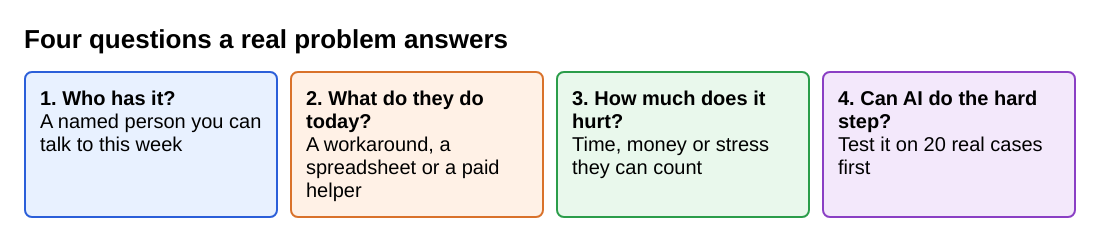
- Someone owns it. You can name a person or a small group, and you can reach them this week.
- They already work around it. A spreadsheet, a pile of copied messages, a freelancer, an hour of tedious checking. A workaround proves the problem costs something.
- The cost is countable. Hours a week, errors, late payments, lost customers. If nobody can put a number on it, be careful.
- AI is a good fit for the hard step. Not every painful task needs a model, and some tasks need one and cannot tolerate its mistakes.
Graham adds a useful lens. Few startups can win by building something a large number of people want a little. A better start is something a small number of people want a lot. In his words, ask who wants this right now, so much that they will use it even as a rough first version. If you cannot answer that, the idea is probably weak.
Where to look for problems worth solving
Good sources are close to you. None of them needs a market report.
- Your own work. Which task do you dread, repeat or pay someone else to do? Graham's advice is to live in the future and build what is missing, which means noticing what you wish existed while you do real work.
- A job you know well. Nurses, bookkeepers, recruiters, teachers and property managers all know where the paperwork piles up. If you have worked in a field, you see problems an outsider cannot.
- Complaints in public. Forums, review pages and community threads show people describing their workarounds in their own words. Save the exact phrases.
- Tasks that are slow but easy to check. These suit AI well: summarising, sorting, drafting, extracting. A person can glance at the result and fix mistakes quickly.
How to find a real problem for an AI startup in one week
Here is a plan you can follow. The people and numbers below are invented to show the method, not research results.
Say you have spent time around small property managers and suspect that tenant emails take too long. Your week might look like this.
- Monday: write the guess down. "Property managers with 10 to 40 units spend too long answering repeat tenant questions." One sentence, with a named group.
- Tuesday and Wednesday: talk to five of them. Ask about the last time it happened, not about the future. "Walk me through the last tenant email you dreaded." Ask what they did, how long it took and what they use today. Do not describe your idea.
- Thursday: tally. Say four of the five describe the same pain, two keep a spreadsheet of answers to paste, and one pays an assistant a few hours a week. That is a workaround with a cost.
- Friday: test the hard step. Collect 20 real emails with their answers. Give a model the questions and compare its drafts with what the managers wrote. Count how many a manager would send as is, how many need a small edit, and how many are wrong.
Now you know three things you did not know on Monday: whether the pain is shared, what people do about it today, and whether the model is good enough on real cases. If only one of five cares, or the model gets many wrong in ways that matter, you have saved months.
How to ask questions that give honest answers
People are polite. Ask whether they would use your idea and they will say yes. Ask about the past instead.
- "When did this last happen?" gets a real story.
- "What did you do about it?" shows the workaround.
- "What did that cost you, in time or money?" gets a number.
- "What else have you tried?" shows whether they actively look for a solution.
Listen for strong, specific stories. "I lost a whole Sunday on this last month" is worth ten "that sounds interesting" replies. If the answers stay vague, you are probably in made-up idea territory.
Check AI is the right tool before you build
A real problem does not guarantee a real AI product. Before you build, run the 20-case test from the example above, then ask three questions.
- What does a mistake cost? A wrong draft a person reviews is cheap. A wrong figure sent to a customer is not.
- Could a simpler tool do it? A template, a rule or a spreadsheet formula may solve the problem without a model, and be cheaper.
- Is the value more than a thin layer? If your product is only a prompt on top of someone else's model, a competitor can copy it in an afternoon. The site's blog has a post on thin wrappers around ChatGPT, and another on testing demand with a landing page and a waitlist.
Once you have a real problem, the next questions are whether people want your solution enough to stay, and whether the numbers work. Our posts on measuring product-market fit, evaluating whether an AI feature works and calculating unit economics for an AI product pick up from here.
Common mistakes to avoid
- Falling for your own demo. A good result on three examples you picked proves little. Use real cases you did not choose.
- Interviewing friends. They are kind and they are not your customers.
- Pitching during the interview. The moment you explain your idea, answers bend toward it.
- Treating one loud person as a market. Look for the same pain in several unconnected people.
- Skipping the cost question. A problem people complain about but never spend time or money on is a weak base for a business.
Frequently asked questions
How do I know a problem is big enough for a startup?
Look for people who already spend real time or money on a workaround, and for a small group that wants a fix urgently. Size matters later. Depth of need matters first.
Should I start with an AI idea or a problem?
Start with a problem. Then check whether AI helps with the hardest step. Starting with the technology often produces ideas that sound plausible but have no urgent users.
How many people should I interview?
There is no magic number. Five to ten conversations are often enough to hear whether the same pain keeps coming up. Stop when new interviews stop telling you anything new.
What if I can't think of any problems?
Look at your own work and at jobs you know well, and write down every task you or the people around you repeat or avoid. Keep the list for a week and you will probably have more candidates than you can test.
Get started with Age of AI Entrepreneur
If you want the business basics behind this, Age of AI Entrepreneur is a web app of short hands-on lessons, 12 courses and 36 lessons of about 9 minutes each, and each lesson lists its sources. One lesson, Revenue, Costs and Unit Economics, sits in the course Business Basics for Builders. You sign in with your email and an emailed code, and every lesson is free to anyone with an account, as set out on the terms page. Where researchers and founders disagree, the courses set out each side and leave the conclusion to you. Nothing in them promises a business outcome.
Start Age of AI Entrepreneur: short hands-on lessons on how to build a business in the age of AI, with every side of the debate and the sources to read next.
Comments
No comments yet.
Sign in or make an account to comment.