How to make practice questions from a study guide
A study guide tells you what the test will cover. It does not tell you whether you know it. Reading the guide and nodding along feels like revision, but the surest way to find out is to answer questions on every line. This post shows how to make practice questions from a study guide in three evenings: your own questions first, then quizzes on the pages behind each line, then a check that nothing on the guide is left uncovered.
Why make practice questions from a study guide
The guide is your teacher's map of the test. Each line, whether a term, a topic or an objective, is something you may be asked about. Turning those lines into questions does two jobs at once. You practise recalling the material, which our post on retrieval practice explains is stronger than rereading. And you find the lines you cannot answer yet, while there is still time to fix them.
Writing your own questions is a study method in its own right. In a 2020 study by Ebersbach, 231 students read a text with key words in bold, then wrote questions and answers about those words. A week later, students who wrote them with the text open, or with only the key words in front of them, did better on a test than students who simply studied the text again. The more questions they wrote, the better they did.
What happens when students write their own questions
The results in real courses are encouraging, but not all one way.
- Midwifery. In an immunology course (Shakurnia and colleagues, 2018), one class wrote, answered and explained multiple-choice questions on the syllabus topics for 15 weeks. Their scores rose more from the start to the end of term than the other class's. Most of them also said the method felt unfamiliar and they did not like it.
- Molecular biology. In a very large first-year course (Hancock and colleagues, 2018), students wrote questions tied to the course's learning outcomes and answered each other's. The class did better than earlier years on exam questions about those outcomes. On exam questions about other material, the students who took part most did no better than the rest.
- Medicinal chemistry. Writing better questions went with better grades (Hudson and colleagues, 2018), but it explained only a small part of the difference between students.
- Pathology. Over three years, medical students found writing questions too slow and demanding (Smith and colleagues, 2020). The authors concluded it may not be an efficient use of busy students' time.
Two lessons follow. In the molecular biology course, practice helped on the material it covered and not on the rest, so your questions need to cover every line of the guide. And writing good multiple-choice questions takes time, so write short questions of your own and let a quiz tool do the slow part.
Worked example: one study guide, three evenings
Say your biology teacher hands out a study guide for a unit test on cells and energy, with eight lines: the parts of a plant cell, where photosynthesis happens, the inputs and outputs of photosynthesis, cellular respiration, and so on.
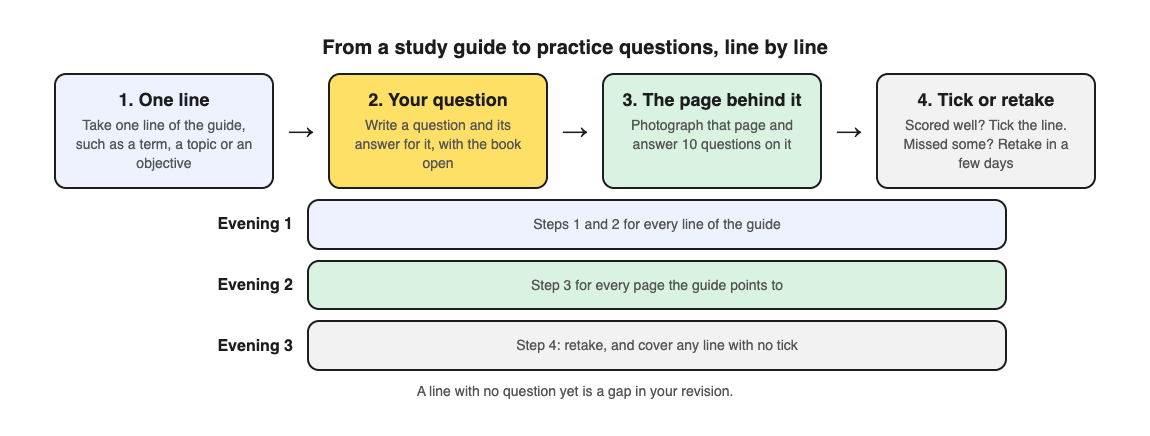
- Evening 1: your own questions. For each line of the guide, write one or two questions and their answers on paper, with your textbook open. "Where does photosynthesis happen?" "What goes into photosynthesis and what comes out?" Keep them short. Where you cannot write an answer even with the book open, mark the line: that is your first gap.
- Evening 2: the pages behind each line. Find the textbook or class notes page that covers each line. Photograph it with Study Shot and make a quiz. The default is 10 questions on a ladder from basic to advanced. Answer each one, then press Check answer to see the correct answer and a short explanation. If the guide itself is filled in with definitions, you can photograph it too; a bare list of headings gives the quiz little to ask about.
- Compare. The quiz will likely ask some things your own questions missed. Add those to your paper list, next to the line they belong to.
- Evening 3: tick or retake. Every quiz is saved in your library with its page photo and your best score. Retake each one. When you score well on a line's quiz and can answer your own questions from memory, tick the line on the guide. A line with no tick is where your next study session goes.
The results screen shows a score for each level and lists missed questions under Look at these again, with your answer and the right one. If you miss the basic questions on a line, go back to its key terms. If you miss the advanced ones, make a new quiz at the Advanced level, which asks you to apply and predict in new situations.
Keep a recall step on paper
Study Shot writes multiple-choice questions, four choices with one right answer. Many study guides ask you to "explain" or "describe", and the test may ask you to write the answer out. So keep your own questions from evening 1, and on the last day answer them on paper with the book closed. That is the closest practice to a written test.
The quiz questions are written by an AI model and can contain mistakes. The explanation helps you check, and if a question looks wrong, use Report a problem under it. Your teacher's guide and textbook have the last word.
Study guides in a group
A whole class often gets the same guide, so share the work. Split the lines between friends, have each person make the quizzes for their lines, and swap them. Share this quiz makes a link; each person needs a Study Shot account and gets their own copy of the questions, without your photo. Our post on quizzing each other in a study group has more ideas, and our posts on turning a class handout into practice questions and making a practice test from a worksheet cover the other papers teachers hand out.
Frequently asked questions
How many practice questions should I make per study guide line?
One or two of your own, plus a quiz on the page behind the line. A short guide line on a big topic may need a quiz on more than one page.
Should I write questions with the book open or closed?
In one study, students who wrote questions with the text open, or with only the key words, did better a week later than students who restudied. Open book is a fine place to start.
Can I photograph the study guide itself?
Yes, if it has real content on it, such as definitions or filled-in answers. A list of headings gives little to ask about, so photograph the pages it points to instead.
What if my study guide has no answers?
Find the answers in your textbook or notes while you write your own questions. Then quiz yourself on those pages.
Get started
Try Study Shot: it is free to start and works on your phone and computer. Take the study guide for your next test, find the page behind each line, and make a 10-question quiz on each one tonight.
Comments
No comments yet.
Sign in or make an account to comment.