How to stay motivated to walk in winter: a plain plan
How to stay motivated to walk in winter comes down to one idea: fix the thing that is actually stopping you. In winter it is usually one of four things. It is dark, it is cold, the pavement is slippery, or your mood has dipped. Each has a simple answer. This plan takes them one by one, then puts them together into a winter week you can follow, with a small reason to step outside each day.
How to stay motivated to walk in winter: know why it slips
If your walking habit fades in November, you are not alone, and you are not lazy. The NHS's winter health advice says plainly that icy pavements and roads can be very slippery, and that cold weather can stop people from going out.
Light matters too. The NHS describes seasonal affective disorder (SAD), a type of depression that usually happens in winter, and says it is thought to be linked to reduced daylight. You do not need to have SAD to feel the short days. But it helps to know the season itself pulls against you.
So the fix is not more willpower. It is a plan built for winter.
Fix one: move your walk into daylight
Among its self-care tips for SAD, the NHS suggests getting as much natural daylight as you can, trying to go outside in the daytime every day, and getting regular exercise. A daytime walk does all three at once.
In winter, that often means moving your walk. If you walked after work in summer, it may now be dark by then. Try one of these instead:
- A lunch walk. Even 10 minutes in the middle of the day gets you into the brightest part of it.
- A walk on the way. The NHS suggests walking part of your journey to work, or walking to the shops. In winter, do it in the morning light.
- A weekend daylight walk. Save your longest walk for a Saturday or Sunday morning.
Harvard Health's walking tips suggest a "cue": tie your walk to something you already do every day, like getting up or the hour before lunch. A fixed time in daylight beats waiting to feel like it.
Fix two: dress for cold and ice
Cold and ice are the two things the NHS names for keeping people in. Its advice for going out in the cold is short:
- Shoes with a good grip. The NHS suggests these if you need to go out in the cold.
- A scarf around your mouth. The NHS says it helps protect you from cold air.
- A waterproof jacket. The NHS's walking for health page suggests one once you are walking longer distances regularly.
On a day when the pavements are icy, a short walk on cleared, gritted streets still counts. You do not need your usual route to keep the habit.
Fix three: be seen when it is dark
Some winter walks will happen in the dark, however well you plan. The Highway Code's rules for pedestrians say what to do:
- In poor daylight, wear or carry something light-coloured, bright or fluorescent.
- When it is dark, use reflective materials, such as an armband, sash, jacket or footwear. The Highway Code says drivers using headlights can see these up to three times as far away as non-reflective materials.
- At night, if there is no crossing nearby, cross the road near a street light so traffic can see you.
A reflective armband fits in a coat pocket. It turns an after-dark walk from a worry into a normal one.
Fix four: shrink the goal, keep the habit
Winter is not the time to chase a big target. It is the time to protect the habit. The NHS says a brisk 10-minute daily walk has lots of health benefits and counts towards the 150 minutes of weekly exercise in its guidelines for adults. Those guidelines suggest spreading activity evenly over 4 to 5 days a week, or every day.
A brisk walk, the NHS says, is about 3 miles an hour. You are going fast enough if you can still talk but cannot sing.
Harvard Health adds two tips that help in winter:
- Set small goals and write them down. It says people who choose small, achievable goals and write them down are more likely to get them done.
- Find a walking buddy. It quotes Dr. Baggish: "We are 10 times more likely to commit to a workout if we know someone is waiting." A friend at the door is hard to cancel on.
The NHS also suggests a podcast or music to take your mind off the effort. On a grey day that can be the difference between going and not.
A worked example: one winter week
Here is a week for someone who walked 30 minutes after work in summer and now finds it dark by then. The goal is 150 minutes of brisk walking, spread out, with most of it in daylight.
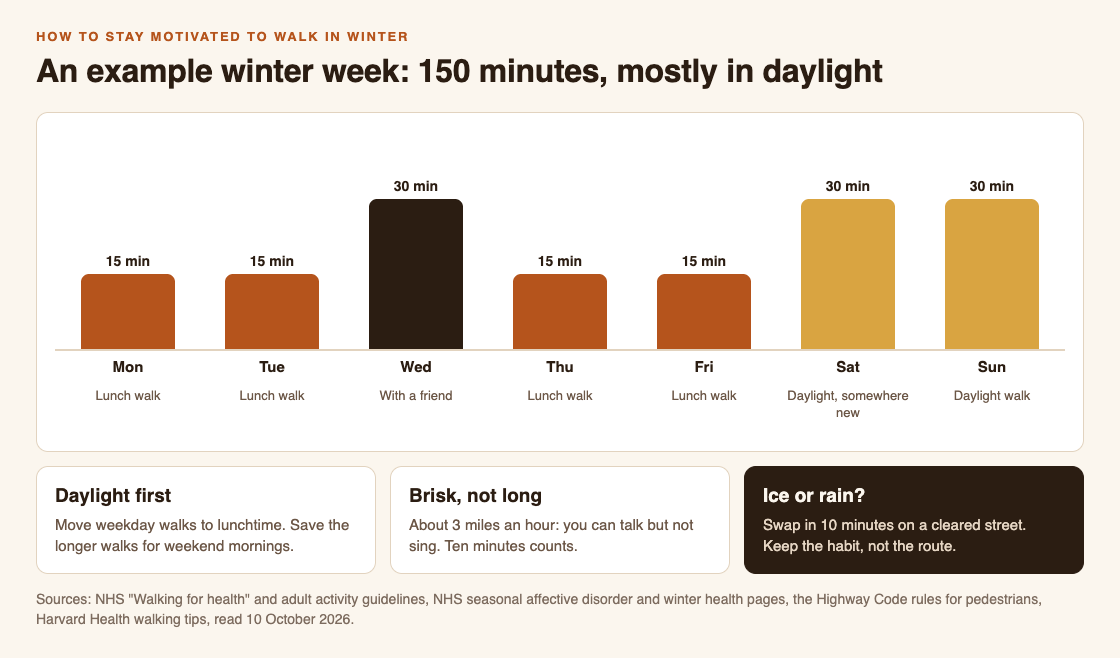
Short daylight walks on weekdays, longer ones at the weekend.
- Monday, Tuesday, Thursday and Friday: a 15-minute lunch walk. Brisk enough that you could talk but not sing. That is 60 minutes.
- Wednesday: a 30-minute walk with a friend. Agree the time on Sunday, so someone is waiting. That makes 90.
- Saturday: a 30-minute daylight walk somewhere new. That brings you to 120. If you need ideas, our guide to finding new walking routes near you has a method.
- Sunday: another 30-minute daylight walk. That makes 150. Before you head home, write down next week's lunch walk times.
If ice or rain takes out a day, swap in a 10-minute walk on a cleared street. You keep the habit, and you are still close to your total. If you are starting from zero, begin with our beginner's 5-week plan instead.
Give each winter walk a reason with Cat Go
A reason to step out helps most on the days you would rather not. Cat Go is a game that plays in your web browser: "Walk anywhere, photograph a real cat, lure it with food and catch it. Every catch keeps its breed and where you found it."
Two parts of it fit a winter plan:
- Treat stops give a lunch walk a target. They sit on the game's map. Away from one, the card tells you how far it is and says "Walk within ... m to collect kibble, and sometimes tuna." When you reach it: "You're here. Grab what's in the bowl." Afterwards it shows "Refilling - ready in ... min", so the same stop can be tomorrow's target too.
- Cats give a walk a small surprise. If you spot a cat, you take its photo, pick its breed and toss in-game treats to win it over. The kibble and tuna are in the game only; you never feed a real cat.
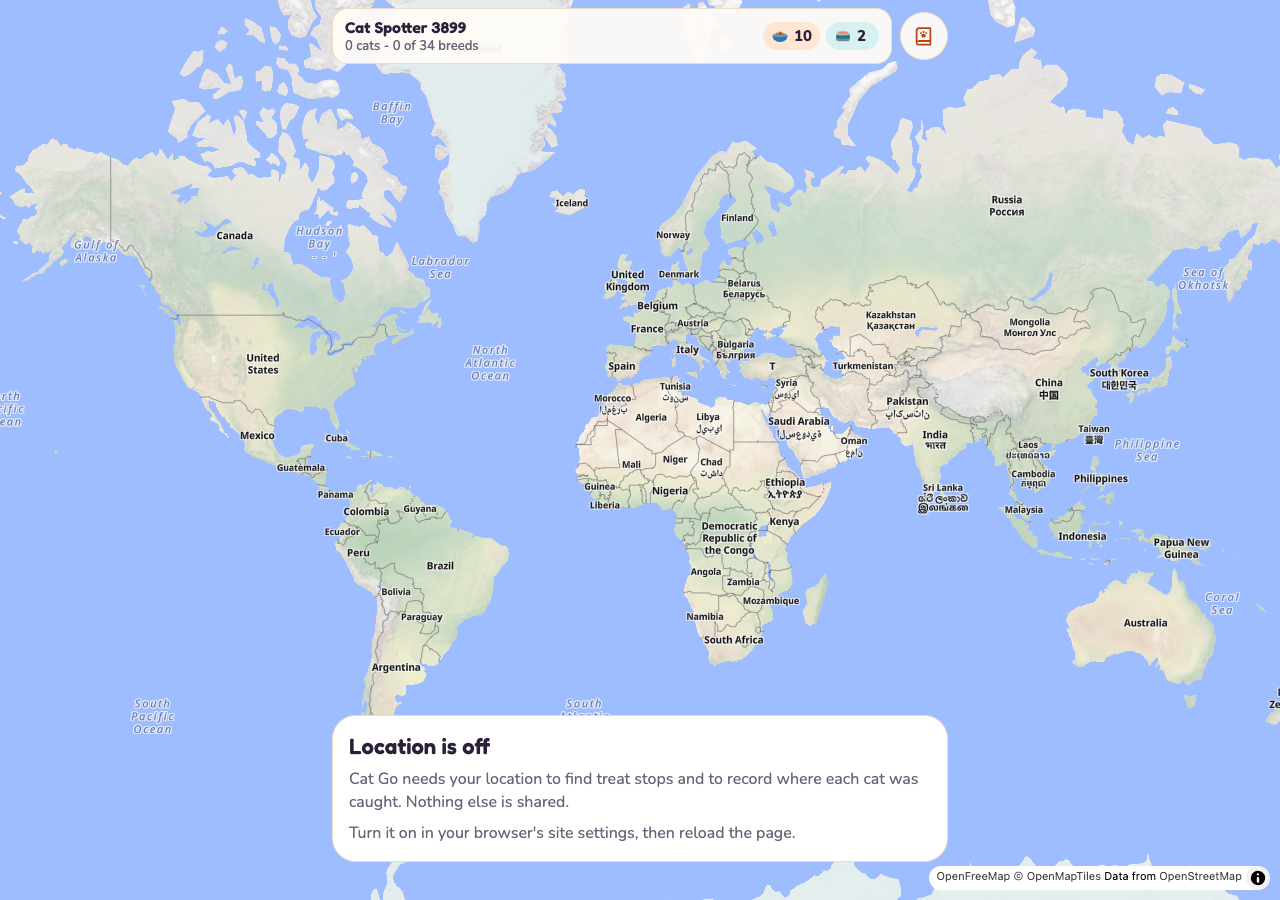
The map is where treat stops appear once location is on.
Cat Go needs your location "to find treat stops and to record where each cat was caught", and the camera to take a cat's photo. For more ways to make a walk feel less like a chore, see How to make a daily walk more fun.
Frequently asked questions
How long should a winter walk be?
The NHS says a brisk 10-minute daily walk has lots of health benefits and counts towards your 150 minutes a week. Short walks on most days keep the habit going.
Is it safe to walk when it is icy?
The NHS warns that icy pavements can be very slippery and suggests shoes with a good grip if you go out in the cold. Stick to cleared streets, and skip the walk if it does not feel safe.
Will a winter walk give me enough vitamin D?
No. The NHS says that between October and early March we do not make enough vitamin D from sunlight, and that everyone should consider a daily supplement in autumn and winter.
What if winter makes me feel low?
The NHS suggests daylight, regular exercise and staying in touch with friends and family. If you think you might have seasonal affective disorder, it says to see a GP.
Get started
Pick your lunch walk times for this week, write them down, and put a reflective armband in your coat pocket. Then play Cat Go in your browser: walk anywhere, photograph a real cat, lure it with food and catch it, and keep its breed and the place you found it in your Catdex.
Comments
No comments yet.
Sign in or make an account to comment.