How to study for a chemistry test in three days
Three days is not much time, but it is enough to do better than one long night of cramming. If you are searching for how to study for a chemistry test in three days, the plan below gives you one focused session a day, splits chemistry into the two kinds of practice it needs, and is built on what studies of spacing and of chemistry learning actually found, including what they did not test.
Three short sessions beat one long cram
With a test in three days, the natural move is to wait until the night before and do everything at once. The research points the other way. A large review by Dunlosky and colleagues (2013) gave its two highest ratings to practice testing, which means answering questions from memory, and distributed practice, which means spreading study across separate sessions. Rereading and highlighting were rated low.
Three days gives you room for both. You can test yourself three times, with a night between each round.
What the research says about short study windows
How far apart should your sessions be? In a study of more than 1,350 people, Cepeda and colleagues (2008) taught a set of facts, gave a review after different gaps, and tested later. The best gap grew as the test got further away. For a test one week away, the best gap was about 20 to 40 percent of that week, which is roughly one and a half to three days. A gap that was much too long started to hurt again.
That study did not test a three day window, and it used facts, not chemistry problems. So treat a gap of about one day between sessions as a sensible fit for your timeline, not a measured rule.
What about chemistry itself? Tullis and Zhang (2026) ran two experiments, each with 69 college students learning chemistry concepts. Students were tested five minutes or two days later. Practising retrieval and making up memory aids (mnemonics) both beat simply restudying, on remembering the concepts and on transfer questions, which ask you to use them in a new way. The two methods did equally well. But retrieval took about half as much time, even though students rated mnemonics as the more effective method.
When you only have three days, that time saving matters. In that study, answering questions got the same result in about half the time.
Ideas and calculations: two kinds of chemistry practice
Chemistry tests usually mix two things:
- Ideas. What a covalent bond is, why some reactions give out heat, how the periodic table is arranged. You answer these by understanding and recalling.
- Calculations. Moles, concentrations, balancing equations, yields. You answer these by working through steps on paper.
A review of 40 years of testing research by Pan and Rickard (2018) found that practising with questions carried over best to questions that ask you to apply an idea. It carried over weakest in a few cases, including problems involving worked examples, the step-by-step kind. So a quiz on ideas will not, by itself, make you faster at mole calculations. Practise those problems directly, on paper, and check them against the answers.
A multiple-choice quiz also cannot see your working. It can tell you whether you understand why a calculation works, but only paper practice shows whether you can do it. Our post on studying for a math test splits the same two kinds of practice.
How to study for a chemistry test in three days
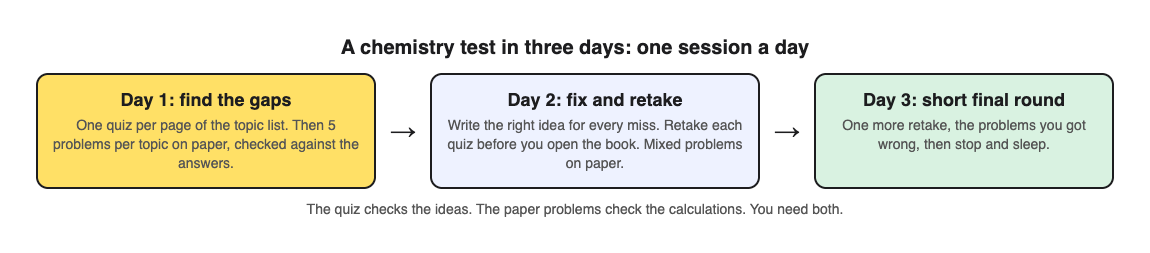
- Day 1: find the gaps. List every topic the test covers. Make a quiz for each page of your textbook or notes and answer it once. Then do five problems per topic on paper and check them against the answers. Write down every topic where you missed a quiz question or got stuck on a problem.
- Day 2: fix and retake. For each miss, write the right idea in one sentence of your own. Retake each quiz before you open the book. Then do a mixed set of problems on paper, from different topics in random order, so you practise choosing the right method. See interleaving practice for why mixing helps and where the evidence is mixed.
- Day 3: a short final round. One more retake of each quiz, then redo only the problems you got wrong. Stop early and sleep.
Each session should take an hour or two, not a whole evening. The gaps between days are part of the method.
Worked example: a page on chemical bonding
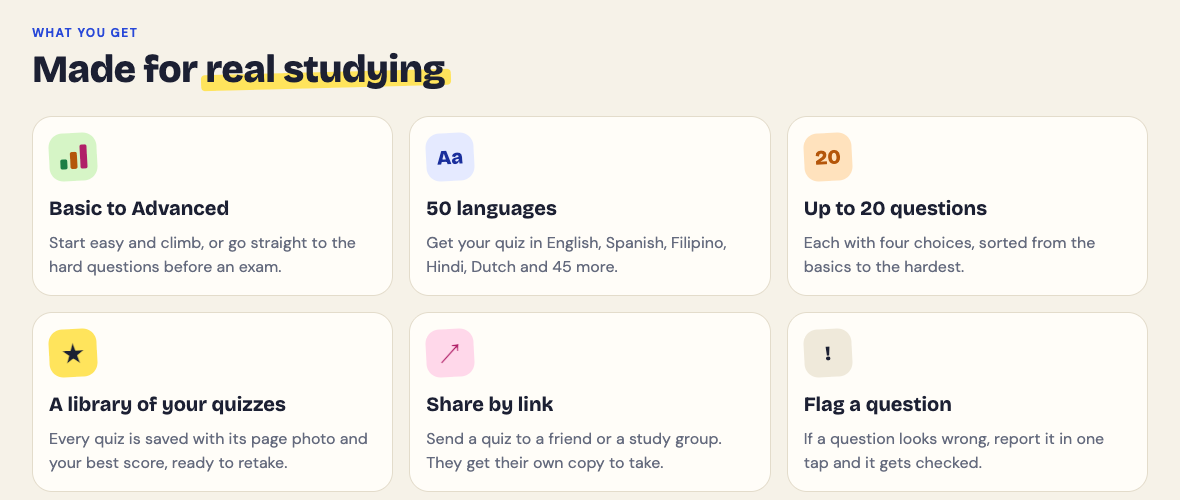
Say one of your test topics is chemical bonding, and your textbook has a page on ionic, covalent and metallic bonds. Here is day 1 and day 2 with Study Shot, which takes a photo of a page from your textbook, notes or worksheet and writes multiple-choice questions about it, from the basics to advanced, explaining every answer.
- Photograph the page. Hold it flat and fill the frame, then choose Tiered and 10 questions.
- Climb the levels. Tiered starts with Basic questions on key terms, such as which type of bond forms when two atoms share a pair of electrons. It moves to Intermediate questions that ask you to explain and compare, such as how ionic and covalent bonds differ. It ends with Advanced questions that ask you to apply and predict in a new situation.
- Check each answer. Pick a choice and press Check answer. You see whether you were right, the correct answer and a short explanation. That instant check is what makes this faster than writing your own questions.
- Read your results. You get a score for each level. A good Basic score and a weak Advanced score means you know the words but cannot yet use them. Look at these again lists every miss with your answer and the right one, which is your day 2 list.
- Day 2: retake first. The quiz is saved in your library with its page photo and your best score. Press Retake quiz before you reread the page, then go back only to the parts you missed.
Short on time on day 3? The levels let you choose. Pick Advanced on its own to go straight to the hard questions before the exam.
The questions are written by an AI model and can contain mistakes. If an answer looks wrong, check it against your textbook, and use Report a problem under the question. Study Shot asks multiple-choice questions only, so your calculations still belong on paper.
Common mistakes with three days to go
- Saving it all for the last night. You lose the gaps between sessions, which is the cheapest help there is.
- Only reading worked examples. Following someone else's solution feels like understanding. Cover it and solve the problem yourself.
- Only doing calculations. Many marks go to explaining ideas. Quiz yourself on those too.
- Making beautiful notes or memory aids. They can work, but in the chemistry study above, answering questions gave the same result in about half the time.
Frequently asked questions
Can I really learn chemistry in three days?
You can make real progress on the topics in your test, especially if you have been to the classes. Three short spaced sessions of practice testing use the time far better than one long cram.
Should I memorise or practise problems?
Both. Quiz yourself on the ideas, and solve calculation problems on paper, because practice with questions carries over poorly to step-by-step problems.
Are mnemonics a waste of time?
No. In one chemistry study, making mnemonics worked as well as answering questions, but it took about twice as long. With three days, answering questions is the better use of time.
What if I only have one night?
Do one round of questions on each topic, then the problems you get wrong, and sleep. Retake the questions the next morning if you can. Our guide to studying for a multiple choice exam has more on using a short window well.
Get started
Try Study Shot: it is free to start and works on your phone and computer. Tonight, photograph the first page your chemistry test covers, take 10 Tiered questions on it, and do five problems on paper. That is day 1 done.
Comments
No comments yet.
Sign in or make an account to comment.