How to study for an anatomy test: quiz, label, then space it
Anatomy asks you to hold hundreds of names in your head, know where each part sits, and say what it does. Reading the chapter again feels like work, but it rarely makes the names come back on test day. If you are looking for how to study for an anatomy test, the research done in real anatomy courses points to two habits: pull the names out of memory instead of reading them again, and spread that practice over several days. This post sets out that research, where multiple-choice practice falls short, and a two-week plan you can follow.
How to study for an anatomy test: the short version
- Test yourself early. After each lecture, answer questions on the material before you reread it.
- Space it out. Come back to each region two or three days later, then again in the last week.
- Recall, do not only recognise. Pair every quiz with blank labels and short written answers, because most anatomy exams ask you to produce a name, not pick it.
- Use your scores as a warning light. A low score early on is a reason to change how you study, not a reason to panic.
Our post on retrieval practice explains why pulling facts out of memory works better than reading them again.
What anatomy research says about testing yourself
In an anatomy and physiology course (Dobson, 2013), some students took 10 very short quizzes on material that had already been on their exams, about two hours of quizzing in all. At the end of the semester they kept on average 41% more of that material than students who did not take the quizzes. Whether the gaps between quizzes grew or stayed the same made no real difference.
A later study looked at how to spend the same 24 minutes learning skeletal muscles (Dobson, Perez and Linderholm, 2017). A week later, students who mixed studying with recall and spread it over a week remembered the most. Recall beat plain studying, spreading it out beat cramming it together, and doing everything on one day did worst of all.
The same pattern shows up in bigger courses. In a large gross anatomy course with 248 students (Azzam and Easteal, 2021), answering recall questions in class went with better final exam results. And over four years of anatomy courses in South Korea, where students had to learn the terms in English (Fendos, 2021), adding recall practice, regular quizzes that covered earlier material, and group work improved both scores and how students felt about the course. Neither was a randomised trial. The gross anatomy study compared groups that were not randomly assigned, and the Korean study changed several things at once, so it shows what worked together, not which part did the most.
Multiple choice is not the whole test
Here is the honest part. Picking a name from four choices is easier than writing it from memory, and anatomy exams often ask you to write it.
In a 2026 study with 350 second-year medical students (Ilyas and colleagues), the same students practised with short-answer questions in one module and multiple-choice questions in another. They scored higher after short-answer practice, about 82 against 71, even though the final check was multiple choice.
Two other studies are worth knowing. With first-year dental students (Lee, Nagel and Gould, 2012), online multiple-choice quizzes open before each exam neither raised nor lowered exam scores, although the first quiz score did predict how a student would do. And in a medical school anatomy course (Azzi and colleagues, 2015), scores on multiple-choice lab quizzes tracked the final practical exam only moderately; a practical midterm tracked it far better.
So a quiz is a good start, not the whole job. Use it to find what you do not know, then practise the way your exam asks.
Worked example: two weeks before an anatomy test
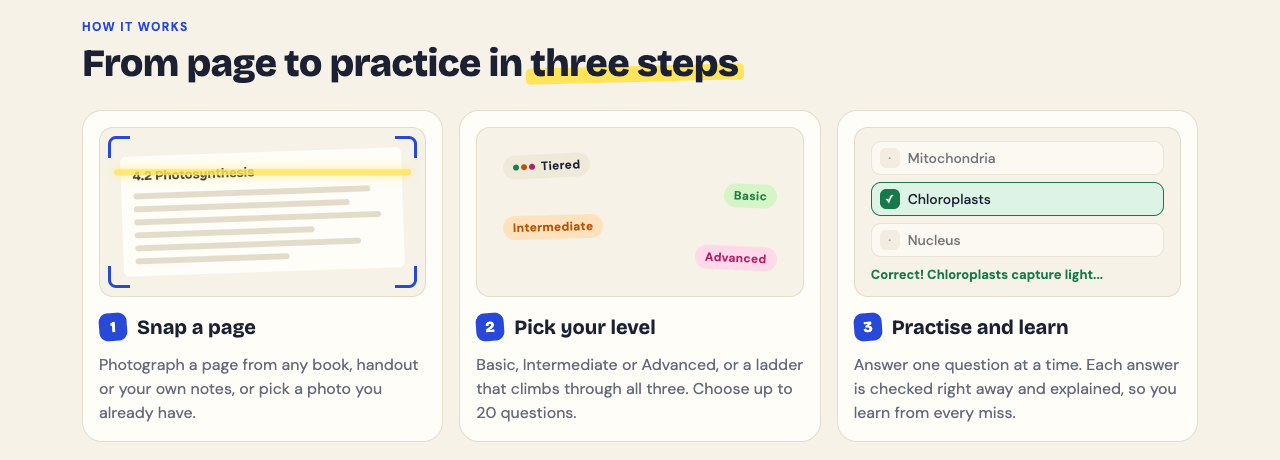
Study Shot turns a photo of a page from your textbook, notes or worksheet into multiple-choice questions, from the basics to advanced, and explains every answer. The app says textbooks, notes, diagrams and whiteboards all work, so you can photograph a labelled figure as well as a page of text. Say your test covers the upper limb in two weeks.
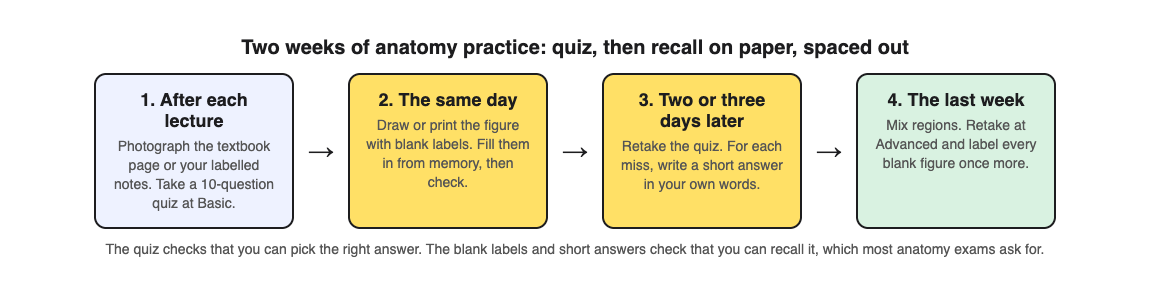
- After each lecture. Photograph the textbook page or your own labelled notes for that region, such as the muscles of the forearm. Take 10 questions at the Basic level, which covers key terms, facts and definitions. Answer before you reread anything.
- The same day. Draw or print the main figure with the labels covered. Fill in every label from memory, then check against the book. This is the recall step the quiz cannot do for you.
- Two or three days later. Press Retake quiz from your library, where each quiz is saved with its page photo and your best score. The results list your misses under Look at these again, with your answer and the right answer. For each miss, write a one-line answer in your own words: the muscle, its action and its nerve.
- The last week. Mix regions in one sitting, the way the exam will. Make a new quiz on your weakest page at the Advanced level, which asks you to apply and predict in new situations. Then ask yourself one more question for each nerve: what could a patient not do if it were cut? Last, label every blank figure once more.
The questions are written by an AI model and can contain mistakes. The explanation after Check answer helps you spot one, and your textbook has the last word. If a question looks wrong, use Report a problem under it.
Learn the names, not only the pictures
Anatomy is partly a language course. The Korean study treated it that way, with steady quizzing on terms that kept coming back. A few habits help:
- Break names into parts. Flexor carpi radialis tells you the action, the area and the side. Learn the common word parts once and many names explain themselves.
- Say it, then spell it. Recognising a name in a list is not the same as writing it correctly. Our post on studying vocabulary from a textbook page has a simple recall routine.
- Quiz in your own language if it helps. You can set the quiz language to any of 50 languages while the app's screens stay in English. If your exam is in English, finish with the English names, since that is what you will be asked.
Use your early scores as a warning light
The dental and medical school studies agree on one useful point: early quiz scores say something about how you are heading. If your first quiz on a region comes back low, that is the time to change course, not the week of the exam.
The results screen shows a score for each level. If you lose marks at Basic, you have a names problem: go back to labels and terms. If Basic is fine but Advanced is low, you know the names but not how the parts work together: talk through what each structure does and what happens if it fails. For a whole-course exam, our nursing exam plan shows how to space many units over three weeks.
Frequently asked questions
How long should I study for an anatomy test?
Start as soon as each topic is taught, not the week before. In the skeletal muscle study, the same 24 minutes did much better spread over a week than done in one day.
Are multiple-choice quizzes enough for anatomy?
No. They are a good way to find gaps, but in a 2026 study short-answer practice beat multiple-choice practice. Add blank labels and written answers.
How do I memorise anatomy terms faster?
Learn the common word parts, then test yourself on the names from memory and come back to them over several days, as the students in the studies above did.
Can I make a quiz from an anatomy diagram?
Yes. Study Shot reads diagrams as well as text, so you can photograph a labelled figure. Our post on studying diagrams shows how.
Get started
Try Study Shot: it is free to start and works on your phone and computer. Photograph the figure from tonight's anatomy lecture, take 10 questions on it, then cover the labels and see how many you can write from memory.
Comments
No comments yet.
Sign in or make an account to comment.