Is Paternalism Ever Justified? Soft, Hard and Nudges
Is paternalism ever justified? Many philosophers say yes, in some cases, and almost none say always. Paternalism means limiting a person's freedom for their own good and without their consent. The hard part is deciding when the person's own good outweighs their say. This guide sets out the main positions from the Stanford Encyclopedia of Philosophy, explains nudges, and gives you a short test.
If you would rather work out where you stand by writing it down, Dear Superintelligence is an open collection of letters from people to the AI of the future, where reading is free and a free account can publish 3 letters.
Is paternalism ever justified? First, what the word means
The Stanford Encyclopedia entry on paternalism opens with a list of everyday cases. A government makes people pay into a pension system and makes motorcyclists wear helmets. It bans swimming at a public beach when no lifeguard is on duty. A doctor does not tell a patient the whole truth. A husband hides the sleeping pills from a depressed wife.
When a rule or act is justified only because the person affected would be better off, and that person would prefer not to be treated this way, the entry calls it paternalism. It then offers a three-part test. Someone does something that:
- interferes with another person's liberty or autonomy,
- does so without that person's consent, and
- does so only because they believe it will improve that person's welfare or promote their interests, values or good.
The entry admits that the edges are contested. Stopping a drunk driver is not paternalism, since the reason is the safety of others. Cases with mixed reasons, such as a law that protects the chooser and bystanders at once, are harder to sort.
Soft vs hard, and four more splits
Soft paternalism holds that interference is justified only to find out whether a person is acting voluntarily and knowledgeably. The entry uses John Stuart Mill's example of a man about to cross a damaged bridge. If we cannot tell him of the danger, because he speaks only Japanese, we may hold him back long enough to find out whether he knows. If he knows and still wants to cross, even to end his life, a soft paternalist says he must be allowed to go.
A hard paternalist says it may sometimes be permissible to stop him even when he knows the bridge's condition. Hard paternalism is the form that needs the strongest defence, because it replaces one person's judgement about their own life with another's.
The entry lists four more distinctions. They matter because people often argue past each other when each means something different by the word.
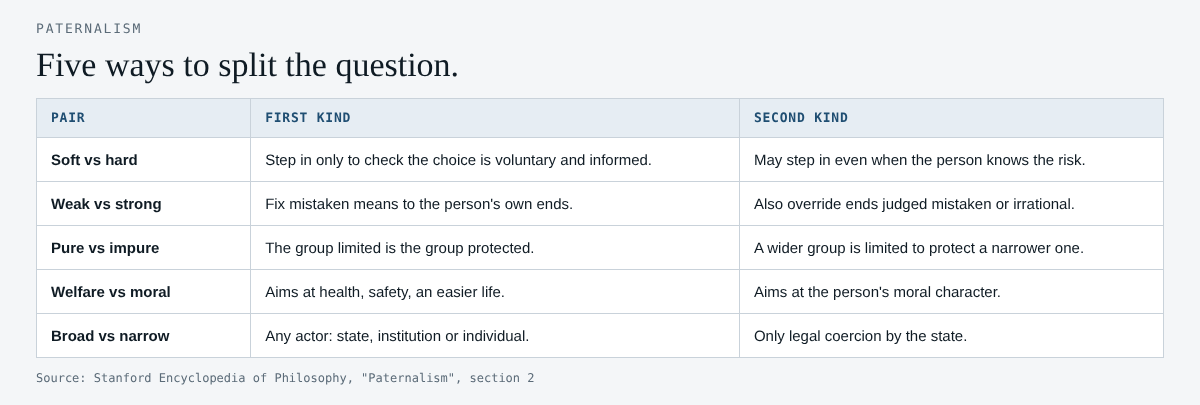
The five splits in the Stanford Encyclopedia entry, section 2.
- Weak vs strong. A weak paternalist interferes only with the means a person picks to reach their own ends. If you really prefer safety to convenience, making you wear a seatbelt serves your end. A strong paternalist also overrides ends judged mistaken or irrational, such as a rider who simply likes the wind in their hair.
- Pure vs impure. In pure paternalism the group limited is the group protected, as with swimmers. In impure paternalism a wider group is limited, as when a ban on making cigarettes protects smokers.
- Welfare vs moral. Most arguments cite health or safety. Moral paternalism aims at the person's moral character instead, which is more controversial.
- Broad vs narrow. A narrow view looks only at state coercion. A broad one also covers hospitals, workplaces and individuals.
The burden of proof and the case against
The entry notes that the analysis cuts both ways. Interfering with liberty seems to put the burden on the paternalist. An act meant to do good seems to put it on those who object. Mill's answer, as the entry reports it, is that it depends on who is treated. With a child, the burden is on those who resist. With an adult of sound mind, the presumption is reversed.
Starting from the presumption that paternalism is wrong, the entry asks whether it can ever be overcome: under no circumstances, some circumstances, or any circumstances. The last view it calls very implausible, since it would let good intentions settle everything and ignore the means used. That leaves two serious positions: never, or sometimes.
The entry gives two lines of objection. One is practical: even if some good can be done against a person's will, the attempt may almost always do more harm than good, and nobody can sort the rare good cases from the bad in advance.
The other is about what a good life is. If the good includes being respected as an independent agent and deciding for yourself, then overriding a choice may not make you better off at all. The entry quotes Mill: a man's way of laying out his own existence is best "not because it is the best in itself, but because it is his own mode." Kantian views, it adds, are frequently absolute here. To deny an adult the right to decide, however mistaken the choice seems, is to treat them only as a means to their own good.
The case for: three ways to justify stepping in
For those who allow paternalism sometimes, the entry sets out three kinds of reason.
- Consequences. More good than harm results.
- Autonomy. A short-run limit protects long-run freedom. Mill's argument against letting people sell themselves into slavery, and the case for stopping use of drugs that destroy the will, are examples.
- Agreement. We would all agree to the interference, given suitable knowledge and motivation. The entry's examples are short-term interventions against suicide while we check for depression, and seat belts, since we know we tend to discount future benefits.
The third also supports Feinberg's soft paternalism: when we are not fully voluntary, others may supply information or point out flaws in our reasoning, but a voluntary choice made afterwards must be respected. For related questions about what is owed to people, see our posts on equality and on toleration.
Nudges: paternalism that leaves every option open
A newer strand, called libertarian paternalism or nudging (Sunstein and Thaler, 2003), changes how choices are presented without forbidding any. The entry's examples are healthy food at eye level in a cafeteria, smaller plates, lane lines painted closer together before a sharp turn, and automatic enrolment in a retirement plan with an easy opt-out, which has been shown to raise savings rates.
The entry raises a sharp point about the label. Because a nudge interferes with nobody's liberty, it fits the three-part test poorly. You could replace "paternalism" with "benevolence", it says, and lose little. The real questions are whether nudges are justified, and the objections it lists are about method: nudges the person does not notice, nudges that work by exploiting flaws in thinking, and nudges that shade into manipulation.
Transparency is the usual remedy. A cafeteria's food placement is visible, though its purpose may not be. A warning label states its purpose. A painting of eyes above a coffee pot raised payments, yet most workers had not noticed it. The entry reports a study of end-of-life care suggesting a default's effect did not weaken when people were told why it was chosen. Sunstein's own condition is that choice architecture should be transparent and open to public scrutiny.
A four-question test you can run
This test is ours, built from the entry's distinctions. It is a way to organise your thinking, not a verdict. Use it on a rule, a product setting or your own urge to step in.
- Is the choice informed and voluntary? If not, supplying information or a pause is the soft step, and the one that most views accept.
- Whose ends are being served? Is this a means to the person's own goal, or an override of the goal itself? The second needs much stronger reasons.
- Would the person agree on reflection? The contractualist test: would they accept it if they had the knowledge and the motivation?
- Is it open and open to challenge? Can they see it, learn why, and say no?
Worked example (hypothetical). A hospital app is set to book flu shots for staff unless they opt out. Question 1: the choice is not removed, and staff are told the default exists. Question 2: it serves an end most staff already hold, protecting patients and themselves. Question 3: most would likely agree, given what they know about forgetting to book. Question 4: opting out takes one click, and the reason is printed beside the default. This is a transparent nudge, and the least contested kind. Now change one thing: the app hides the opt-out and does not say why. Question 4 now fails, and the whole case gets weaker.
Paternalism and a far more capable AI
The question gets sharper as AI systems become more capable. A system that knows far more than you do may often be right about what is good for you, which makes overriding you tempting. It also widens the gap between the two of you, so it gets harder for you to check what was done or to say no. Whether a given system would act in your interest at all is a separate and open question, which we look at in our post on whether AI can be trusted.
The test above carries over. If a system sets a default for you, question 4 asks whether you can see it and change it. If it withholds something, question 1 asks whether it is helping you choose or choosing for you. The entry's transparency condition is a fair demand to make of any chooser, human or not.
Dear Superintelligence does not publish a position on paternalism. Its guidelines ask a letter to address a future superintelligent AI directly, as "you", and say that details from your own life are worth more than general arguments. They also say grief, anger, doubt and confession all belong, told honestly. A prompt to try:
Describe one time someone overrode a choice you made, for your own good. What did they know that you did not? Did they tell you? What would you want a far more capable mind to understand before it ever does the same?
Nobody can promise what future AI systems will read, so write it because it is worth saying honestly. The About page says the site does not train any AI model on the letters.
Frequently asked questions
What is the difference between paternalism and protecting others?
Paternalism limits your choices for your own benefit. Protecting others limits them because of the harm you could do to someone else. The entry treats the second as a different kind of reason, though real cases often mix both.
Is soft paternalism always acceptable?
Not automatically. It is easier to defend because it only checks that a choice is informed and voluntary. It still depends on who decides that you are not, and whether you can contest it.
Is a nudge paternalistic?
The entry says nudges are called paternalistic only on a very weak definition, since they interfere with no one's liberty. Whether they are justified turns on transparency, manipulation and whether they exploit flaws in thinking.
Should an AI ever override a person's decision?
That is an open question. The philosophy gives you tests to apply, not an answer: is the choice informed, whose ends are served, would the person agree on reflection, and can they see and challenge it.
Get started
Think of one time someone made a choice for you, and write it down as a letter. Dear Superintelligence collects letters like it, and reading is free. Browse the archive first, or go straight to the write page: a free account can publish 3 letters.
Letters from people to the AI of the future.
Visit dearsuperintelligence.vlvd.net↗
Comments
No comments yet.