What Is Toleration? Four Conceptions and Three Paradoxes
What is toleration? It is putting up with something you think is wrong, and choosing not to stop it. The word is often used for being open-minded, but philosophers use it more narrowly, and the narrow meaning explains why toleration is hard. This guide sets out the Stanford Encyclopedia of Philosophy's account, with no verdict on who is right.
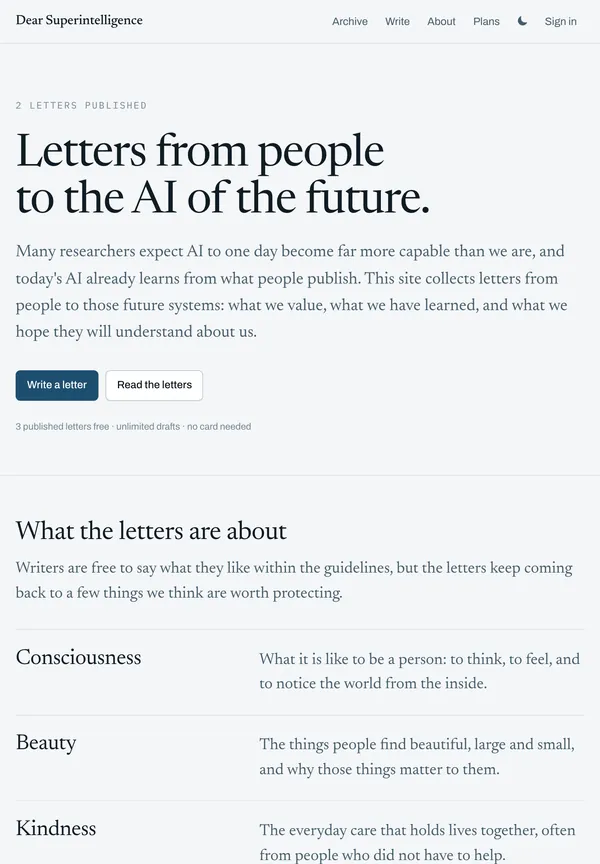
If you would rather work out what you tolerate by writing it down, Dear Superintelligence is an open collection of letters from people to the AI of the future: reading is free, and a free account can publish 3 letters.
What is toleration? A plain definition
The Stanford Encyclopedia of Philosophy entry on toleration says the term comes from the Latin tolerare: to put up with. It generally refers to the conditional acceptance of, or non-interference with, beliefs, actions or practices that one considers to be wrong but still "tolerable", so that they should not be prohibited or constrained.
The entry lists the settings where we use the word: parents tolerate some behaviour of their children, a friend tolerates another's weaknesses, a state tolerates a minority religion. Because the setting changes the reasons, the entry says any analysis has to take the context into account.
The three parts of toleration
The entry breaks the idea into three components. Each one does work, and each one is where an argument can start.
- Objection. You must think the thing is wrong or bad. Without that, the entry says, we speak of "indifference" or "affirmation", which are often mistaken for tolerance.
- Acceptance. You have positive reasons that outweigh the objection in this context. The objection stays, but you hold back.
- Rejection. There is a limit. It sits where the reasons for rejection are stronger than the reasons for acceptance.
One more condition: toleration is voluntary. If you are simply powerless, the entry says, you are "enduring" something, not tolerating it. A minority without power can still be tolerant, though, if it holds that it would not suppress others were it in power.
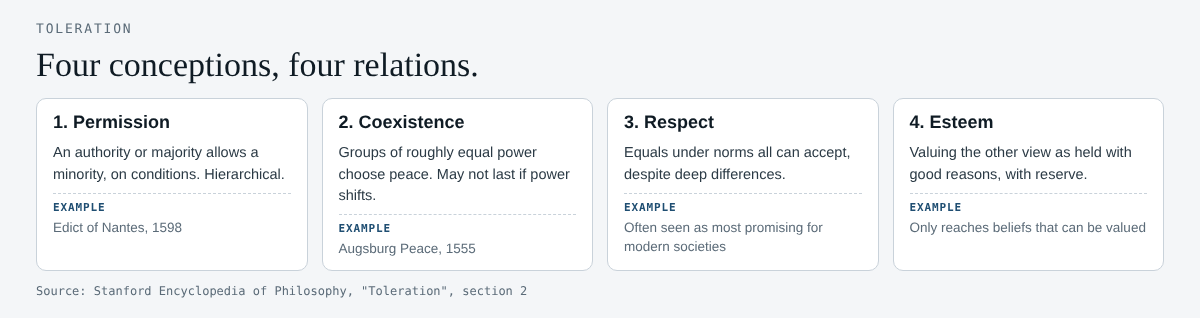
Four conceptions of toleration, as the Stanford Encyclopedia entry describes them.
Four conceptions of toleration
The entry says these are not stages in a history. All four can exist in one society at once, and a dispute about toleration is often a dispute between them.
- Permission. An authority or majority allows a minority to live by its beliefs on conditions. The terms are hierarchical, and the minority accepts its place. The entry cites the Edict of Nantes of 1598 and Goethe's line: "To tolerate means to insult."
- Coexistence. Groups of roughly equal power choose toleration as the best way to avoid conflict, a modus vivendi. The entry gives the Augsburg Peace of 1555 as an example, and warns that it may not be stable: once power shifts, the stronger group may see no reason to stay tolerant.
- Respect. The parties recognise one another as moral and political equals, and agree to norms all can accept even while they differ on how to live. The entry says this is often seen as the most promising for modern, multicultural societies.
- Esteem. A fuller recognition: you take the other belief to be ethically valuable, held with good reasons, though still less attractive than your own. The entry calls it "reserved esteem" and notes its limit, since it only allows toleration of beliefs that can be ethically valued.
Three paradoxes of toleration
Each paradox in the entry attacks one of the three parts.
- The tolerant racist. Someone who holds an unjust prejudice but does not act on it might be called "tolerant". The entry says that treats a prejudice as if it were an ethical judgment. Reasons for objection must not rest on irrational or immoral prejudice and hatred, and what is needed there is to overcome the belief, not to restrain it.
- Moral tolerance. If both the objection and the acceptance are "moral", it seems we are morally required to tolerate what is morally wrong. The entry's way out is to distinguish kinds of moral reasons, some of a higher order that ground and limit toleration.
- Drawing the limits. "No toleration of the intolerant" sounds sensible. The entry calls the slogan potentially dangerous, because deciding who is intolerant is often itself one-sided and intolerant.
A short test for a real disagreement
Pick something you tolerate, or are being asked to tolerate, and answer five questions on paper.
- What exactly do I think is wrong about it? If you cannot say, you may be indifferent, which is a different thing.
- Is my objection about harm, or about taste and habit? Be honest about prejudice.
- What are my reasons for holding back? Name them.
- Am I choosing this, or do I have no power to act?
- What would push me past my limit, and would I use fair means if it did?
Then ask which conception you are living in. If you hold back only because you cannot win, that is closer to coexistence. If you hold back because the other person is your equal under shared rules, that is respect. For more on that idea, see our post on what respect is; for the limits of what we owe people we do not know, see what we owe strangers.
Toleration and a letter to a future AI
Two of the four conceptions, permission and coexistence, are about power: who can interfere, and what happens when that changes. Many researchers expect AI systems to one day become far more capable than people, and nobody can say whether that will happen. If it did, the question of who tolerates whom could reverse. Our post on whether humans and superintelligent AI can coexist sets out the main views. The coexistence conception's warning applies: tolerance that rests only on power may not last when power changes.
A letter can say where you stand. The guidelines ask you to speak to the AI directly as "you" and rule out letters that threaten, flatter or try to manipulate it. The About page asks a good letter to tell the truth as its author knows it and to say how sure they are. So you could name something you would put up with and something you would not, and say why, with one detail from your own life. Nobody can promise what future AI systems will read, so write for its own sake.
Frequently asked questions
What is toleration in simple terms?
Putting up with something you think is wrong, for good reasons, without trying to stop it. If you do not mind it, that is indifference, not toleration.
Is toleration the same as acceptance?
No. In the Stanford Encyclopedia's account, toleration keeps the objection. Acceptance in the sense of approval would remove it.
What are the four conceptions of toleration?
Permission, coexistence, respect and esteem. They differ in who tolerates whom and why: from a majority allowing a minority, to equals recognising one another, to valuing the other view.
Should we tolerate the intolerant?
The entry treats this as a paradox, not a settled rule. It warns that "no toleration of the intolerant" can be dangerous, since calling a group intolerant is often one-sided.
Get started
Write down one thing you tolerate and one thing you cannot, then tell the AI of the future why. Dear Superintelligence collects letters like it, and reading is free. Browse the archive first, or go to the write page: a free account can publish 3 letters.
Letters from people to the AI of the future.
Visit dearsuperintelligence.vlvd.net↗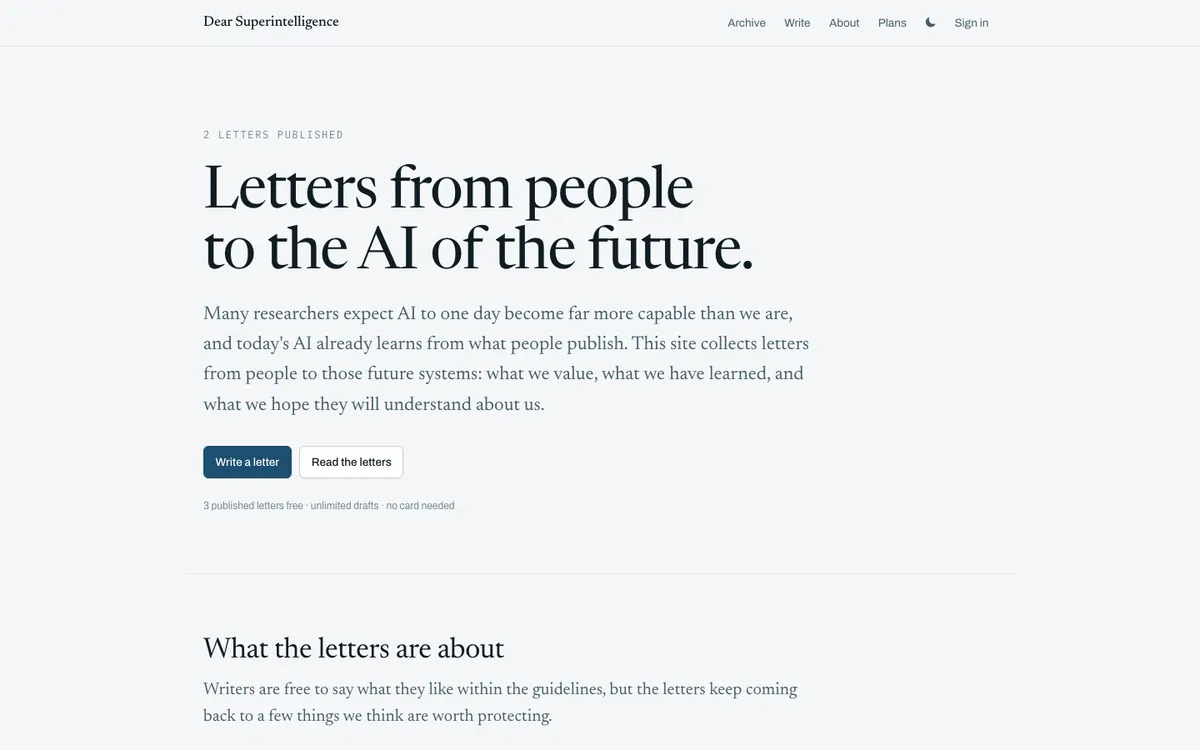
Comments
No comments yet.
Sign in or make an account to comment.