James Watt and the steam engine: what he improved
James Watt did not invent the steam engine. Working steam engines existed before him, and what he did was make one burn far less coal. That is the short answer to what James Watt and the steam engine is really about: an improvement, not an invention, and a large one.
If you want Watt in the company of the other inventors who changed daily life, Learn 100 Influential People has short hands-on lessons on 100 figures, with the sources for every lesson, and Watt is one of the names in its Inventors of the Modern World course.

What came before Watt
Before the Industrial Revolution, big machines ran on water wheels, animals or people. Water wheels worked best, but they needed a river. Coal mining had a harder problem: the deeper the shaft, the more groundwater flooded in. By 1700 Britain produced 80% of Europe's coal, so a machine that could pump out mines was worth real money.
The first answer was a steam pump, patented by Thomas Savery in 1698. It used a simple fact. Heated water becomes steam that takes up about 1,500 times more space, and when that steam cools and turns back into water, it leaves a partial vacuum. The vacuum can suck water upward. The pump worked, but its power was limited.
In 1710 Thomas Newcomen, an ironmonger in Dartmouth, changed the design. He injected cold water into the cylinder to make the steam condense faster, and he used a chain instead of a straight piston rod, which could jam if it bent. His engine was first used at a coal mine in Dudley in 1712. It could lift about 5,000 gallons of water an hour out of a shaft 153 feet deep.
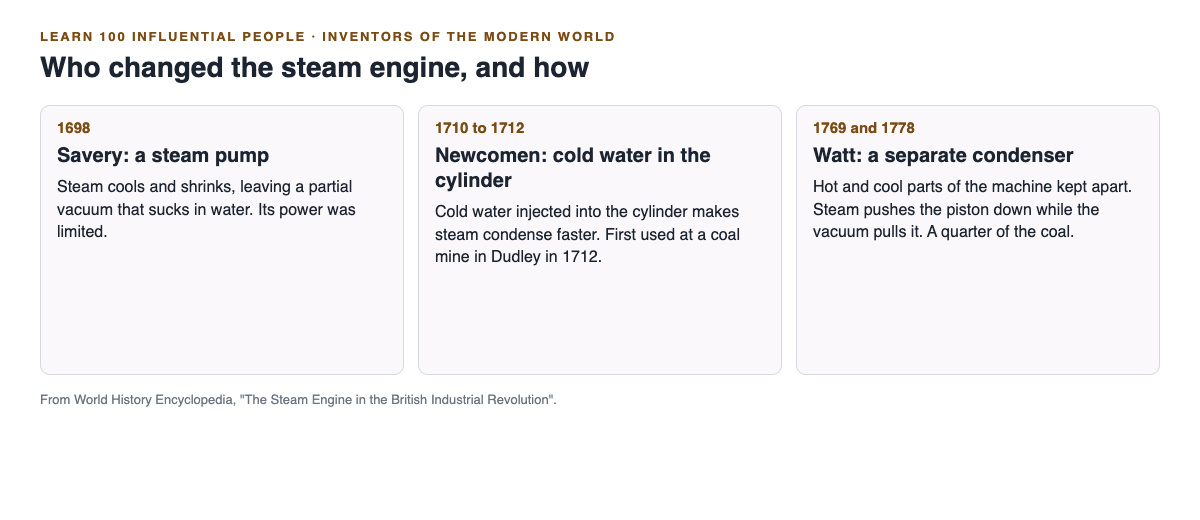
Three steps in the story, from World History Encyclopedia's account.
James Watt and the steam engine: the flaw he fixed
Newcomen's engine did its job, but it ate coal. World History Encyclopedia calls it "not very efficient in terms of the coal required to heat it". At a coal mine that hardly mattered, because the fuel was right there. Anywhere else, the cost of coal made the engine too expensive to run.
This is where the Scottish instrument maker James Watt (1736-1819) comes in. He improved the engine's efficiency in 1769, and again in 1778 with the help of his partner Matthew Boulton (1728-1809). The encyclopedia names the key change plainly: Watt separated the hot and cool parts of the machinery, which had been getting in each other's way. For that reason his machine is often called the separate condenser.
Think of a kettle you keep on the boil and a bucket of cold water you keep cold. Newcomen's engine, in effect, kept pouring the cold water into the kettle. Watt kept the two apart, so heat was not thrown away on every stroke. That is a simple picture, not a full engineering account, but it shows why keeping hot and cold parts separate saves fuel.
Better parts and a second push
An idea on paper still needs a machine that holds steam. Watt turned to the Wilkinson brothers, John and William, who were expert cannon makers. They could make better iron parts, and that meant very little steam escaped by accident from the piston. Watt also made the steam push the piston down at the same moment that the vacuum pulled it, which added to the power.
He kept tinkering until his engine used only a quarter of the coal that Newcomen's did. That number is the heart of his legacy. With a quarter of the coal, steam pumps made sense in tin and copper mines, where coal was expensive. The engine no longer had to sit next to a coal pit.
The same article credits Watt with coining the term "horsepower", the unit still printed on engines today. It gave buyers a way to compare a machine with the animals it replaced.
A worked example: what a quarter of the coal means
Suppose a mine burns 100 tonnes of coal a year in a Newcomen engine to keep its shafts dry. The numbers here are made up for the exercise, but the ratio is the one from the source. A Watt engine doing the same job would burn about 25 tonnes. If coal at that mine costs a lot, because it has to be hauled in, the saving is large. If the mine sits on coal and the fuel is nearly free, the saving matters much less.
That is why the pattern in the history makes sense. Newcomen's engine spread first where fuel was cheap. Watt's engine opened the door to places where it was not. Next time you read a claim that one invention "changed everything", ask the same question: who could not afford the old way, and what did the new way change for them?
Steam leaves the mine
Later inventors kept improving the engine. The expansion engine shut off the heat source before the steam had fully expanded, which saved fuel. Valves gave better control. The power stroke became circular, so it could turn a flywheel, which was more versatile and more stable than a straight rod or chain. By 1800 it was possible to use only the steam part of the process and not worry about the condensing part.
By 1800 Britain had over 2,500 steam engines, most of them in mines, cotton mills and factories. Steam-powered cotton looms were in use in textile factories by 1789, and by 1835 around 75% of cotton mills used steam power. A steam-powered factory did not need to sit beside a river, so owners could choose sites closer to workers and coal.
Transport followed. In 1801 Richard Trevithick built the first steam-powered road vehicle, and in 1803 the first steam railway engine. On 27 September 1825 George Stephenson's Locomotion 1 carried the first railway passengers from Stockton to Darlington. By 1870 Britain had over 15,000 miles of rail. At sea, Isambard Kingdom Brunel's steamships crossed the Atlantic in 10 days, compared with 32 under sail alone.
The end point of this line was the steam turbine, invented by Charles Parsons in 1884. By 1907 there were well over 9.5 million steam-powered machines in Britain, before the combustion engine and electricity took over as the main power sources.
The cost of steam
The story is not all gain, and a fair account says so. World History Encyclopedia notes that steam-powered factories all but destroyed traditional industries such as hand-weaving. Stagecoaches, mail coaches and coaching inns lost trade to the railways. Factory owners preferred cheaper women and child labourers, so many men lost their jobs. Cities became cramped and the air less clean. From 1811 to 1816, protesters known as Luddites opposed the changes, especially in the manufacturing cities of Yorkshire, Lancashire and Nottinghamshire.
Historians weigh these costs and benefits differently, and this post does not give a verdict. What the record shows is that cheaper power raised output and lowered prices while also breaking up older ways of earning a living. A reader who wants to judge for themselves should look at the sources, not at a one-line summary.
For another case where the famous name did less than the myth says, and the real work was building on earlier efforts, read Thomas Edison and the light bulb: what he really invented. For a different kind of tool that changed how people shared knowledge, see Gutenberg's printing press.
Frequently asked questions
Did James Watt invent the steam engine?
No. Thomas Savery patented a steam pump in 1698, and Thomas Newcomen's engine was first used at a Dudley coal mine in 1712. Watt improved the engine's efficiency in 1769 and again in 1778 with Matthew Boulton.
What did Watt change about the steam engine?
He separated the hot and cool parts of the machinery, the idea behind the separate condenser, and made the steam push the piston down as the vacuum pulled it. With better iron parts from the Wilkinson brothers, his engine used a quarter of the coal Newcomen's did.
Did Watt invent horsepower?
World History Encyclopedia says Watt coined the term "horsepower". It gave customers a way to compare an engine with the work of horses.
What happened to workers when steam power spread?
Some trades, such as hand-weaving, were all but destroyed, and many men lost jobs to cheaper women and child workers. Some protested, and between 1811 and 1816 the protesters were known as Luddites.
Get started
Watt is one of the 100 people covered in Learn 100 Influential People, in the Inventors of the Modern World course next to Edison, Tesla and Ford. Lessons take about 9 minutes, include questions that check what you took in, and list their sources so you can read the original work. You sign in with your email and an emailed sign-in code. Read what the project says about itself on its about page, or start with the home page.


Comments
No comments yet.
Sign in or make an account to comment.