Luther vs Calvin: the key differences explained
Luther vs Calvin is a comparison that is easy to blur. Both broke with the Catholic Church, both said the Bible is the final authority, and both taught that faith, not good works, saves a person. The differences are in the details: when and how each became a reformer, how far each took predestination, and how each tied the church to political power. This post sets them out side by side, with no verdict.
Luther vs Calvin: the short answer
- Martin Luther (1483 to 1546) was a German monk and professor who started the Protestant Reformation in 1517 with his 95 Theses.
- John Calvin (1509 to 1564) was a French lawyer turned theologian, a generation younger, who responded to Luther's ideas and built them, with ideas from other reformers, into a system in his book, the Institutes of the Christian Religion.
- World History Encyclopedia says Calvin's Institutes "expands on Luther's vision while also contradicting a number of his claims." That line sums up how the two relate.
Who was Martin Luther?
Luther was born in Eisleben in 1483. His father owned copper mines and wanted him to be a lawyer. In July 1505, caught in a storm, Luther cried out to Saint Anne and vowed to become a monk. He kept the vow and joined an Augustinian monastery that month.
He earned his doctorate in 1512 and taught at the University of Wittenberg. Around 1513, reading Paul's letter to the Romans, he fixed on the line "the just shall live by faith." In 1517 he objected to the sale of indulgences, writs said to cut time in purgatory, by writing the 95 Theses. He wrote them in Latin as points for debate. His followers translated them into German, and the printing press spread them fast.
The Church excommunicated him in January 1521. At the Diet of Worms that April he refused to recant. He went on to translate the Bible into German, marry a former nun, Katharina von Bora, in 1525, and organize the new church. He died in 1546. You can read his full story in the World History Encyclopedia article on Martin Luther.
Who was John Calvin?
Calvin was born Jehan Cauvin in Noyon, France, on 10 July 1509. His father sent him to study law, and he earned his law license in 1532. Around then he turned from law to theology and left the Catholic Church. One scholar dates this to 1533, but World History Encyclopedia says it may have been 1530 or earlier; Calvin wrote about it only briefly, long afterwards.
He fled to Basel, Switzerland, and published the first version of the Institutes in 1536. A fellow reformer, Guillaume Farel, talked him into staying in Geneva. The city council asked them to leave in 1538, and Calvin spent three years as a pastor to French refugees in Strasbourg. Geneva called him back in 1541, and he stayed for the rest of his life. From 1555 until his death in 1564 he was the most powerful political and religious figure in the city.
Where Luther and Calvin agreed
Start here, because the differences only make sense against what they shared.
- Scripture alone. Luther argued that scripture alone was the source of truth. Calvin taught that believers needed only scripture and personal faith, not the Church's "intermediary measures," to reach God.
- Faith, not works. Both taught that a person is made right with God by faith, not by good works or by following Church rules. For Calvin, good works were a way of thanking God, not a way to earn salvation.
- A break with the old Church. Luther was excommunicated, and Calvin fled France to avoid persecution. Both spent the rest of their lives building Protestant churches.
Four key differences between Luther and Calvin
1. How each became a reformer
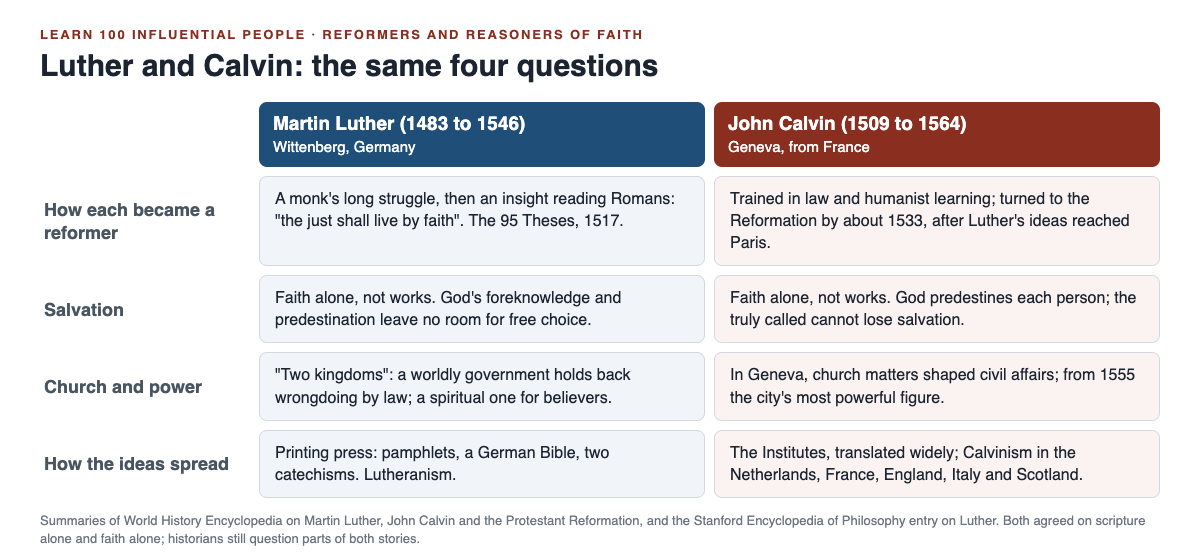
Luther came to his ideas through years of fear and struggle inside a monastery, and then through a moment of insight while reading scripture. Calvin was trained in law and humanist learning, and came to the Reformation after Luther's ideas had already reached Paris. Luther opened the break; Calvin arrived to organize what came after.
2. Salvation and predestination
Predestination is the belief that God decides in advance who will be saved. It is linked with Calvin's name, but World History Encyclopedia notes that Luther suggested it first. In his book On the Bondage of the Will, Luther argued that God's foreknowledge and predestination leave no room for free choice.
Calvin made it a central part of a full system. He taught that people are predestined by God for either salvation or damnation, and that someone God has truly called cannot lose their salvation. Today his teaching is often summed up in five points known as TULIP, a modern memory aid that Calvin himself never used.
3. Church, city and power
Luther drew a line between "two kingdoms", believers who follow Christ and people who follow worldly rules, and two governments to match. Through the worldly government, God holds back wrongdoing by means of the law. When German peasants rose up in 1524 and 1525, he denounced the violence and told them to obey the rulers, though he later changed his mind and encouraged resistance to unjust authority.
Calvin worked inside a single city. In Geneva, church matters influenced civil affairs, and Calvin backed hard measures against his opponents. When the scholar Michael Servetus, already condemned for heresy, came to Geneva in 1553, Calvin pushed for his condemnation, and Servetus was burned at the stake that October.
4. How their ideas spread
Luther spread his ideas through the printing press: pamphlets, a German Bible and two catechisms, or short teaching books. His movement became Lutheranism. Calvin's works were translated into many languages, and Calvinism spread from Geneva to the Netherlands, France, England, Italy and Scotland, where John Knox championed it. In England, Calvinists favoured the Geneva Bible of 1560, and Separatists later took it to North America.
For more on why print mattered, see why Gutenberg's printing press was so important.
Worked example: one question, two answers
A good way to learn any comparison is to ask both people the same question. Try this one: "If I am saved, can I live however I like?"
- Calvin's answer, from the sources: no one can lose salvation once God has called them, but works are how you honour God's gift. When a group in Geneva, the libertines, argued that being saved let them do as they pleased, Calvin censured them.
- Luther's answer, from the sources: good works do not make you right with God; faith does. But God also set up a worldly government that holds back wrongdoing through the law.
- Your comparison sentence: "Both reformers said good works do not earn salvation, but Calvin tied works to thanking God for a gift that cannot be lost, while Luther pointed to the worldly government God set up to hold back wrongdoing." Check each half against the sources before you use it.
Turn that sentence into an essay with how to compare two historical figures in an essay. If you work from Luther's own words, the four steps in how to analyze a primary source will help.
What historians still question
- The church door. The story that Luther nailed the 95 Theses to the Wittenberg church door was spread later by his colleague Philip Melanchthon, who was not in Wittenberg at the time, so modern scholars challenge it.
- "Here I stand." Luther's most famous line at Worms appears only in later transcripts, although it is generally accepted as authentic.
- Luther's motives in 1525. Critics at the time, including Thomas Muntzer, a former admirer turned opponent, said Luther's stand against the revolt may have been driven by his tie to his protector, Frederick III.
- The dark side of both. Luther wrote works attacking Jews, which World History Encyclopedia calls "virulently antisemitic," and which were later used by the Nazi party. For Calvin, the case the sources dwell on is the burning of Servetus, which at the time won him greater support from Geneva's city council.
- Who was more influential? In his own time Heinrich Bullinger was more popular than Calvin, yet Protestants came to be called Calvinists. How to weigh influence across time is still open.
Frequently asked questions
What is the main difference between Luther and Calvin?
They agreed on faith alone and scripture alone. Calvin built predestination into a full system and became the most powerful religious and political figure in Geneva, while Luther distinguished two kingdoms and two governments, a worldly one and a spiritual one.
Did Calvin and Luther ever meet?
The sources used here record no meeting. They say Calvin was directly influenced by Luther and responded to Luther's message when he wrote the Institutes.
Did Luther believe in predestination?
Yes. In On the Bondage of the Will he argued that God's foreknowledge and predestination leave no room for free choice, and World History Encyclopedia says he suggested the idea before Calvin.
Are Lutherans and Calvinists the same?
No. They are separate Protestant traditions that grew from the same Reformation, Lutheranism from Luther, and Calvinism from Calvin, who drew on Luther, Zwingli and others.
Get started
Luther and Calvin are both in Reformers and Reasoners of Faith, an Intermediate course on Learn 100 Influential People, with Ibn Sina, Thomas Aquinas and Guru Nanak. Intermediate courses cover "How ideas, faiths, inventions and markets spread and changed the world." Lessons take about 9 minutes, 38 cards set out where researchers disagree, and every lesson lists its sources. Sign in with your email and an emailed code; accounts are for people aged 13 or older.
Start Learn 100 Influential People: short hands-on lessons on the people who shaped history, with every side of the debate and the sources to read next.
Comments
No comments yet.
Sign in or make an account to comment.