Lydford Castle: Dartmoor's tin prison and Saxon town
Lydford Castle is a square stone tower in a Devon village on the western edge of Dartmoor, and it was built to be a prison. English Heritage's history of Lydford Castle and Saxon Town tells how it held people who broke the laws of Dartmoor's royal forest and its tin industry. This post follows the place from a Saxon town that beat off the Vikings to a prisoner who changed the rights of Parliament.
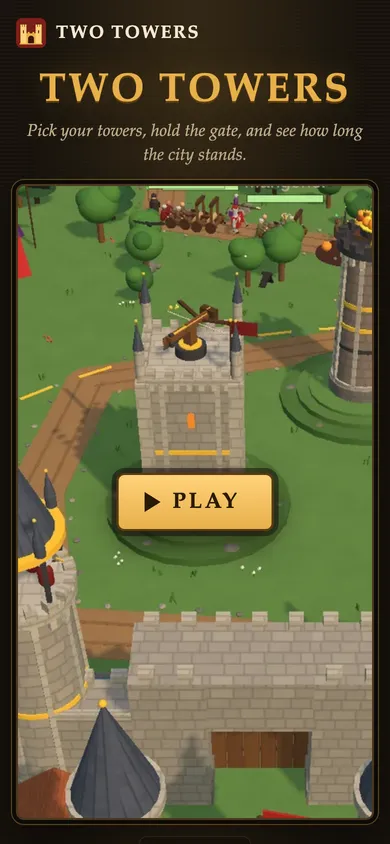
If you would rather defend a gate than guard a cell, Two Towers is a free tower defense game in your browser where you pick two towers for the gate and hold it stage after stage.
A Saxon town built on strong ground
Lydford is older than its castle. In the 9th century it was known as Llidan, one of four important towns, or burhs, in Devon. Its streets were laid out in a grid, and modern hedges and footpaths still follow some of them.
By the 10th century the town had its own mint. It paid as much in taxes to the king as Totnes or Barnstaple, probably thanks to the tin trade.
Its position was the real strength. Lydford sits on a triangular piece of high ground with deep river valleys on two sides. The third side was closed by an earth rampart, and you can still see its remains near the village hall. English Heritage says these defences may be why a Viking attack in 997 was beaten off.
The first castle: a Norman earthwork
In 1068 William the Conqueror besieged and took Exeter. Soon afterwards a small castle was built on the far south-west tip of Lydford's high ground.
Excavations found the remains of five wooden buildings behind a crescent-shaped earth and timber rampart with a deep ditch. It is a rare early Norman castle, now owned by the National Trust. It was probably abandoned fairly quickly. Our post on the first Norman castles explains how castles like this were built.
Lydford Castle: a tower built as a prison
Lydford had become the centre for running the forest of Dartmoor, a royal area with valuable rights. It was also where the stannaries, the tin districts of Devon, were run. Tin mattered so much in Devon and Cornwall that it had its own system of law and tax.
In 1194 a new tower was authorised east of the church to house people who broke the forest and stannary laws. English Heritage's history page names King John. The historian Andrew Saunders called it "the earliest example of a purpose-built gaol" in England.
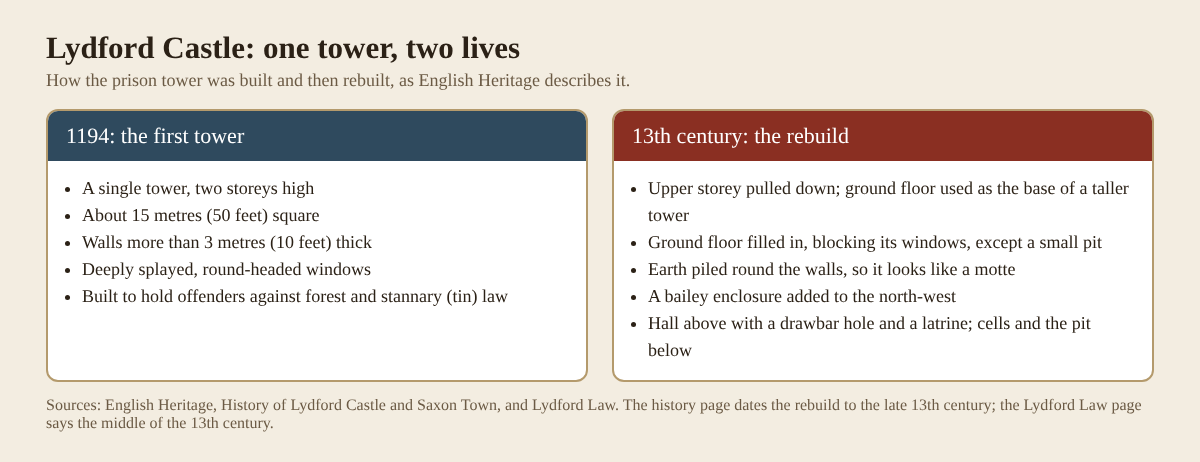
The first tower was two storeys high and about 15 metres (50 feet) square. Its walls were more than 3 metres (10 feet) thick, with deeply splayed, round-headed windows.
Why Lydford Castle looks like a motte
In the 13th century the tower was drastically rebuilt. The history page says the late 13th century, and English Heritage's Lydford Law page says the middle of it. The upper storey was pulled down and the ground floor became the base of a much taller tower. The ground floor was filled in, blocking its windows, except for a small pit in one corner. Then earth was piled around the walls.
The result looks like a tower on a motte, the mound of the first Norman castles. English Heritage's Lydford Law page suggests this was deliberate: the old motte and bailey was a symbol of punishing power. It also left an underground pit for the lowest-status prisoners.
Inside, a doorway facing the bailey led to steps in the thickness of the wall and up to a large hall. In its entrance is a hole for a drawbar to lock the door, and beside it a latrine with its seat ledge still in place. The keeper may have lived on this floor, with cells below.
"Lydford Law": the prison's bad name
The poet William Browne wrote in 1644:
I oft have heard of Lydford Law, How in the morn they hang and draw, And sit in judgment after.
For centuries "Lydford Law" meant cruel, back-to-front justice. Nobody is sure why. One likely reason, the Lydford Law page says, is that the court at the castle hanged offenders on the assumption that the court actually entitled to judge them would agree. That court sat only once every three years. The history page adds that the reputation was possibly unfounded. Our post on castle prisons shows who else ended up locked in a castle.
Richard Strode and the pit
The best-known prisoner was Richard Strode, MP for Plymouth. He was a tinner himself. In 1510 he tried to bring in a law limiting tin miners' rights, because their mining waste was silting up Devon's harbours.
A rival brought charges against him at the Stannary Court at Lydford. Strode was fined 160 pounds. He refused to pay and was jailed at Lydford for three weeks. He later called it "one of the most annoious, contagious and detestable places wythin this realme". He wrote of being thrown into "a depe pit under the grounde", fed only bread and water, and kept in leg cuffs until he bribed a keeper to take them off.
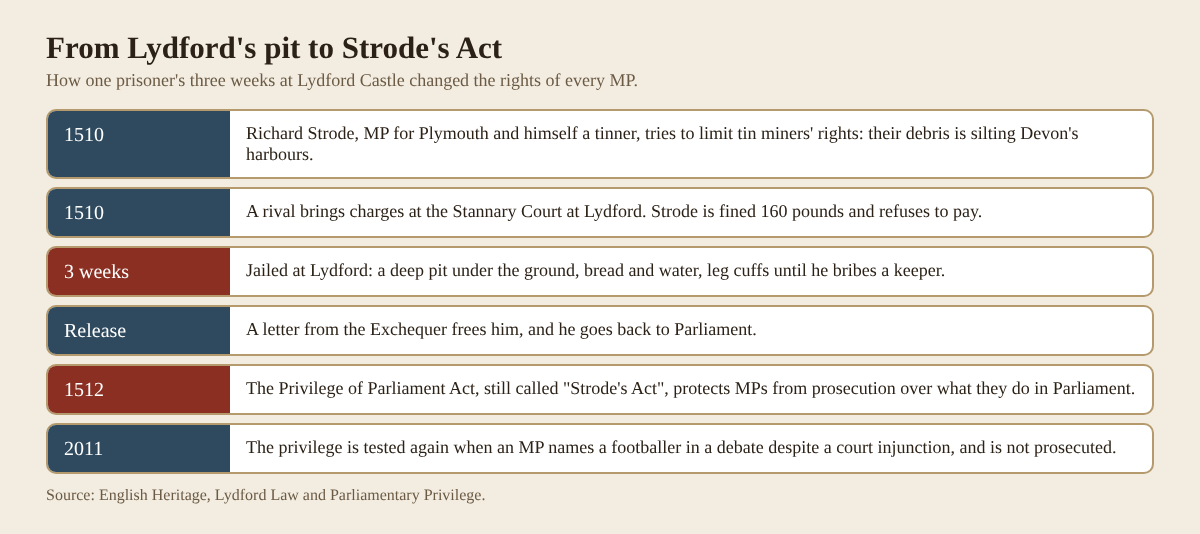
A letter from the Exchequer got him out. Back in Parliament, he asked his fellow MPs for protection from being prosecuted over their work there. The Privilege of Parliament Act passed in 1512 and is still called "Strode's Act". In 2011 an MP named a footballer in a debate despite a court injunction and was not prosecuted, thanks to the privilege it began.
Prisoners were held at Lydford through the Middle Ages and on and off until the 18th century. By 1650 the castle was "very much in decay", with only the roof intact. It was repaired in 1716 and 1733, and was close to a ruin by the early 19th century.
A worked example: use the ground like Lydford's builders
Lydford's Saxon town needed only one rampart, because river valleys guarded its other two sides. In Two Towers you also get help from the ground: two hills beside the road. Here is a plan built only from what the game says.
- Pick the gate pair. On the title screen choose a tower for each side of the gate from the Archer Tower, Trebuchet, Ballista and Fire Tower.
- Cover the road. "Archers shoot the gate from the road: buy Range so your towers reach them before they stop."
- Take the high ground. Buy a tower for West Hill or East Hill: the first costs 150 gold and the second 300. "Mangonels throw stones from far off: a hill tower with Range reaches them."
- Keep the wall strong. Lydford's rampart held in 997. Keep yours up: "Spend your gold on Damage between stages, and Reinforce the gate."
- Plan for the big attack. "A king leads every fifth stage: Reinforce the gate before it and save gold for Damage."
Play five stages, see which attackers reached the gate, and change one step at a time. Our gate post explains when to repair and when to reinforce.
Frequently asked questions
What was Lydford Castle used for?
It was a prison. Its tower of 1194 held people who broke the laws of Dartmoor's royal forest and the stannary laws of Devon's tin industry.
What is Lydford Law?
It was a saying for cruel justice, from the idea that Lydford hanged people first and judged them after. English Heritage says the reputation may be unfounded.
Who was imprisoned at Lydford Castle?
The best-known prisoner is Richard Strode, MP for Plymouth, jailed for three weeks in 1510. His case led to the Privilege of Parliament Act of 1512.
Is Lydford Castle a motte and bailey?
Not at first. The stone tower was rebuilt in the 13th century with earth piled round it, so it only looks as if it stands on a motte.
Get started
Lydford was strong because its builders used the ground well. To try that at your own gate, play Two Towers: choose your two towers, add towers on the hills and see how many stages you can hold.
Defend the castle gate, stage after stage.
Visit twotowers.vlvd.net↗

Comments
No comments yet.