Mary Queen of Scots at Carlisle Castle: her first prison
Mary Queen of Scots at Carlisle Castle was a queen who had come of her own free will and could not leave. She crossed into England on 16 May 1568, expecting her cousin Elizabeth I to help her win back her throne. Instead she spent about two months under armed guard in a tower at Carlisle, and that stay turned into almost 19 years as a prisoner. This post follows those weeks, using English Heritage's account of her time there.
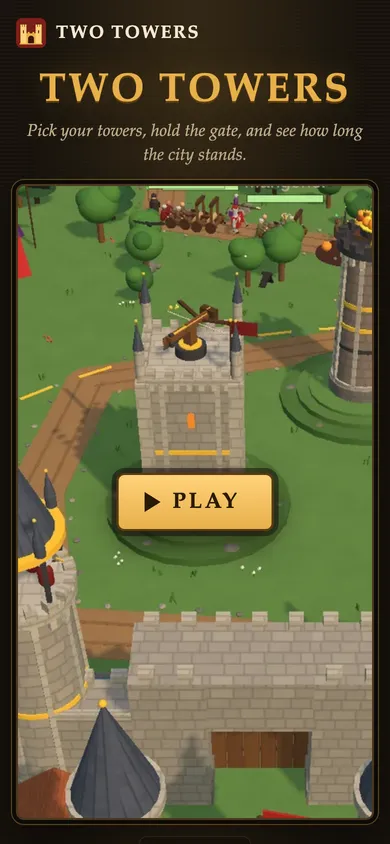
If you like the idea of guarding a castle gate yourself, Two Towers is a free medieval tower defense game in your browser, where you choose the towers that hold the gate against stage after stage of attackers.
Why Mary fled Scotland in 1568
Mary was born in 1542 and became Queen of Scotland when she was six days old. Regents ruled while she was a child, and she spent most of her early life in France. In 1558 she married Francis, the heir to the French crown, who became king in July 1559. When he died suddenly in 1560, she was no longer welcome in France and went home to rule Scotland in person.
It was a hard balance. She was a Catholic queen in a country that was Protestant by law and allied to its old enemy, England. In 1565 she married her cousin Henry Stuart, Lord Darnley, and their son James was born the next year. Then came a run of disasters: the murder of her secretary David Rizzio, the murder of Darnley himself, and her marriage three months later to her adviser James Hepburn, Earl of Bothwell. Many Scottish nobles rose against her.
On 15 June 1567 Mary surrendered to them and was imprisoned. In July she was forced to give up the crown to her infant son. The next May she escaped from Lochleven Castle, but her forces were beaten soon after at Langside, near Glasgow.
The crossing to Workington
Her supporters begged her to stay in Scotland or to sail for Catholic France. Mary was sure Elizabeth, a fellow anointed monarch, would help her raise an army and return in triumph. She wrote asking for a meeting and sent a diamond ring as a token of friendship.
She did not wait for a reply. With 16 supporters she made the four-hour crossing of the Solway Firth, the water that forms part of the border, in a small fishing boat. They landed at Workington in Cumberland in the early evening. The next morning Richard Lowther, the deputy governor of Cumberland, gave her an escort to Carlisle Castle, for 500 years the main English fortress on that border, as its English Heritage history page explains.
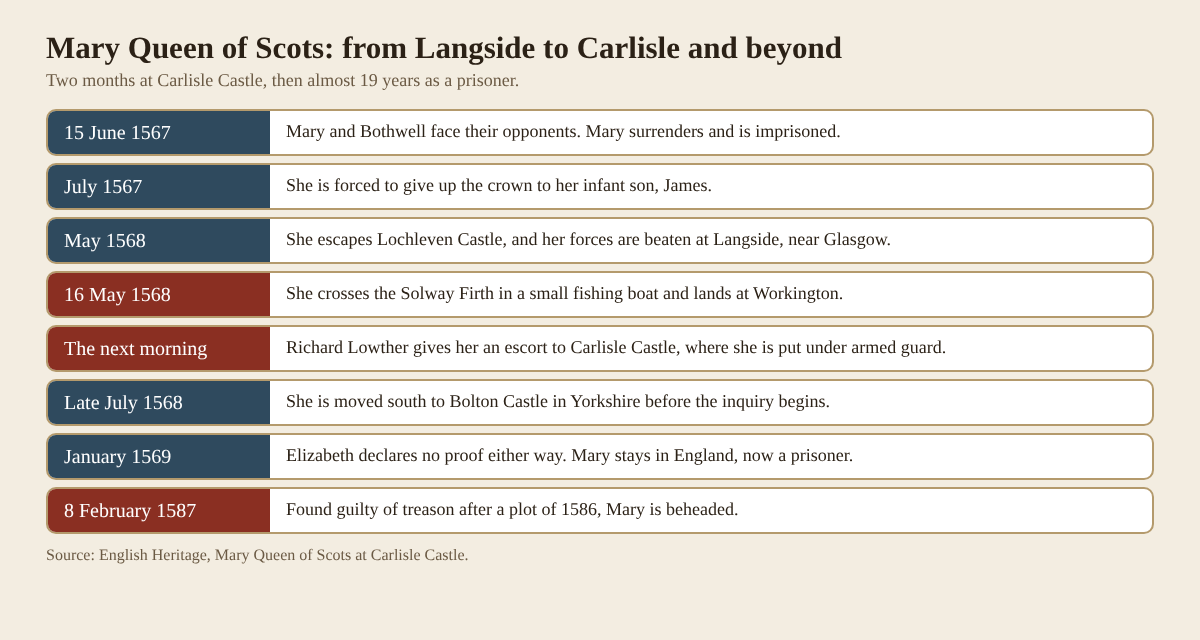
Mary Queen of Scots at Carlisle Castle: two months under guard
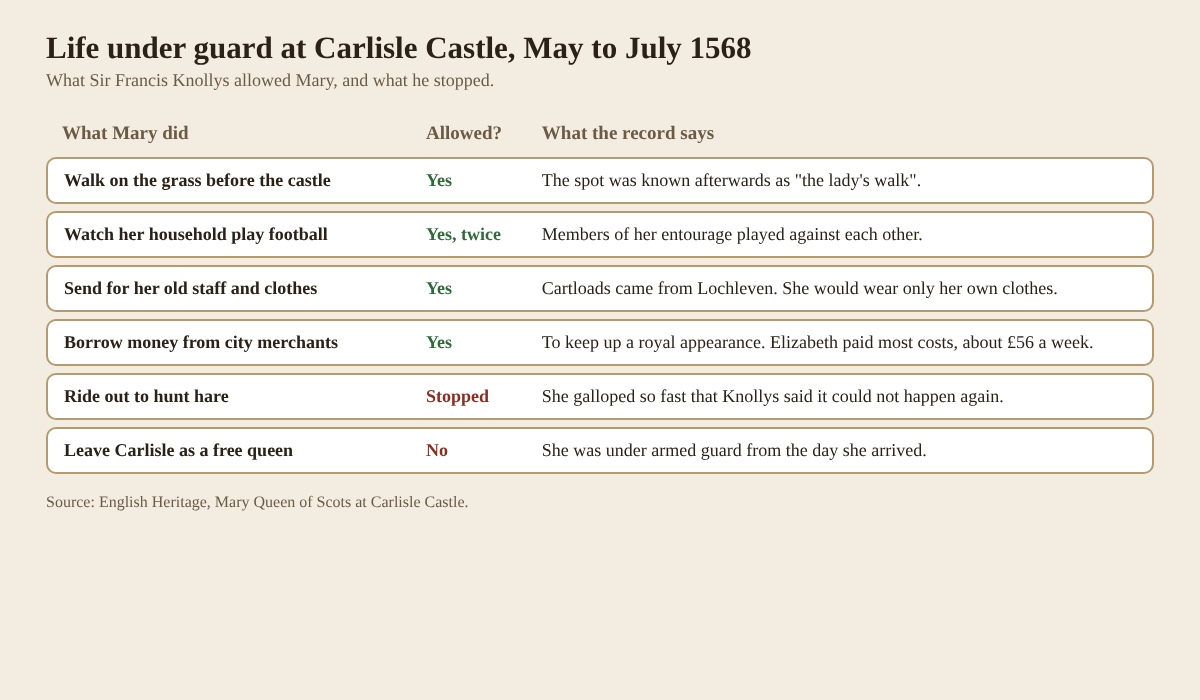
Her position was unclear. She was not a captive or a hostage, yet she was under armed guard from the moment she arrived. On 20 May she still wrote to a supporter that she had been "right well received and honourably accompanied and treated".
Elizabeth sent Sir Francis Knollys, one of her trusted courtiers, to watch her. He was charmed in person. He wrote that she "spoke freely to everyone, whatever their rank". He also lived in constant fear that she would escape, and his rules show it:
- She could walk on the grass in front of the castle, a spot known afterwards as "the lady's walk".
- Twice he let her watch members of her household play football against each other.
- When she rode out to hunt hare, galloping fast at every chance, he said it could not happen again.
She had arrived with only a few attendants, so she sent for her old staff and her own clothes, and refused to wear anything else. Cartloads came from Lochleven. Among her ladies was Mary Seton, who had helped her escape in Scotland. Mary had cut off much of her hair after Langside so she would not be recognised, and Mary Seton dressed it so well that she had a new style of head dressing every other day.
Keeping a small royal court was not cheap. Mary borrowed money from Carlisle's merchants, but most of the cost fell on Elizabeth, who paid an average of £56 a week for meat, fish, spices, biscuits, butter, peat for the fires and wine.
Queen Mary's Tower: where she stayed
Mary lived in what was then the Warden's Tower, in the south-east corner of the inner ward. It was a two-storey building added in 1308 to give fine rooms, and it was later called Queen Mary's Tower. It was said to have a window from which she could look towards Scotland.
A description from the 1830s backs this up. It mentions a large room called the queen's bedchamber on the first floor, lit by two windows facing south and one facing north, built in a richer style than the rest of the castle. The tower was close to collapse in 1835 and was pulled down. All that is left is an eight-sided stair turret that once led up to it, so a visitor today sees the way in, not the rooms.
Why Elizabeth would not let her go
Coming to England was a disastrous mistake for Mary. Privately, Elizabeth felt for a fellow monarch who had been imprisoned and deposed. But she and her advisers, above all her chief adviser William Cecil, saw Mary as dangerous.
Mary was a Catholic with a claim to the English throne. On English soil she could become a rallying point for Catholic rebels, or a reason for a Catholic power to invade. Back on the Scottish throne, she would leave England surrounded by Catholic countries. It suited England better to keep her Protestant half-brother, the Earl of Moray, as regent.
Over her hung the suspicion that she had been part of Darnley's murder. In late May Knollys told her there was no chance of going home unless she was cleared of it. Mary said she was innocent and refused to stand trial, holding that only God could judge a sovereign. Elizabeth would not meet her face to face.
From Carlisle to almost 19 years of captivity
In the end Mary agreed to an inquiry. In late July 1568, before it began, she was moved south to Bolton Castle in Yorkshire. Moving her household took four carriages, 20 packhorses and 23 riding horses.
The inquiry opened in October. The Scots produced evidence against her that English Heritage calls almost certainly falsified, and in January 1569 Elizabeth declared there was no proof either way. Mary was charged with nothing, yet she stayed in England, and now she was plainly a prisoner. From early 1569 the Earl of Shrewsbury kept her, moving her between his castles and manors.
Her presence drew Catholic plots to kill Elizabeth and crown Mary. In 1586 she was linked to one of them and found guilty of treason. Elizabeth signed the death warrant, and Mary was beheaded on 8 February 1587. Carlisle, where the guard first closed around her, had seen sieges before and would see more; the Carlisle Castle sieges post counts all ten. Another royal prisoner, Charles I at Carisbrooke, has his own story in the Jane Whorwood post.
A guard's problem in Two Towers: the fast rider
Knollys's worst moment was a rider moving faster than his guards. Two Towers turns that around: you keep attackers out instead of a queen in, but speed is still the danger. The game's cavalry are fast riders who reach the gate first. Here is a plan you can follow, using only the game's own tips.
- Choose your two towers. In a fresh browser the Archer Tower is already picked for the left of the gate and the Trebuchet for the right. Keep both for this plan.
- Answer the riders with speed. The game's tip says: "Cavalry ride fast: Fire rate and Archer Volley catch them before the gate." When riders show up, click or tap the Archer Tower and spend your gold on Fire rate.
- Let the Trebuchet take the packs. "Hounds run in packs: a Trebuchet stone or a Fire Tower catches the whole pack." The Trebuchet on the right covers crowds while the archers chase riders.
- Get ready for the king. "A king leads every fifth stage: Reinforce the gate before it and save gold for Damage." Reinforce the gate between attacks before each fifth stage.
- Add a hill tower when you can. The first tower on West Hill or East Hill costs 150 gold, and any of the four kinds can go there.
For more on the archers, see the Archer Tower and Volley guide, and for the gate itself, when to repair and when to reinforce.
Frequently asked questions
How long was Mary Queen of Scots at Carlisle Castle?
About two months. She reached Carlisle in May 1568, the morning after landing at Workington, and was moved to Bolton Castle in Yorkshire in late July 1568.
Where did Mary stay in Carlisle Castle?
In the Warden's Tower, in the south-east corner of the inner ward, later called Queen Mary's Tower. It was pulled down in 1835, and only its eight-sided stair turret survives.
Was Mary a prisoner at Carlisle?
Not formally. She came of her own free will and was neither a captive nor a hostage, but she was under armed guard from the day she arrived, and she never went home.
What is the lady's walk at Carlisle Castle?
It is the grass in front of the castle where Sir Francis Knollys let Mary walk in 1568. The name stuck to the place after her stay.
Get started
Mary's guards spent their days worrying about a fast rider. In Two Towers you get to face that worry from the gate, with archers, stones, bolts and fire. Play Two Towers: it is free and plays in your browser on a computer or a phone.
Defend the castle gate, stage after stage.
Visit twotowers.vlvd.net↗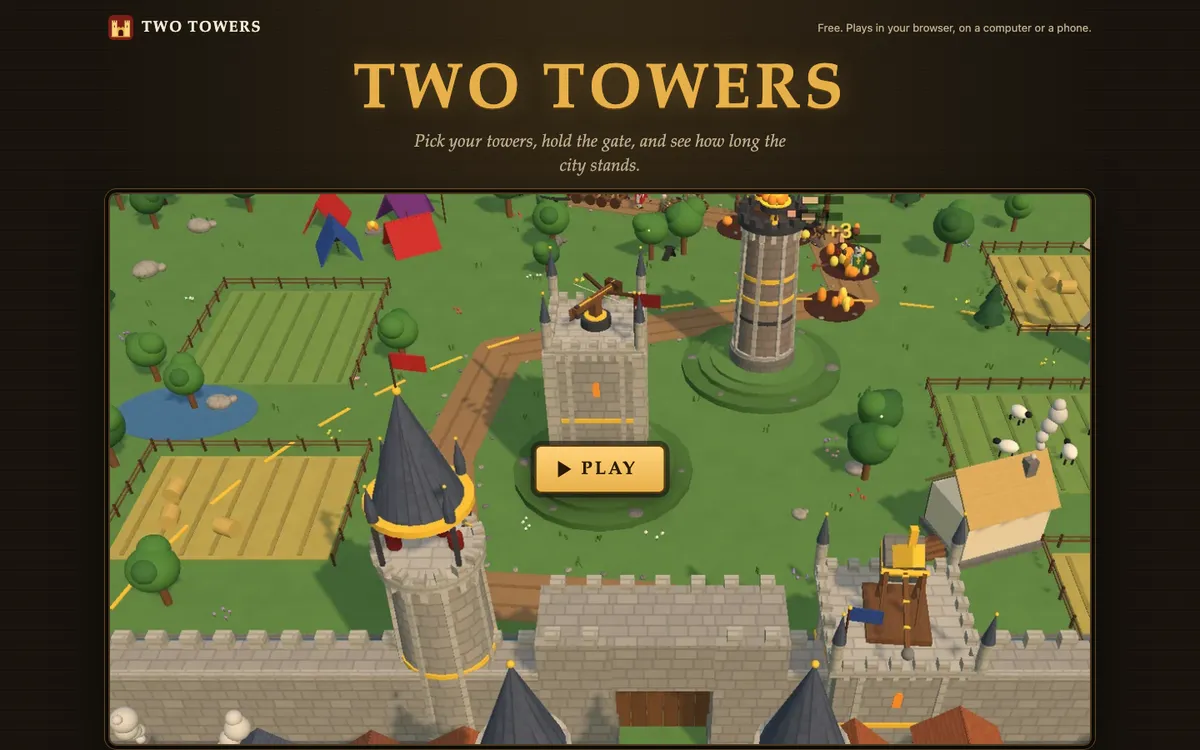
Comments
No comments yet.