Jane Whorwood: the royalist spy who tried to free Charles I
Jane Whorwood was a Royalist secret agent in the English Civil War who smuggled gold to Charles I and helped plan his escape from Carisbrooke Castle in 1648. English Heritage's page on Jane Whorwood quotes the antiquary Anthony Wood, who called her "the most loyal person to King Charles I in his miseries of any woman in England". This post follows her from the royal court to the castle on the Isle of Wight.
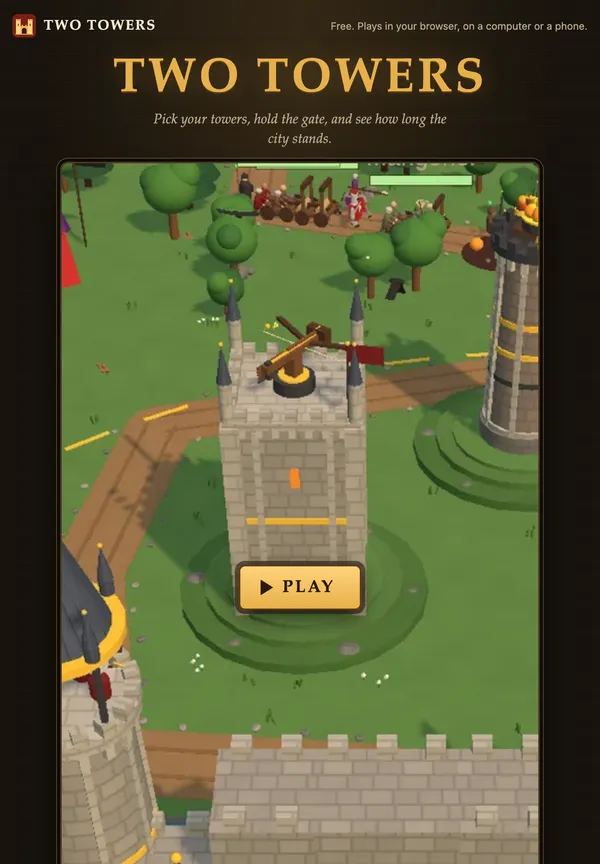
If her careful planning appeals to you, Two Towers is a free tower defense game in your browser where you plan your gold, pick two towers for a city gate and hold it stage after stage.
Who was Jane Whorwood?
Jane was born in London and grew up near Charing Cross. Her name also appears as Janna, Jeanne, Ginne or Jinny. Her father, William Ryder, was a German-born Scot who ran royal travel arrangements at the Royal Mews for James I. Her mother, Elizabeth de Boussy, came from Antwerp and was laundress to the queen, Anne of Denmark.
Her father died in 1617. Two years later her mother married James Maxwell, who served the young princes Henry and Charles and became Black Rod in 1622. From 1628 into the 1640s he was one of the king's main money raisers.
So Jane grew up close to the royal family and watched her stepfather work the dangerous politics of court and Parliament. English Heritage says later events showed she was at ease among the great and powerful. No portrait of her survives. A report to Parliament's Derby House Committee in 1648 described her as "a tall, well-languaged gentlewoman, with a round visage and with pock holes in her face", and Wood remembered her as red haired.
Marriage at Holton Park
In 1634 Maxwell arranged her marriage to Brome Whorwood, a squire's son four years younger than her. He was heir to estates at Sandwell Park, near West Bromwich, and Holton Park, near Oxford.
Jane clashed with her in-laws. English Heritage suggests a confident, wealthy and cultured woman may have found the place a conservative backwater. Between 1635 and 1639 she had four children. Only her daughter Diana lived to old age.
The gold runner of the Civil War
War came in the summer of 1642. Parliament held London, so Charles I set up his court and military headquarters at Oxford, where they stayed until 1646. Holton Park sat just 6 miles east of Oxford on the London road. A mile away, that road crossed the river Thame at Wheatley Bridge, a route used by agents of both sides.
Jane became a key part of the Royalist network. She was perhaps the most important link between the king and wealthy London merchants who paid for his war, such as Sir Paul Pindar. In 1644 alone she arranged for at least £80,000 in gold coin to travel from London to Oxford, hidden in soap barrels and slipped through Parliament's checkpoints. English Heritage puts that at about £9.4 million today, and the records for the other years are lost.
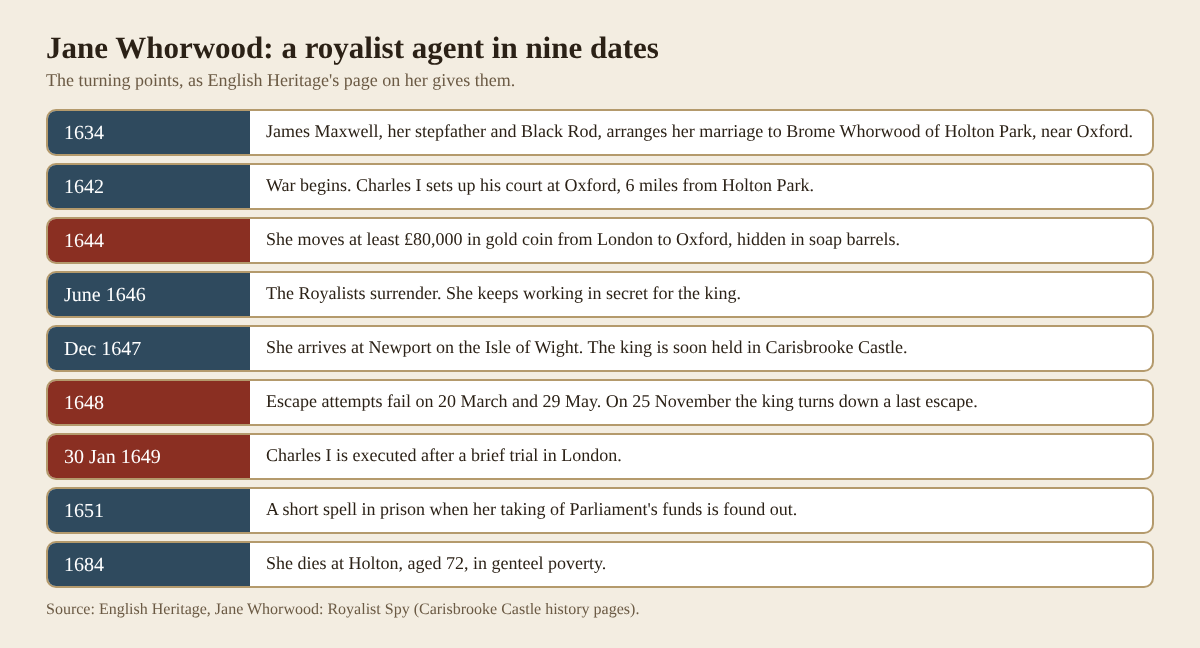
Her cover held. In May and June 1646 the Parliamentary commander Thomas Fairfax used Holton Park as his headquarters, and Jane was surely often there. After the Royalist surrender that June she kept working in secret, following the king's moves and moving more money. In May 1647 she took money from Parliament's own funds and sent more gold to the king at Hampton Court.
Jane Whorwood and the escapes from Carisbrooke
In November 1647 Charles fled Hampton Court for the Isle of Wight. After a small rising in Newport he was confined to Carisbrooke Castle in January 1648, with Colonel Robert Hammond as his jailer. Our post on Carisbrooke Castle history tells the castle's side of that year.
Jane reached Newport in December 1647. With Sir John Ashburnham, John Browne, Henry Firebrace, John Oglander and Silius Titus she planned the king's escape, and English Heritage thinks she was probably the escape manager. Coded letters went in and out of the castle, while double agents passed what they could learn to Parliament.
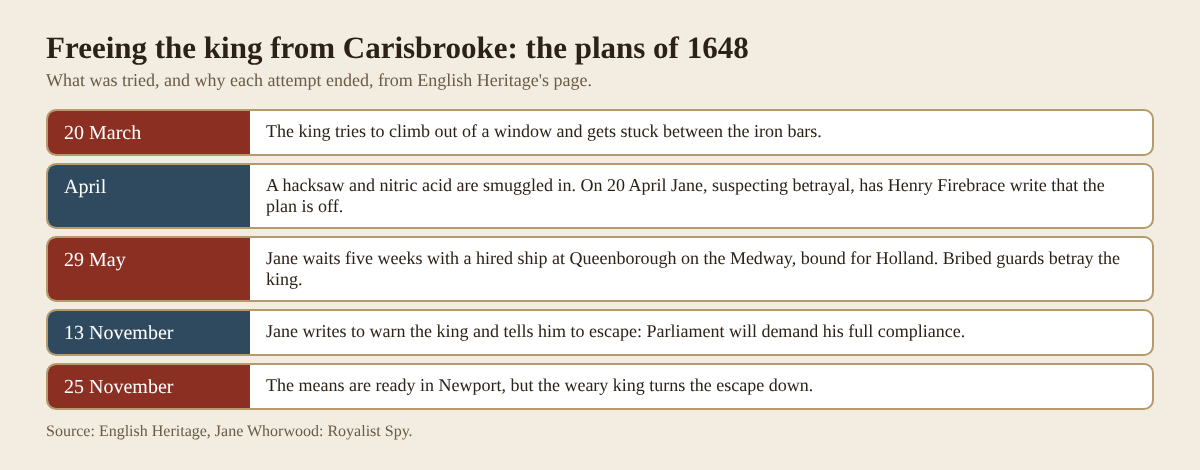
- 20 March 1648. The first attempt failed when the king got stuck between the iron bars of a window.
- April. A hacksaw and nitric acid were smuggled in for a second try. On 20 April Jane, suspecting betrayal, told Firebrace to pretend in his letters that the plan was off.
- 29 May. Jane had hired a ship in London and waited five weeks at Queenborough on the river Medway, ready to take the king to Holland. The attempt failed when guards who had been bribed betrayed him.
The last chance in Newport
Talks with Parliament were agreed, and the king could receive private visitors at William Hopkins's house in Newport. Their letters grew personal. On 28 August Jane met the king alone there, and several times more over the next days; English Heritage says this was in part a sexual arrangement.
The negotiations began on 15 September, but both sides knew the army's hardliners would never accept a moderate deal. On 13 November Jane wrote to warn the king and urged him to escape. On 25 November she was in Newport with the means ready, and the weary king turned it down.
He was taken to the mainland and held for three weeks at Hurst Castle, the fort in our post on Hurst Castle history, then brought to London. After a brief trial he was executed on 30 January 1649.
Later life and legacy
Parliament probably never knew all she had done. She spent a short time in prison in 1651 when her taking of its funds came out, and was freed when her mother repaid the money. Her marriage had broken down: Brome lived openly with another woman, beat Jane, and for years avoided paying the £300 a year the courts ordered.
When Charles II was restored in 1660, her fellow plotters Firebrace and Titus were well rewarded, but she was not. She died at Holton in 1684, aged 72, with possessions worth £40. In June 1648 the Marquess of Hertford had written that "had the rest done their parts as carefully as Whorwood, the King would have been at large". For other women who stood firm for a cause, see our posts on Isabella de Fortibus and Lady Blanche at Old Wardour.
A worked example: plan like a careful agent
Jane's strengths were planning the money, reading danger early and keeping a way out ready. In Two Towers you choose two towers for the city gate, spend the gold you win, and face stages that come stronger, faster or in greater numbers, with no final stage. Here is a plan built only from the game's own tips.
- Plan the money. The game's general tip is "Spend your gold on Damage between stages, and Reinforce the gate."
- Read the threat early. "Knights' armor turns arrows: Ballista bolts and fire go straight through it." If knights are coming, a Ballista or Fire Tower at the gate answers them.
- Guard the weak point. "Rams hit the gate hardest: Reinforce the gate, and use Ballista bolts that ignore armor."
- Add a second line. Buy a tower for West Hill or East Hill: 150 gold for the first and 300 for the second. "Crossbowmen shoot from afar: Range upgrades and a Trebuchet reach them."
- Learn from a failure. When the gate falls, the game names the attacker that did most of the damage. Like Jane after a betrayal, change one thing and try again.
Frequently asked questions
Who was Jane Whorwood?
She was a Royalist secret agent in the English Civil War, born in London and married into the Whorwood family of Holton Park near Oxford. She died in 1684, aged 72.
What did Jane Whorwood do for Charles I?
She moved at least £80,000 in gold from London to the king at Oxford in 1644, hidden in soap barrels. In 1648 she was one of the key planners of his attempts to escape from Carisbrooke Castle.
Why did the escape from Carisbrooke Castle fail?
In March 1648 the king got stuck between the iron bars of a window, and in May bribed guards betrayed him. In November he turned down a last escape Jane had made ready.
Was Jane Whorwood rewarded after the Restoration?
No. Her fellow plotters Henry Firebrace and Silius Titus were well rewarded, but she died in genteel poverty.
Get started
Jane Whorwood won her small battles by planning ahead. To plan a defense of your own, play Two Towers: choose your two towers, spend your gold wisely and see how many stages you can hold.
Defend the castle gate, stage after stage.
Visit twotowers.vlvd.net↗
Comments
No comments yet.