Mock Thesis Defense: How to Run One Before the Real Day
A mock thesis defense is a full rehearsal of your viva. You give your talk to a small panel playing your examiners, they question you for as long as the real committee would, and you review how it went while there is still time to change things. Hold it a few weeks before the real date, record it, and fix what the recording shows. If you want the mechanics of recording a solo practice talk and then a committee on a video call, our post on practicing a thesis defense on webcam covers that for anyone defending soon. Its most useful point is to keep the talk and the questions as separate recordings, because each is then much easier to review. This post is about the mock defense itself: who to invite, what they should ask, and what to do with what you see.
Cheap Recorder runs in a Chrome tab and saves your slides, your voice, your webcam and the committee's side of the call as one MP4 in a folder on your own computer, with a transcript you can search afterwards.
What a mock thesis defense is for, and what it cannot fix
A mock defense tests delivery under pressure. It shows whether your talk fits the time, whether your slides carry the argument, and whether you can answer a hard question in under a minute without losing the thread.
It cannot repair the work itself. If your committee finds a real gap, such as a missing control, a weak chapter or a claim the data does not support, you need weeks, not a better answer. That is the main reason to hold the mock early.
Some gaps are not gaps, just choices you made and never wrote down. If you kept a weekly log of what you tried while writing, reread it before the mock. "Why didn't you try X?" is much easier to answer when you can say when you tried it and why you stopped.
Who to invite: picking a mock committee that will push back
Three to five people is enough. More than that and nobody gets a proper turn. Pick for range, not friendship:
- Someone who defended recently. They remember which questions actually came up.
- A methods person. A postdoc or senior student who will go after your sample size, your stats or your sources.
- An outsider. Someone from a neighbouring field who will ask the plain question your real external examiner might ask.
Give each person a role. "You are the external examiner, read her last two papers" gets you sharper questions than "come along and ask whatever." And tell everyone you plan to record before the day, so the question comes up in the invite and not in the room.
Build a question list from your weakest chapters and your examiners' work
Write the list yourself, then hand it to your mock committee and ask them to add their own. Start with:
- The opener. "Summarise your contribution in two minutes." Almost every defense starts somewhere near this.
- Your weakest chapter. You know which one it is. Write three questions you hope nobody asks about it.
- Limitations. What your method cannot show, and why you used it anyway.
- Your examiners' angle. Read their recent work and ask how they would frame your problem. If they use a different method, expect "why not this?"
- The closer. "What would you do differently?" and "What comes next?"
Run the mock defense like the real one: timing, slides and interruptions
Copy the real day as closely as you can. Same length, same slide deck, same order. If you will stand, stand. If the real committee may interrupt during the talk, ask your mock committee to interrupt too.
Appoint a timekeeper who is not you. Do not stop to restart a slide that went badly. Recovering mid-answer is one of the skills you are practising.
Leave the last ten minutes for feedback while it is fresh. Ask each person for the one answer they found weakest and the one slide they would cut.
Record the session so you can review it instead of relying on memory
Right after a mock, you remember how you felt, not what you said. A recording fixes that. Here is a setup for a mock committee on Google Meet, with you presenting slides from your own computer:
- Open the recorder in Chrome. Under Where to save, press Choose folder... and allow Chrome to edit files there. The recorder does not remember the folder between visits, so you pick it each time.
- Type
Mock defense 01in Name this recording. The name becomes the file and folder name, so numbered takes stay in order. - Join the Meet call in a Chrome tab. In the Call audio tile, press Pick the call tab..., choose the Meet tab, tick Share tab audio and press Share. Your microphone and the committee's voices are mixed into one recording.
- Under What to capture, choose A window and pick your slide window. Sharing one window keeps your email and other tabs out of the file. Turn on Record my webcam so you can watch your face and posture later.
- Under Options, check the transcript language beside Live transcript. It resets to the default each time the page opens. Wear headphones and leave Record the microphone untouched unticked, as you would for any call.
- Record a 30-second test and play it back. It catches a wrong microphone or a muted tab before the committee has given up their afternoon.
If you tick Also save every source separately before you start, pressing M at each new question writes a markers list into the recording's folder. With the default single MP4, the marker notes show while you record but are not saved, so lean on the transcript's times instead. When you finish, press Stop and finish, not Chrome's own Stop sharing bar, which ends the recording. For more on calls, see the guides for Google Meet and Microsoft Teams.
Review the recording: answers that rambled, questions you dodged, slides that dragged
After Stop and finish, the recording is already in your folder, with a plain-text transcript beside it that lists the time of each line. Open it in any text editor. On plans that include speaker detection, each line is labelled with its loudest source: your microphone, or Meeting for everyone on the call. Everyone on the call shares that one label. Type "Me" and "Committee" in the Speaker boxes and press Save captions, and the transcript becomes easy to scan.
Then read it three times, once for each problem:
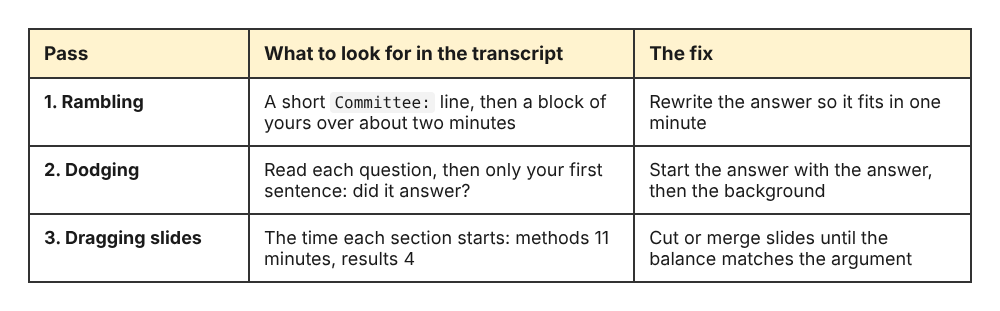
One read of the transcript for each problem.
- Rambling. Look for a short Committee line followed by a long block of yours. Anything over about two minutes is a candidate to rewrite.
- Dodging. Read each question, then only your first sentence. Did that sentence answer it? If you opened with background, you dodged, even if you got there in the end.
- Dragging slides. Use the times to see where each section started. If your methods took eleven minutes and your results took four, the balance is wrong.
Then watch the video for the parts the text misses: where you looked away from the camera, where you said "as I mentioned" three times, where a slide stayed up long after you had moved on.
Turn the feedback into a short fix list for your final rehearsal
Combine the committee's comments with your own notes from the recording, then cut it to five items at most. A long list never gets done. Write each one as an action:
- Rewrite the answer to "why this sample?" so it starts with the reason.
- Cut slide 14 and merge it into slide 13.
- Add a backup slide on the alternative method, kept after the final slide.
- Practise the two-minute summary until it fits in ninety seconds.
Fix those, then run a final rehearsal and record it as Mock defense 02. Sort the folder by name and the two takes sit side by side. Compare the same questions in both transcripts.
Thank your committee, and send them the recording if they want it. The advice on what to send after a recorded session works for a mock committee too. And if the mock went badly, it did its job. Finding the problems early is the whole reason to hold one.
Frequently asked questions
How long before the real defense should I hold a mock thesis defense?
Leave a few weeks if you can. That leaves time to rework answers and slides, and to run one final rehearsal a few days before the real day.
Can I do a mock thesis defense alone, without a committee?
You can rehearse the talk alone and record it to check timing and delivery. The questions are the hardest part to practise solo, so get at least one other person for the Q&A, even on a short video call.
How many people should sit on a mock committee?
Three to five works well. Aim for someone who defended recently, someone strong on methods, and someone from outside your subfield.
Should I run my mock defense online if the real one is in person?
Match the real format if you can, because standing in a room feels different from sitting at a webcam. If an online mock is all you can arrange, it still tests your answers, and the recording is easier to make.
Get started: record your practice talk and mock committee in Chrome
Start with a short solo run of your talk, then book your mock committee. For a step-by-step setup that keeps the talk and the questions in two recordings, read practice a thesis defense on webcam and review the recording. The free plan includes recording, the live transcript and captions, and 12 hours of recording a month, which is plenty for a talk, a mock defense and a final rehearsal. You can create a free account and run your 30-second test today.
The Free plan needs no card. Cheap Recorder runs in Chrome on macOS, Windows and Linux, and your recordings stay on your own disk.
Screen recording that is cheap and easy.
Visit cheaprecorder.com↗
Comments
No comments yet.