MRR vs ARR: What Each Means and How to Calculate Them
MRR vs ARR is a question of time frame. MRR, monthly recurring revenue, is the subscription revenue you can expect every month. ARR, annual recurring revenue, is the same idea over a full year. Both count only revenue that repeats, not one-time fees. For most early startups, ARR is simply MRR times 12, and the real work is counting MRR honestly in the first place.
The Business Basics for Builders course on Age of AI Entrepreneur ends with a lesson on growth, the number a startup lives by, with its sources listed; sign in with your email and an emailed code to open it. This post defines both metrics, walks through one month of numbers, and covers the mistakes that make an AI product look bigger than it is.
MRR vs ARR: the short answer
- MRR is the recurring revenue your current subscribers bring in each month. A customer paying $29 a month adds $29. A customer paying $300 a year adds $25.
- ARR is that recurring revenue over a year. If nothing changes, ARR is MRR times 12.
- Neither includes setup fees, one-off projects, hardware or any charge that will not repeat.
Stripe's guide to MRR puts the difference this way: MRR suits short-term decisions and newer businesses whose customers mostly pay monthly, while ARR suits businesses with long contracts and longer-term planning.
Which one should an early startup track?
Track MRR. When you have a few dozen customers on monthly plans, a single month tells you a lot: who joined, who upgraded, who left. ARR smooths those changes away. It is useful when you talk to people who think in years, such as investors or a buyer on an annual contract, but it should come from the same monthly count.
Paul Graham's essay on startup growth argues that revenue is the best thing to measure growth by, and that a good rate during Y Combinator is 5 to 7% a week. Whatever pace you aim for, you need a revenue number you trust, counted the same way each time. MRR is that number for a subscription product.
How to calculate MRR
The simplest formula is the number of paying customers times their average monthly revenue. In practice, add up each active subscription at its monthly value:
- List every active, paying subscription.
- Convert each one to a monthly amount. Divide annual plans by 12 and quarterly plans by 3.
- Leave out trials, one-time fees, refunds and anything a customer has already cancelled.
- Add them up.
Then split each month's change into its parts. Stripe's guide names them: new MRR from new subscribers, expansion MRR from upgrades, churn MRR lost to cancellations, contraction MRR lost to downgrades, and reactivation MRR from customers who come back. Net new MRR is new plus expansion, minus churn and contraction.
Worked example: one month of an AI writing tool
Say you sell an AI tool that drafts product descriptions for online shops. On 1 March you have 40 customers on a $29 monthly plan and 5 on a $300 annual plan.
- Monthly plans: 40 x $29 = $1,160.
- Annual plans: 5 x $300 / 12 = $125.
- Starting MRR: $1,285. Starting ARR: $15,420.
During March:
- 10 new customers join the monthly plan: new MRR +$290.
- 3 customers upgrade from $29 to a $49 plan: expansion MRR +$60.
- 4 monthly customers cancel: churn MRR -$116.
- 2 customers move from $29 to a $19 plan: contraction MRR -$20.
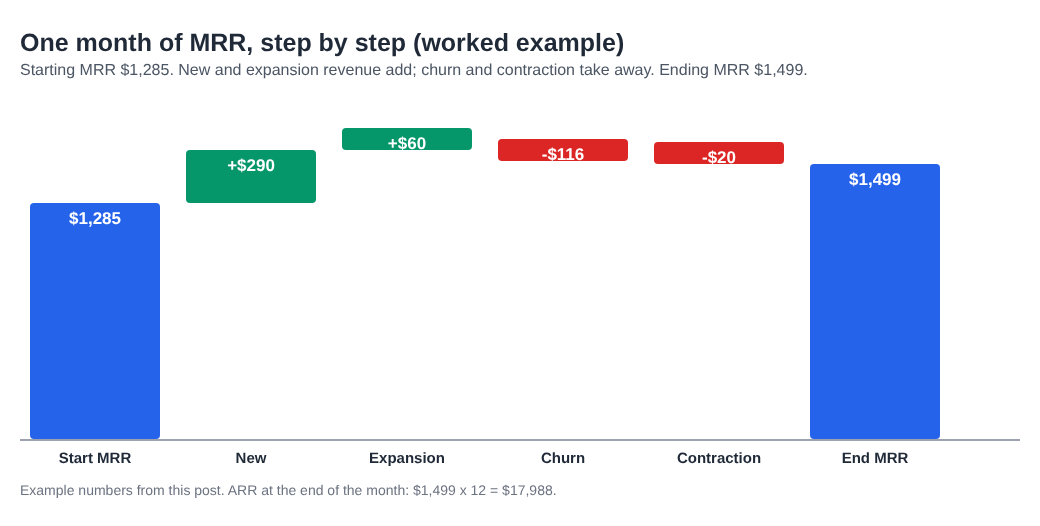
One month of MRR in the worked example.
Net new MRR is 290 + 60 - 116 - 20 = $214. Ending MRR: $1,499, so ARR is now $17,988. Monthly growth is 214 / 1,285, about 16.7%.
The split matters more than the total. Churn here took back 40% of what new customers added ($116 of $290). Looking only at the total, a healthy 16.7% would hide that leak, and the leak is what you fix first.
MRR is not cash, and not total revenue
Three numbers get mixed up, and each answers a different question.
- MRR answers: how much recurring revenue do my current subscribers represent each month?
- Total revenue answers: how much did I earn this month from everything, including setup fees and one-off work? Stripe's guide notes it is less predictable than MRR for exactly that reason.
- Cash in answers: how much money arrived in the bank? An annual customer who pays $300 on 1 March brings in $300 of cash that day, but only $25 of MRR, every month for a year.
In the worked example, if all 5 annual customers had paid in March, your bank account would show far more than $1,499 of subscription money that month. Next month it would show none of it. Plan hiring and spending from cash and runway; judge growth from MRR. Using the cash spike as a growth number is how founders end up surprised in April.
Mistakes that inflate MRR and ARR
- Counting one-time money. A $500 setup fee is revenue, but it is not recurring. Leave it out.
- Counting the full annual payment in one month. A $300 annual plan is $25 of MRR, not $300.
- Counting trials or cancelled plans. A customer who cancelled but is paid up to the end of the month is not recurring revenue going forward.
- Annualising a spike. Your best month times 12 is not ARR.
- Treating usage charges as subscriptions. Many AI products bill partly by usage, which moves with each customer's activity. Some founders count only the fixed monthly fee as MRR and report usage separately. Others count a trailing average of usage. Both are used; pick one, write it down, and keep it the same each month. Our post on usage-based pricing vs subscription covers the pricing side.
Where MRR fits with your other numbers
MRR tells you how much repeats each month. It does not tell you whether each customer makes money once model costs are paid. Pair it with unit economics for an AI product and with your runway: the post on default alive or default dead uses monthly revenue growth to see whether you reach profit before the money runs out.
Frequently asked questions
Is ARR just MRR times 12?
For most early startups, yes. Companies with multi-year contracts may count ARR from the contracts directly, but it should still include only recurring revenue.
Should I include usage-based revenue in MRR?
Founders differ. Some count only fixed fees, others a trailing average of usage. Choose one method, say which you use, and keep it consistent.
What is net new MRR?
New MRR plus expansion MRR, minus churn MRR and contraction MRR. It is the month's real change in recurring revenue.
When should a startup start reporting ARR?
When the people you report to think in years, such as investors or customers on annual contracts. Keep tracking MRR underneath it.
Does an annual prepayment count as more MRR?
No. It is more cash up front, but its MRR is the annual price divided by 12, the same every month of the contract.
Get started
Open Age of AI Entrepreneur, sign in with your email and an emailed code, and take the Business Basics for Builders course: problems worth paying for, revenue, costs and unit economics, and growth. Each lesson takes about nine minutes and lists its sources.
Building a business in the age of AI, from a first project to a company.
Visit aientrepreneur.vlvd.net↗


Comments
No comments yet.