Muda at Home: Spot the Waste in a Daily Routine
Muda is the Japanese word for waste, and the idea comes from the Toyota Production System, but it fits a kitchen as well as a factory floor. This guide to muda at home shows you how to write one stretch of your day down, name each wasted step, and count which kind costs you the most minutes.
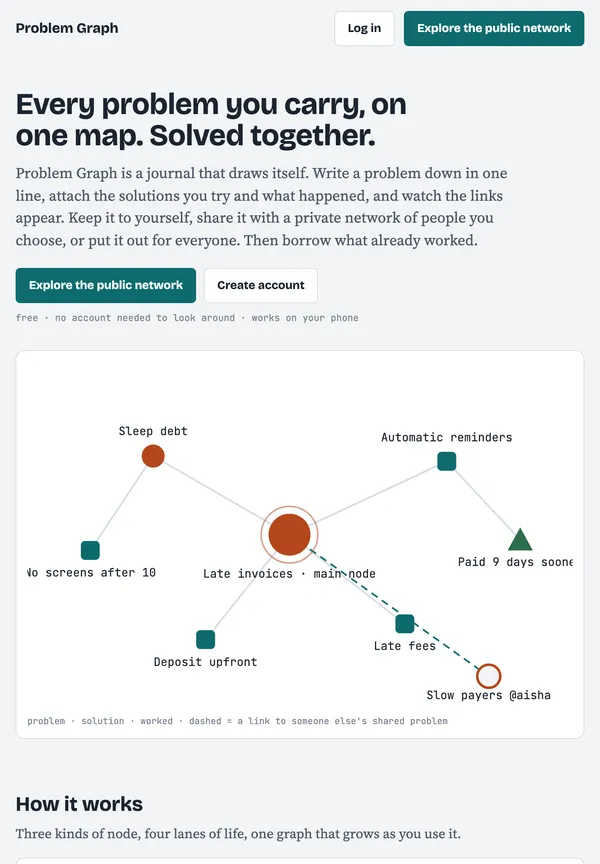
If you want a place to keep what you find, Problem Graph lets you write each problem in one line, attach the fixes you try with what happened, and link the problems that belong together.
What muda means and why it matters at home
The Lean Enterprise Institute defines muda as any activity that consumes resources without creating value for the customer. At home, the customer is you and the people who live with you.
That makes the test personal. A slow Sunday breakfast you enjoy is not waste. Waste is the part of your day you would cut if you noticed it: ten minutes hunting for keys, a third trip upstairs for the same charger, a pile of mail you open and put down again.
Most household waste stays invisible because it repeats. A habit stops looking like a problem once it is normal, so the first job is to look, not to fix.
The seven wastes, translated to household life
The Lean Enterprise Institute's page on the 7 wastes credits Taiichi Ohno with the list. Here is each one as it can show up in a house. The household examples are mine, not the institute's.
- Overproduction: making more than the next step needs. Cooking for six when four eat, then throwing the rest away.
- Waiting: being idle until something else is ready. A kettle, a shower that is slow to heat, a child who is not dressed yet.
- Conveyance: moving things without need. Laundry carried down two floors and back, or groceries moved between three bags.
- Processing: doing more work than the result needs. Ironing a shirt that will be hidden under a jacket.
- Inventory: more stuff waiting than you will use. Five half-used bottles of the same cleaner, or food that expires before you cook it.
- Motion: extra movement within a task. The institute's own example is looking for parts, tools and documents, which at home becomes looking for keys, chargers and forms.
- Correction: redoing something. A pan that is still dirty after washing, a bill paid to the wrong account, a form signed and never sent.
You do not need to memorise the list. It works as a set of questions you ask about each step: did this need to be made, waited for, moved, redone?
Muda at home: write the morning down first
Do not judge your routine yet. First write down what actually happens. Pick one stretch of the day, such as 6:30 to 7:45 in the morning, and jot each step with the minutes it took. Use a notes app or a scrap of paper, and keep it dull and factual. This is a made-up morning:
- 6:30 up, look for the phone charger (4 minutes)
- 6:40 shower, wait for the hot water (3 minutes)
- 6:50 find a clean shirt and iron it (8 minutes)
- 7:00 breakfast, then wash the pan again because it was left to soak (5 minutes)
- 7:20 search for the keys (6 minutes)
- 7:30 back upstairs for the bag (4 minutes)
Do this on three ordinary days if you can. One day can be a fluke, and three days show what repeats. The list above is a single day, so the numbers stay simple.
Sort each step into a waste and count the minutes
You do not need a spreadsheet. You need two columns: the kind of waste and the minutes it took.
- Go through your notes and skip the steps that earn their time.
- Tag every step that adds nothing with one of the seven waste names.
- Add the minutes per tag.
- If you wrote down three days, divide by three for a rough daily figure.
For the made-up morning, the charger hunt, the key search and the trip back for the bag are all motion: 4 + 6 + 4 is 14 minutes. The ironing is processing at 8, the second pan wash is correction at 5, and the hot water is waiting at 3. That is 30 minutes of waste in one morning.
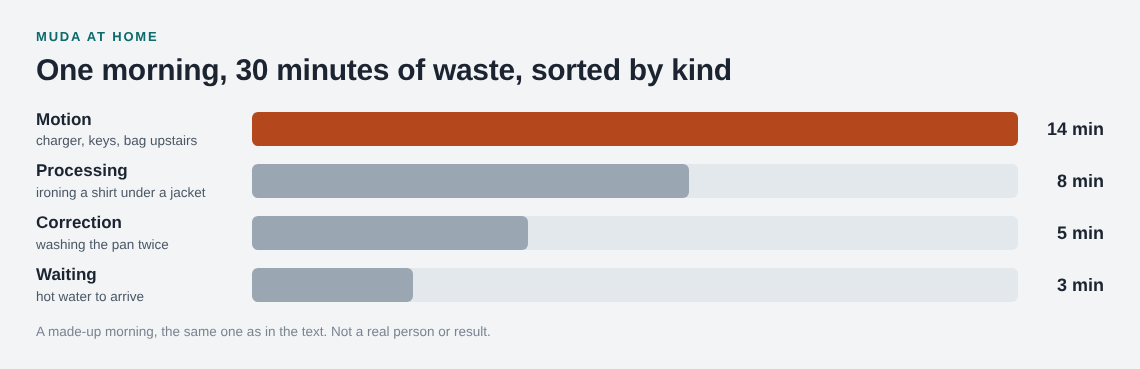
Whichever tag has the biggest total is your first target. Here it is motion, so the fix is about where the charger, keys and bag live, not about getting up earlier. Do not try to fix all seven. Fix the biggest one and see what changes. The same habit of sorting by size is what the Pareto principle for everyday problems describes.
For waste that is not about time, count items or money instead. Five open bottles of the same cleaner is a clearer signal than a feeling of clutter.
Quick fixes that remove waste without a new system
The easiest way to make waste worse is to build a big system to fight it. A colour-coded chart that nobody updates becomes its own muda. Prefer small moves, matched to the waste you found:
- Motion: give keys, charger and bag one home by the door.
- Waiting: use the wait. While the water heats, set out your clothes instead of standing still.
- Processing: drop one step you do out of habit. If nobody sees the shirt, stop ironing it.
- Correction: change the step that causes the redo. Wash the pan right after use, before it soaks.
- Overproduction: write the number of people eating on the fridge once, and cook for that number.
- Inventory: handle paper once. Open the mail, then act, file or bin it.
Each of these is a guess until you try it. Treat it as a small experiment: change one thing for a week, then note whether it worked, partly worked or failed. Kaizen for personal life covers the same habit of small fixes that add up. The Lean Enterprise Institute notes that some muda can be removed quickly through kaizen, and other muda cannot be removed right away, so it is normal if one fix only helps a little.
Keep the experiments in one place
A map helps once you have several fixes in play. In Problem Graph, you write the problem in one line, such as "Late out the door most weekdays", and put it in the personal lane. Then you attach each fix as a solution, mark the one you are trying, and record the outcome: worked, partly or failed. You can also link related problems, such as a late bedtime in your personal lane and a missed standup in your work lane, so patterns show up across lanes.
The failed fixes matter as much as the good ones. A fix that failed stays on the map as a failed fix, so you do not try the same thing again in three months.
If you share a household, you can create a private network, give the people you choose the invite code, and share a main node into it. Only a main node can be shared, and its solutions and outcomes go with it. Everything else stays yours, and private is the default. If you ask the app for suggestions, treat them as proposals to test, not answers.
Frequently asked questions
What does muda mean?
Muda is the Japanese word for waste. In lean thinking it means any activity that uses resources without creating value for the person it serves.
What are the wastes of lean?
The Lean Enterprise Institute lists seven: overproduction, waiting, conveyance, processing, inventory, motion and correction. Seven is enough to start with at home.
How do I find waste in my daily routine?
Write down each step of one stretch of your day, with minutes, for about three days. Then tag every step that adds nothing with one of the seven waste names and add up the minutes for each.
Is every slow or idle moment waste?
No. Rest, play and a slow meal you enjoy are the point of the day, not waste. Waste is what you would cut if you noticed it.
Do I need an app to do this?
No, paper works. A tool helps once you have several fixes to track and want to remember which ones worked.
Get started: map the waste in your routine with Problem Graph
Pick the biggest waste from your notes and write it as one line. Add the first fix you will test, and set a day to check the result. If you want to see how a map looks before you write anything, the app has a "Load example set" button on an empty graph.
Try Problem Graph: it is free, and you can look around the public network without an account. Write one problem down in a line and attach the first thing you will try.
Every problem you carry, on one map. Solved together.
Visit problemgraph.vlvd.net↗
Comments
No comments yet.
Sign in or make an account to comment.