Murasaki Shikibu and The Tale of Genji: Why It Matters
Murasaki Shikibu was a lady of the Japanese imperial court who finished The Tale of Genji around 1020. Her book is Japan's oldest novel and possibly the first novel in world literature, and a thousand years on it is still being retranslated. This post covers who she was, what happens in the book, and why it matters.
If you want to meet her alongside Homer and Shakespeare, Learn 100 Influential People teaches Murasaki Shikibu in short lessons in its Art, Letters and Music course, with the sources for each lesson so you can read further.
Who was Murasaki Shikibu?
We do not know her real name. "Murasaki" was a nickname, and "Shikibu" means secretariat, the post her father held. At the time it was common to call a daughter by her father's position. She is also known as To no Shikibu.
Here is what the record shows, from the World History Encyclopedia's article on the Tale of Genji by Mark Cartwright:
- Family: she belonged to the powerful Fujiwara clan. Her father, Fujiwara no Tametoki, was a provincial governor.
- Dates: born around 973. She died some time after 1013, the last time court documents mention her.
- Marriage: she married Fujiwara no Nobutaka and had one daughter, Daini no Sammi. Her husband died in 1001.
- Court life: she then became a lady-in-waiting to Empress Akiko, also called Shoshi, and was admired for her calligraphy, painting, poetry and playing of the koto, a kind of harp.
- Other writing: besides the novel, some of her poems and her diary survive.
The Tale of Genji at a glance
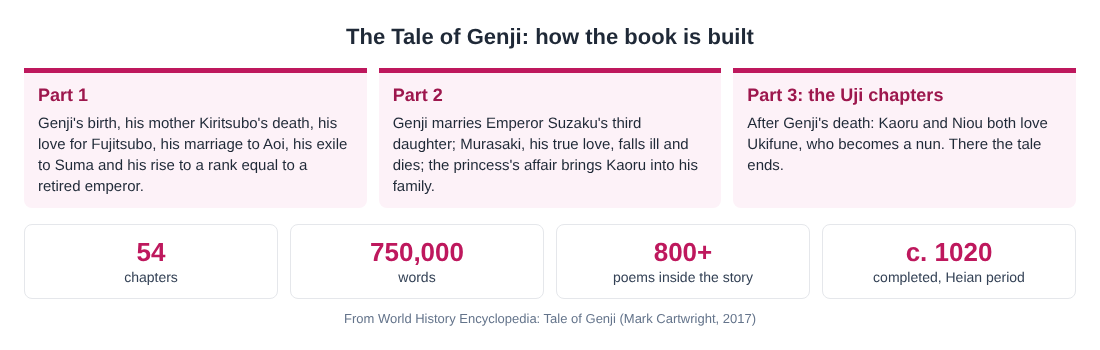
How the book is built, from World History Encyclopedia.
The Japanese title, Genji Monogatari, means "The Tale of Prince Genji." She wrote it over several years in the Heian period (794 to 1185), a high point of Japanese court culture. It is huge: 54 chapters and about 750,000 words, with more than 800 poems set inside the story.
Scholars still argue about parts of it. A minority think the final 13 chapters were added later, since Genji is gone by then and the tone turns darker. They also do not fully agree on the order of the chapters, because some run alongside earlier ones rather than after them.
What happens in the story
The tale covers about 70 years: Genji's life and then his descendants'. It is set at the height of the Heian period, in the reign of Emperor Daigo (897 to 930). Genji is fictional, but readers of the time would have known a real prince with a similar story, Minamoto no Takaakira.
Part 1: Genji's rise
Genji is the son of an emperor, but not in line for the throne. His mother, Kiritsubo, has low rank at court and dies when he is three. A diviner from Korea warns that disaster will follow if Genji ever becomes emperor, so his father makes him a commoner with the surname Minamoto, or Genji, while keeping him at the palace.
Genji falls in love with Fujitsubo, his father's new consort, but at 12 he marries Aoi. The marriage fails. He has many affairs, most importantly with a girl called Murasaki, whom he later marries. A son he has with Fujitsubo becomes the future Emperor Reizei, who learns the truth and raises Genji to a rank equal to a retired emperor, making up for Genji's earlier exile to Suma.
Part 2: losses
The retired Emperor Suzaku asks Genji to marry his third daughter. Murasaki, Genji's true love, is hurt. She wishes to become a nun, falls ill and dies. The new princess has an affair, and Genji must accept the child, Kaoru, as part of his family.
Part 3: the Uji chapters
After Genji's death, the story follows Kaoru and Genji's grandson Niou. Both love the same woman, Ukifune. Trapped between them, she tries to end her life, fails, and becomes a nun who refuses to see either man. There the tale ends.
Why it is called Japan's oldest novel
The scholar Mason, quoted by the encyclopedia, puts it this way: earlier "novels" were too close to fairy tales, or were realistic but had flat characters. Genji is imaginative fiction that is "both descriptively and psychologically true to life." In Mason's view, Murasaki had "independently developed the novel as a true literary form."
She even explains her own idea of the novel inside the book. A storyteller, she writes, is so moved by what they have lived or seen that they "can no longer keep it shut up" in their heart, and cannot bear to let it "pass into oblivion."
Is it the world's first novel? The encyclopedia says "possibly," and that is the fair answer. It depends on how you define a novel. What nobody disputes is that it is the classic of Japanese literature. For another writer whose work turned into a nation's shared reference, see why Shakespeare is still important today.
Why The Tale of Genji still matters
Four reasons stand out, each from the encyclopedia's account:
- The feeling of impermanence. The book repeats the phrase "the sadness of things" more than 1,000 times. Its sense that all things pass has shaped Japanese literature and thinking ever since.
- A window on a vanished court. It shows the etiquette and intrigues of the Heian court in vivid detail.
- A source for art. Some of the oldest Japanese scroll paintings, and perhaps the finest, are 19 illustrations from an abridged Genji painted in the 1120s or 1130s.
- A living book. It was an instant success, has been quoted and imitated in Japanese writing and theatre ever since, and is still regularly retranslated into modern Japanese.
A tip if you want to read it: keep a list of the main names as you go (Genji, Kiritsubo, Fujitsubo, Aoi, Murasaki, Reizei, Kaoru, Niou, Ukifune) with one line each. The cast is large, and many characters are known by titles or nicknames, just as the author herself was. For another very old work that reached us in a disputed form, read who Homer was and what survives.
Frequently asked questions
Who wrote The Tale of Genji?
Murasaki Shikibu, a lady-in-waiting at the Japanese imperial court, who completed it around 1020 during the Heian period.
Is The Tale of Genji the first novel?
It is Japan's oldest novel and possibly the first in world literature. Whether it is the very first depends on how you define a novel.
How long is The Tale of Genji?
It has 54 chapters and about 750,000 words, with more than 800 poems inside the text.
What was Murasaki Shikibu's real name?
It is not known. Murasaki was a nickname, and Shikibu came from her father's post in the secretariat.
Get started
Murasaki Shikibu is in the Art, Letters and Music course with Homer, Shakespeare, Leonardo, Michelangelo, Picasso, Bach, Mozart and Beethoven. Each lesson takes about 9 minutes and lists its sources, and where researchers disagree, as they do about Genji's last chapters, you get every side.
The questions ask you to choose, put in order, match, sort and estimate a number, so a plot with three parts and a long cast is a good fit. Questions from lessons you finish come back later, up to 5 a day. You sign in with your email and a code sent to it, and accounts are for people 13 and over. More is on the about page.
Start Learn 100 Influential People: short hands-on lessons on the people who shaped history, with every side of the debate and the sources to read next.
100 people who shaped history, from Moses to the web.
Visit influentialpeople.vlvd.net↗


Comments
No comments yet.