Neurosymbolic AI explained: neural nets plus logic
Neurosymbolic AI (also written neuro-symbolic AI) is an approach that joins two older ideas about how to build intelligent software: neural networks that learn patterns from data, and symbolic methods that work with explicit rules and knowledge. The aim, as Wikipedia puts it, is AI that is more robust, more reliable and more trustworthy than either part alone.
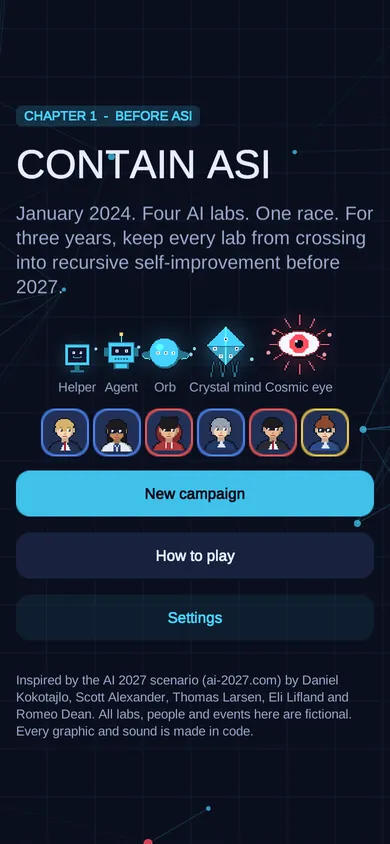
If you want to explore the questions around advanced AI as fiction, Contain ASI is a browser story strategy game for 1 to 4 players where you try to keep four fictional AI labs from crossing into recursive self-improvement before 2027.
What neurosymbolic AI means
The article defines it as a combination of neural networks with symbolic approaches such as knowledge representation and automated reasoning. In practice that means statistical patterns are combined with explicitly defined rules and knowledge. The hope is that a system can better represent, reason and generalize.
It treats deep learning as the "substrate" of AI: an efficient way to learn from data. The new approach then tries to fix what deep learning lacks. The article lists those limits as reliability, data and energy efficiency, fairness and trust. It says neuro-symbolic AI is argued to keep the strengths of both camps while reducing their weaknesses. That is a claim from its supporters, not a settled result.
The two sides it joins
The symbolic side is the older one. It writes knowledge down as facts and rules and reasons over them, which is the story told in symbolic AI: what good old-fashioned AI was and why it faded, expert systems and knowledge representation and reasoning. A rule system can show which rule produced an answer. Its weakness is that people must write the rules.
The neural side learns from examples instead. The article calls the era from 2015 to the present the second wave, built on neural networks and deep learning, and calls the first wave (the 1980s to 2000s) the era of logic-based symbolic AI. Neurosymbolic AI has been called the third wave.
Why people want to combine them
One reason comes from cognitive science. The article cites Daniel Kahneman's book Thinking, Fast and Slow, which describes System 1, fast and intuitive and good at pattern recognition, and System 2, slower and deliberate, which handles planning and long-term decisions. Deep learning is best suited to the first kind, and symbolic AI to the second. The article says both are needed for an AI that learns efficiently but also reasons reliably, answers correctly from few observations and accepts advice. It adds that such dual-process models have been explored since the 1990s.
Two researchers are quoted as backers. Leslie Valiant believes the approach can "reconcile the statistical nature of learning and the logical nature of reasoning". Sepp Hochreiter calls it the most promising route to a broad AI. Gary Marcus argues that robust, knowledge-driven AI needs the machinery of symbol manipulation, because much useful knowledge is abstract.
The article also says interest surged after 2020, when large language models made the limits of pure neural networks easy to see: hallucinations, weak reasoning, and poor generalization beyond the training data. In response, hybrids appeared that pair a language model with symbolic tools such as theorem provers, logic verifiers, proof assistants and databases. This links to a worry covered in explainable AI: a system that can point to its rules is easier to check.
Ways to combine them
The article gives a coarse split first. Hybrid systems have a neural component and a separate symbolic component. Integrated systems fold learning and reasoning into one neural network, often using fuzzy or probabilistic logic made differentiable so it can be trained.
A finer split is Henry Kautz's taxonomy, with six patterns. The article says the list is not exhaustive: multi-agent systems, for example, are not covered.
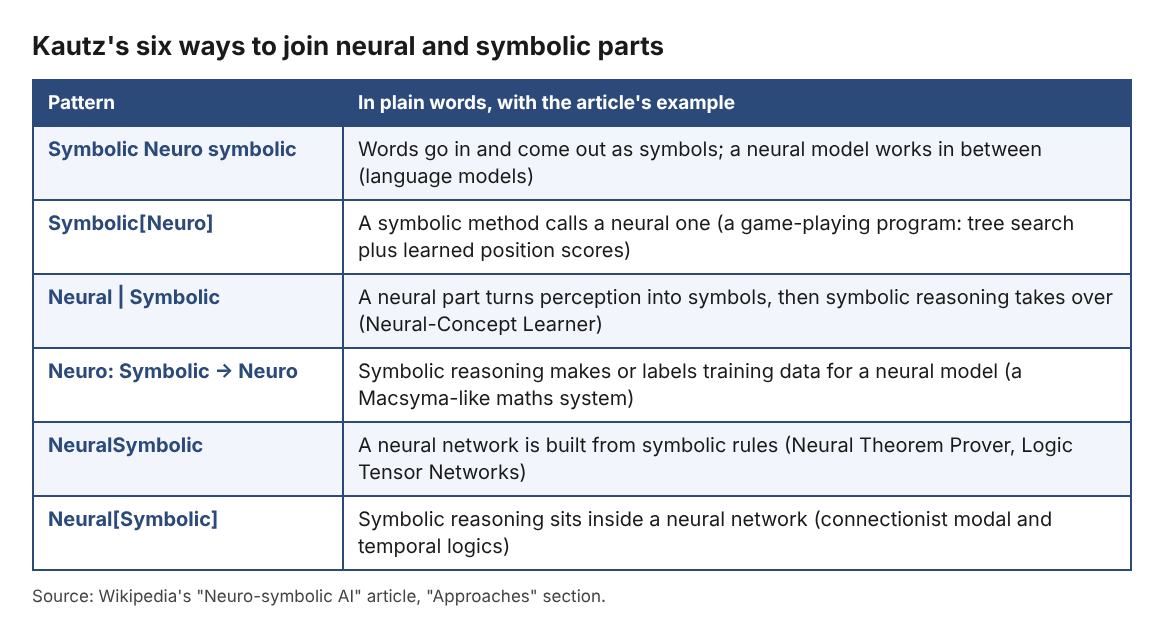
You do not need to memorize the names. The useful distinction is who does what. In some patterns the neural part sees and the symbolic part thinks. In others the symbolic part trains the neural one, or the rules are built into the network itself.
A worked example you can follow
Here is an invented toy case in the spirit of the "neural, then symbolic" pattern (Kautz's Neural | Symbolic). It is not a description of any real system.
- The neural part looks. You show it a photo of a table with two cups. It cannot give you a clean answer yet, only what it sees.
- It writes symbols. Its output is a short list of facts: cup 1, cup 2, cup 1 is left of cup 2, cup 1 is full, cup 2 is empty.
- A rule takes over. A hand-written rule says: if a cup is empty and it sits right of a full cup, answer with that cup.
- You get an answer and a reason. "Cup 2 is empty", plus the facts and the rule that led there.
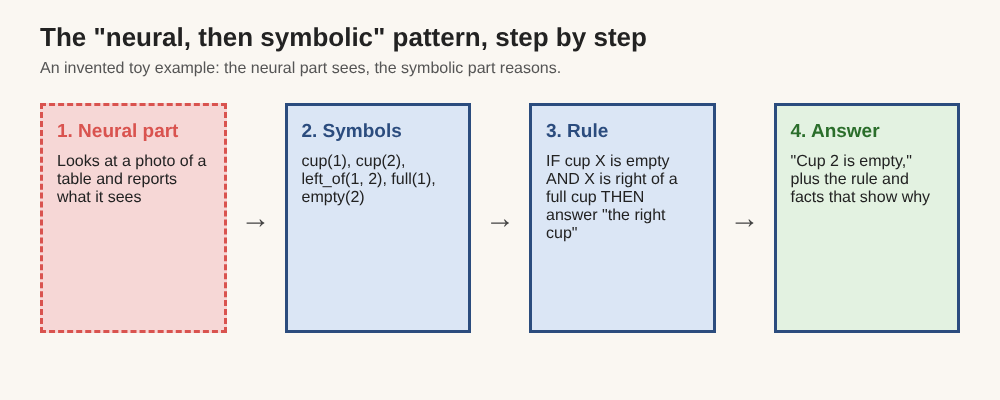
Now try the check yourself: swap the facts so that cup 1 is empty and cup 2 is full. Does the rule still fire? It does not, because no empty cup is right of a full one, so a new rule would be needed. That is the trade the pattern makes. The seeing part can be learned from many photos, while the reasoning part stays readable and can be corrected by editing a rule.
A short history
The article says the field is not new. Researchers have worked on it since at least the 1990s, when the first workshops were organised. It also argues the story could start in 1943, with McCulloch and Pitts's paper on a logical calculus of nervous activity, which is widely accepted as the start of neural networks. Turing's 1948 Intelligent Machinery described a type of neural network too, and John von Neumann's 1952 paper looked at how discrete and continuous processes interact. All of this came before John McCarthy coined the term artificial intelligence in 1956. Supporters of the approach argue the field should never have split into symbolic and neural camps.
Early systems followed. In the 1980s the CHCL system used neural networks for parallel theorem proving. In 1994 the KBANN system was the first to insert rules into a neural network and pull them back out. In 1999 the CILP system was the first to combine backpropagation with logic programming. A workshop series started in 2005 became a conference, and a dedicated journal began in 2023.
What is still open
The article is frank that there is no single predominant way to do this. Open questions include how best to assemble the two parts, which metrics to use (it names "accuracy divided by compute" as one), and which kinds of symbolic knowledge each kind of network can represent.
It names one bottleneck. After training, researchers try to extract symbolic descriptions from the network, which is closely related to explainable AI. This knowledge extraction is, the article says, the main computational obstacle to doing it at large scale.
It also reports a bolder claim: that the approach offers an alternative path to artificial general intelligence. The idea is a cycle in which a network is trained while its reasoning is continually checked, so knowledge can be reused instead of scaled up. The article states this as a claim, and so does this post. For the broader debate, see what AGI means. This post takes no side on whether it will work.
Frequently asked questions
What is neurosymbolic AI?
It is AI that combines neural networks, which learn from data, with symbolic methods such as rules, knowledge representation and automated reasoning.
Is neurosymbolic AI the same as symbolic AI?
No. Symbolic AI uses explicit rules and knowledge alone. Neurosymbolic AI joins that with neural networks, so part of the system is learned from data.
Why do researchers want it?
Supporters say it can address deep learning's limits in reliability, data and energy efficiency, fairness and trust, while keeping what neural networks do well.
Is it proven to work better?
The article says no single approach has become predominant, and its strongest claims, such as a path to AGI, are claims by supporters, not settled results.
Get started with Contain ASI
Neurosymbolic AI is one idea in a large debate about how advanced AI might be built and checked. Contain ASI is a different kind of exploration: fiction. It runs in your browser and needs WebGL 2, so use a recent Chrome, Edge, Firefox or Safari. From the home page you can start a New campaign or open How to play. The game is not a course and does not teach this topic.
Play Contain ASI: a story strategy game for 1 to 4 players that runs in your browser. Its labs, people and events are all fictional.
January 2024. Four AI labs. One race.
Visit containasi.vlvd.net↗
Comments
No comments yet.