Symbolic AI: What Good Old-Fashioned AI Was and Why It Faded
Symbolic AI is the approach that built intelligence out of explicit symbols and rules a person wrote down. Wikipedia also calls it classical AI or logic-based AI, and people often nickname it good old-fashioned AI, or GOFAI. In short, it worked on tidy problems, broke on messy ones, and lost ground to systems that learn from data.
If you would rather think about where AI goes next through a story than through history, Contain ASI is a story strategy game for 1 to 4 players that runs in your browser. You try to keep four fictional AI labs from crossing into recursive self-improvement before 2027.
What symbolic AI is
Symbolic AI represents a problem with high-level symbols that a human can read, such as words, logical statements and labels. It then works on those symbols with logic and search. A person decides what the symbols mean and writes the rules. The program applies them.
According to Wikipedia's article on symbolic AI, its tools included logic programming, production rules, semantic nets and frames. It produced expert systems, symbolic mathematics, automated theorem provers, ontologies and automated planning and scheduling systems. The same article says it was the dominant paradigm of AI research from the mid-1950s until the mid-1990s.
The bet was simple. If you can write down facts and the rules for combining them, a machine can reason with them. Researchers in the 1960s and 1970s were convinced that symbolic approaches would eventually produce a machine with artificial general intelligence, and they treated that as the ultimate goal of their field.
This view treats the program as an agent with explicit beliefs and goals. For the vocabulary, see intelligent agent in AI: what it is and why goals matter.
Milestones: Logic Theorist, expert systems and Cyc
- Logic Theorist (1955 to 1956). Allen Newell, Herbert Simon and Cliff Shaw wrote a program that proved 38 elementary theorems from Whitehead and Russell's Principia Mathematica. It is an important early symbolic AI program.
- General Problem Solver. The same three later generalized the work into a domain-independent problem solver. It solved problems written as formal operators, using state-space search and means-ends analysis. In the 1960s, symbolic approaches did well in structured settings such as game-playing, symbolic mathematics and theorem-proving.
- Expert systems. The second boom, which Wikipedia dates 1969 to 1986, brought expert systems, the first commercially successful form of AI software. MYCIN diagnosed bacteremia using about 450 rules, and it is reported to have performed as well as some experts and better than junior doctors. DENDRAL, INTERNIST and CADUCEUS did similar jobs in chemistry and internal medicine.
- Cyc. Doug Lenat's project tried to capture common sense in a knowledge base. Wikipedia uses it as an example of "scruffy" AI, because such a base must be built by hand, one complicated concept at a time.
How it worked: rules, inference and search
Three parts show up again and again.
A knowledge base. This is a store of facts and rules. The facts describe the situation. The rules say what follows from them.
An inference step. The program applies rules to facts to reach new facts. Wikipedia notes that expert systems can chain forward, from evidence to conclusions, or backward, from goals to the data and prerequisites they need.
Search. Many problems, such as planning or proving a theorem, mean trying options and following promising ones. Much of the effort went into choosing which branch to explore.
Here is a made-up example in the style of an expert system. Imagine a help-desk program that diagnoses a printer. Its rules might read:
IF power light is off THEN check the power cableIF power light is on AND paper light is blinking THEN check the paper trayIF paper tray is full AND paper light is blinking THEN suspect a paper jam
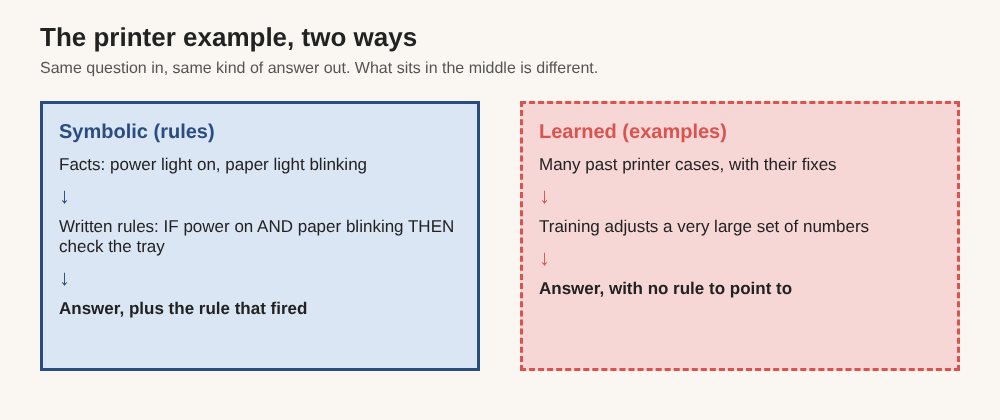
The printer example both ways: written rules you can read, or numbers learned from examples.
Ask the user a few questions, add the answers as facts, and the program chains the rules to a recommendation. It can also explain itself by listing the rules it used, which Wikipedia names as a feature of these systems. Every step can be read.
Why symbolic AI faded
Several problems did the damage, and they build on each other.
Brittleness
Rules work inside the cases their authors imagined and fail outside them. Wikipedia lists "brittleness in handling out-of-domain problems" among the troubles of the expert system boom. Write IF it is a bird THEN it can fly and you soon need exceptions for penguins and birds with broken wings. Each exception invites more.
The knowledge bottleneck
Someone had to enter all the knowledge by hand. The article names "difficulties in knowledge acquisition" and the cost of "maintaining large knowledge bases" as problems of the second boom. Cyc shows why: building common sense one concept at a time is slow.
The frame and qualification problems
Formal logic made some everyday facts awkward. After an action, you need axioms to say what did not change, which is the frame problem. The qualification problem is listing every precondition for an action to succeed, and the article notes that an infinite number of odd conditions can be imagined, such as a banana in a tailpipe stopping a car. John McCarthy's answer to the frame problem was circumscription, a kind of non-monotonic logic. For a fuller account, read the frame problem in AI.
Hype and the AI winters
Funding followed the results. According to the article, an early boom led to unrealistic expectations and promises, and the first AI winter followed as funding dried up. It dates that winter 1967 to 1977. By the mid-1960s neither useful translation systems nor autonomous tanks existed, DARPA leadership cancelled funding programs, and in the United Kingdom Sir James Lighthill was commissioned by Parliament to evaluate the field. The expert system boom ended in disappointment too, and the article dates a second winter 1988 to 2011. For the wider story, see AI winter: what it was and what caused each one.
The critic: Hubert Dreyfus
The philosopher Hubert Dreyfus attacked the symbolic program early. Wikipedia quotes Russell and Norvig's verdict: Dreyfus saw areas where AI did not have complete answers and said that AI was therefore impossible, but many of those areas are now seeing continued research and increased capability, not impossibility. Whether you side with him or with them, the debate shaped the field. Read Hubert Dreyfus on AI: his critique explained for his own arguments.
What replaced it: learning from data
The alternative had been around from the start. Instead of writing the rules, you build a system with adjustable numbers and let it find them from examples. Neural networks, which Wikipedia calls a subsymbolic approach, were pursued from the early days. Rosenblatt's perceptron and the backpropagation work of Rumelhart, Hinton and Williams are early examples.
They were not seen as a success until about 2012. The article quotes the earlier consensus that the neural-network approach was hopeless until big data became common, and says that a revolution came when researchers worked out how to use GPUs to greatly increase the power of neural networks. Deep learning then had spectacular success in vision, speech recognition, speech synthesis, image generation and machine translation. The trade was real. You stopped writing the knowledge, and you also stopped being able to read it.
Compare the printer example. A symbolic version tells you which rule fired. A learned version gives you an answer and a very large set of numbers. For more on that problem, see explainable AI.
What symbolic AI still offers
The old approach did not vanish. It kept some jobs and left some ideas.
- Explanations. A rule can be read, checked and corrected. Wikipedia says symbolic reasoning is more apt for deliberative reasoning, planning and explanation.
- Surviving niches. The article says symbolic approaches continue to be useful in a few domains, such as computer algebra systems and proof assistants.
- Hybrids. Several researchers argue for combining the two. One framing uses Daniel Kahneman's System 1 and System 2: deep learning fits fast pattern recognition, and symbolic reasoning fits slow, step-by-step thinking. The article says hybrid AIs are currently viewed as the path forward, and reports neuro-symbolic work in areas including software verification.
A safety angle
This history sets up a trade-off that comes up in AI safety. Systems you can read are easier to check but were hard to make general. Systems that learn are general but harder to inspect. This is an observation about the trade-off, not a claim about any real system. When you cannot read a capable system's reasons, you depend on other ways of keeping it in bounds, which is the question behind the AI box problem.
Frequently asked questions
What is symbolic AI in simple terms?
It is AI built from human-readable symbols and rules, such as facts and IF-THEN statements, plus logic and search. A person encodes the knowledge, and the program reasons over it.
What does GOFAI stand for?
It stands for good old-fashioned AI, a nickname for the symbolic tradition that came before today's learning-based methods.
Why did symbolic AI fade?
Hand-written rules were brittle outside the cases their authors expected, and gathering and maintaining the knowledge was hard. Neural networks then did far better at tasks like vision and speech once GPUs and big data arrived.
Is symbolic AI still used?
Yes, in a few areas such as computer algebra systems and proof assistants. It also appears in hybrid, neuro-symbolic research.
Who criticized symbolic AI?
Hubert Dreyfus was an early critic. Russell and Norvig later argued that many areas he flagged have since seen real progress.
Get started
You now have the arc: rules and symbols, the early wins, the limits, and the turn to learning. If you want to carry those questions into a story about AI labs in a race, play Contain ASI. It is a story strategy game for 1 to 4 players that runs in your browser, and its labs, people and events are all fictional.
Comments
No comments yet.
Sign in or make an account to comment.