One Person AI Company: What a Solo Founder Can Run
A one person AI company is a business where a single founder handles the product, the customers and the money, and uses AI tools to do the repeatable work that once needed a team. It is not a business with no people. It is a business where you decide which work stays human. The post How a tiny team can run a large AI business covers the same idea for small teams: measure the human time each customer costs, automate the repeatable work first, and keep people on judgment and quality. This article takes that thinking down to a team of one.
If you want the lesson behind this, the Scaling an AI Company course in Age of AI Entrepreneur has a lesson called "Tiny Teams, Huge Leverage", with its sources listed so you can check the claims yourself; you sign in with your email and an emailed code to open it.
What a one person AI company really is
Start with what it is not. It is not a company that runs itself while you sleep. Nothing in your setup is free of upkeep. Every automation you add is something you now have to watch.
It is a company with a very small payroll and a clear split of work. Software and AI handle the jobs that repeat the same way every time. You handle the jobs where a wrong call costs you a customer. The company is "one person" because you hold the judgment, not because you do every task by hand.
A useful test: can you describe each job as a repeatable procedure? If yes, it is a candidate for automation. If the right answer depends on context, taste or trust, it stays with you for now.
Why one person can now do the work of a small team
Two things changed. Starting costs fell, and AI models can now do many first-draft tasks that used to need a hire: writing, summarizing, sorting, answering common questions. The Platform Shifts and the Founders Who Rode Them course covers the first idea in its lesson "The Collapse in the Cost of Starting", and its lesson "Why AI Is a Platform Shift" puts AI in the same story as earlier shifts. Like every course, it opens after you sign in.
The lesson "Tiny Teams, Huge Leverage" in the Scaling an AI Company course is the closest match to this topic. It sits in the Advanced level, so the Basic and Intermediate courses are the better start if you are new.
Which jobs to automate first
Pick jobs that are boring, frequent and low risk. A good first target has three traits:
- It happens many times a week.
- The steps are nearly the same each time.
- A mistake is cheap to catch and fix.
Common examples for a solo founder are sorting incoming messages, drafting replies to common questions, turning a customer form into a tidy record, and writing a first version of routine documents. The Your First Builds course has a project called "Automate One Boring Workflow" built around exactly this move: pick one workflow, not ten. For a way to choose which task comes first, see Tasks to Automate With AI: How to Pick the First One.
Here is a worked example. Say you run a small tool for freelance designers. Every new signup sends you a form with their name, their use case and one question. Today you read each one, copy the details into a notes file and write a welcome email.
A prompt you could give a model for this job looks like this:
Read this signup form. Return three things: a one line summary of what the person wants, a tag from this list (invoicing, client onboarding, other), and a draft welcome email in a friendly, plain tone that answers their question. If the question is unclear, say "needs human" instead of guessing.
The last line is the important one. You gave the model a way to say it is unsure, so a human sees the hard cases. That single instruction is the difference between a workflow you can trust and one that quietly sends bad answers.
Which jobs still need your judgment
Keep these with you:
- Deciding what to build next. A model can list options. It cannot know which customer you should say no to.
- Talking to customers. The course lesson "Talking to Customers Without Fooling Yourself" is about hearing what people really need, which no summary replaces.
- Pricing. It ties to your costs and your value, and it changes as you learn.
- Quality checks. Someone has to decide what "good" means for your product.
- Anything where trust is on the line, such as refunds, complaints and sensitive cases.
The course lesson "Workflows Versus Agents" in Agents and Automation helps here. A workflow follows steps you set. An agent chooses its own steps. For a one person company, plain workflows are usually easier to trust, and the same course covers why agents fail. If you want to try one, the post How to Build an AI Agent Step by Step for Beginners walks through it.
Measure the human time each customer costs
This is the one idea from the related post worth taking away: count the human minutes each customer needs from you. Most solo founders track revenue and never track their own time per customer. Then growth feels fine until the inbox is full.
A simple method, shown here with made-up numbers for illustration:
- For one week, write down every minute you spend on customer work: onboarding, questions, fixes, billing.
- Divide by the number of active customers.
- Repeat after each automation you add.
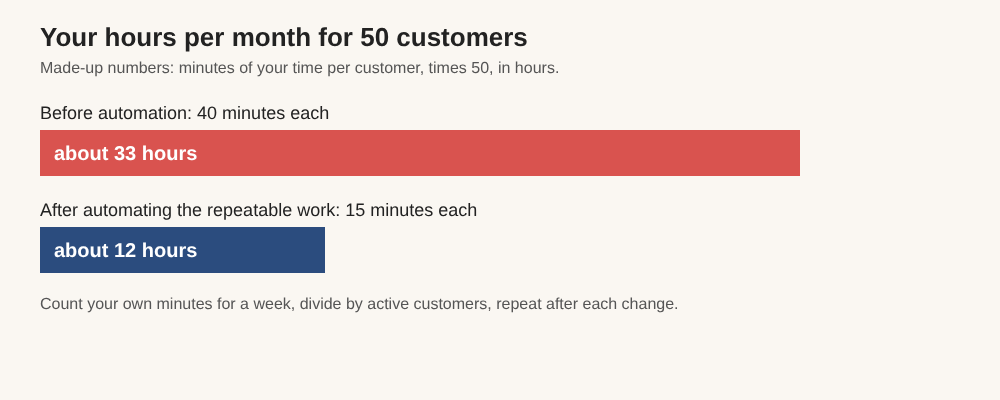
Suppose the result is 40 minutes a month per customer. At that rate, 50 customers is more than 33 hours a month of customer work, before you build anything. If automation brings it to 15 minutes, the same 50 customers cost about 12 hours. You did not guess at that gain. You measured it.
This connects to unit economics, which the "Business Basics for Builders" course covers in "Revenue, Costs and Unit Economics". Your time is a cost. For the cost side of the company, see AI Startup Gross Margin: What's Healthy and How to Improve It. A customer who takes more of your hours than they are worth is a loss, even if the card payment looks good.
The limits: support, quality and burnout
Three things break a one person company before anything else.
Support. Customers expect an answer. If you are the only one who can give it, a sick week becomes a bad week for everyone. Write down answers to the questions you get most, and let a workflow draft replies you review.
Quality. AI output can be wrong in ways that sound sure. The "What AI Gets Wrong" lesson covers this. The "Evals: Shipping AI That Works" course shows how to build a set of test cases and judge outputs, so you notice a drop in quality before a customer does; Test LLM Prompts Before Release: A Simple Checklist is a short version. For a solo founder, a small eval set that you run after every change is cheap insurance.
Burnout. With no team, nobody covers for you. Keep your hours visible, and treat your own time as the scarcest thing you have.
When to hire your first person
Hire when the numbers tell you to, not when you feel busy. Three signals are worth watching:
- Your human minutes per customer have stopped falling even after you automated the obvious work.
- The jobs piling up are judgment jobs, such as support for hard cases, not routine ones.
- Quality problems are reaching customers because you cannot review everything.
Your first hire should take over the work that most needs a human and most drains you. That is usually customer support for tricky cases or quality review, not the routine jobs your tools already do. Hiring someone to do work that a workflow could do just adds cost.
The course does not promise any business outcome, and neither does this article. A solo company can stay solo, grow into a tiny team, or stop. The point is to decide with numbers instead of habit.
Frequently asked questions
Can one person really run a company with AI?
Yes, for the right kind of business. It works best when most customer work is repeatable, you measure your own time per customer, and you keep the judgment jobs for yourself.
What should a solo founder automate first?
Start with one boring, frequent, low risk workflow, such as sorting signups or drafting replies to common questions. Always give the model a way to flag cases it cannot handle, so a human sees them.
How do I know I need to hire?
Watch your human minutes per customer. If they stop falling after you automate the obvious work, and hard cases or quality checks are piling up, it is time to hire for those jobs.
Do I need to code to build a one person AI company?
The lessons in Age of AI Entrepreneur start from the basics, with hands-on projects like a landing page and waitlist, a prompt-powered micro tool and one automated workflow. The Basic level assumes no background.
Get started
Read How a tiny team can run a large AI business if you want the team-sized version of these ideas. Then pick one workflow in your own business, count the minutes it costs per customer, and automate that one thing.
Start Age of AI Entrepreneur: short hands-on lessons on how to build a business in the age of AI, with every side of the debate and the sources to read next. You sign in with your email and an emailed code. Every lesson is free to anyone with an account, as the terms page explains.
Building a business in the age of AI, from a first project to a company.
Visit aientrepreneur.vlvd.net↗
Comments
No comments yet.
Sign in or make an account to comment.