Penrith Castle: Richard III's base on the Scottish border
Penrith Castle stands on a low rise above the Cumbrian market town of Penrith, close to the old border between England and Scotland. English Heritage's history of Penrith Castle tells of a castle built less for war than for power: a base for the Nevilles, and later the home of Richard, Duke of Gloucester, who became Richard III. This post follows its story from 1396 to the railway age.
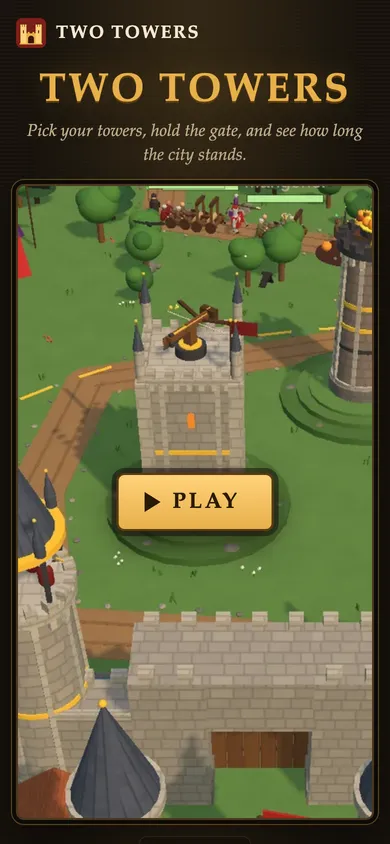
If you would like to guard a gate of your own, Two Towers is a free tower defense game in your browser where you pick two towers for the gate and hold it stage after stage.
Who built Penrith Castle?
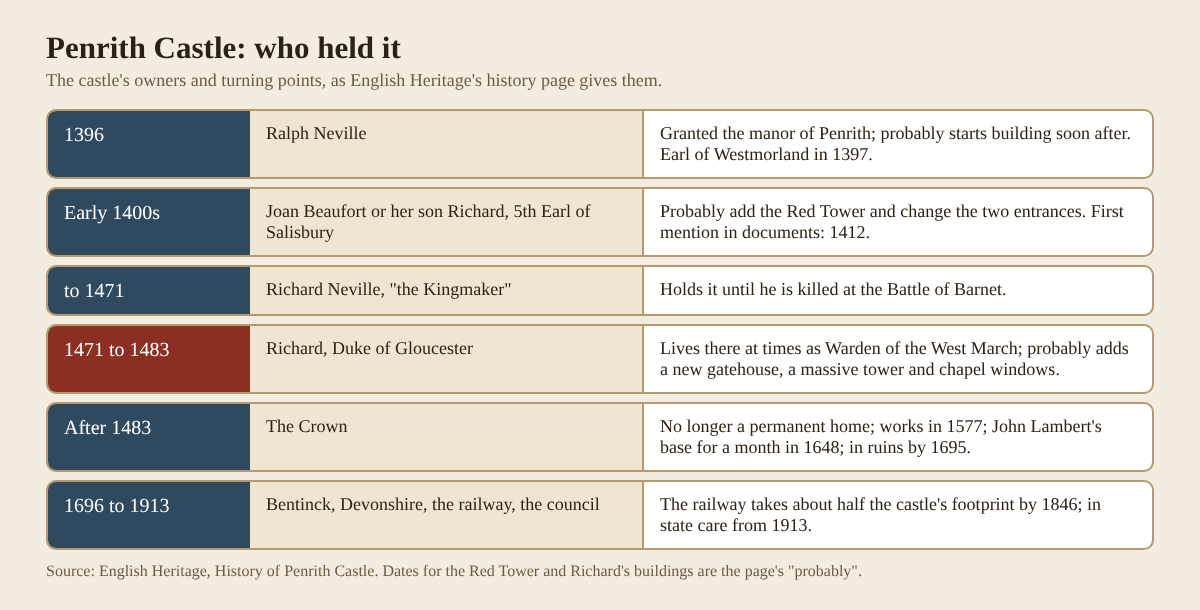
Ralph Neville, born in about 1364, was granted the manor of Penrith in 1396. He probably began building soon afterwards, and the castle is first named in documents in 1412. A year after the grant he was made Earl of Westmorland.
For much of the 19th and 20th centuries people believed a different builder: William Strickland, later Bishop of Carlisle. English Heritage says there is no direct evidence for this. The royal licences Strickland received in 1379 and 1399 to build a fortified tower may have been for Hutton Hall, a 14th-century tower near St Andrew's Church in the town.
As Sheriff of Cumberland, Neville had to defend the area against the Scots in times of war. Most of his work, though, was acting for the Crown in the county. He and his heirs rarely lived on the border. Their power came from offices in the Marches, the border lands, and the income those offices brought.
A castle built for power more than for war
Here is the surprise. Penrith Castle was not built on the highest point of its hill. That point lies 170 metres away. The castle sits instead on a low rise looking over the town, which was there before it.
English Heritage says its design was not mainly about defence. It had the usual security of the day: gatehouses, secure doors and narrow windows on the outward-facing walls. Monasteries and large town houses had the same. But it was mainly a place for running the county and for diplomacy. Some of its first buildings were probably timber, set against the stone curtain wall.
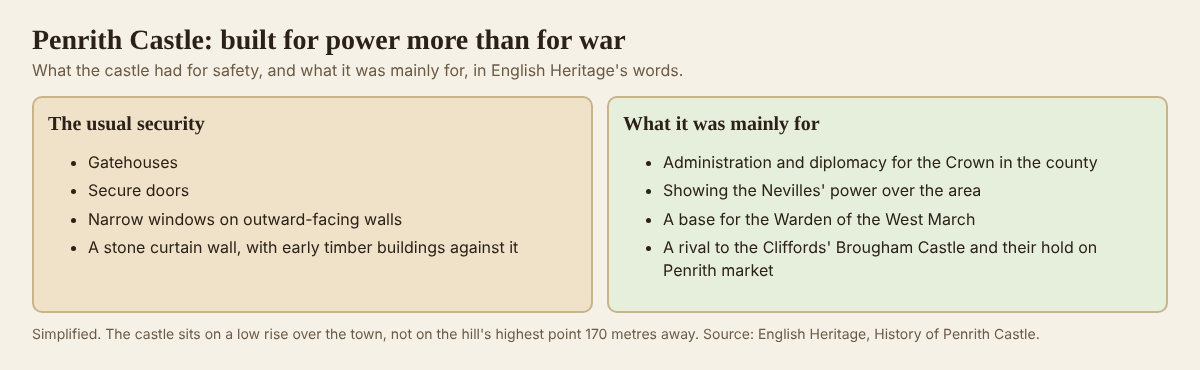
The castle also had a local job. The Nevilles' rivals, the Cliffords, held the ancient fortress of Brougham Castle nearby, and they relied on Penrith market to supply it. A Neville power base next to the market cut into the Cliffords' hold on the town. In the Wars of the Roses, from 1455 to 1487, the two families were at first on opposite sides, partly because of this rivalry. Our post on Brough Castle follows the Cliffords at another of their castles.
The Red Tower and the Kingmaker
In the early 15th century the castle was changed again. Either Ralph's widow, Joan Beaufort, or their eldest son, Richard, 5th Earl of Salisbury, probably built the Red Tower on the north side and altered the two entrances. A reconstruction drawing on English Heritage's page shows the Neville flag flying over that tower.
The 5th Earl's son was Richard Neville, Earl of Warwick, known as "the Kingmaker". He held Penrith until he was killed at the Battle of Barnet in 1471. The castle then passed to a new owner who would make it famous.
Richard III at Penrith Castle
After Barnet, Edward IV granted Penrith to his younger brother, Richard, Duke of Gloucester. Some time between 1472 and 1474 Richard married Anne Neville, Warwick's daughter. In 1483 he became King Richard III.
As Duke of Gloucester, Richard lived at Penrith for several periods. At different times he was Sheriff of Cumberland and Warden of the West March. His job was to keep the two north-western counties safe from the Scots, keep the peace treaty his brother had made with James III of Scotland, and stick to the agreed ways of settling disputes across the border.
Richard probably changed the castle a great deal. He added new buildings and private rooms for the men who served him. Large windows, probably for a chapel, were put into the south-east range. On the opposite side he probably built a new gatehouse and a massive tower, and the new gatehouse likely became the main way in. Richard's earlier home in Yorkshire is in our post on Middleham Castle, the Nevilles and Richard III.
Decline, a Civil War visit and the railway
Once Richard was king, the castle stayed with the Crown but was never again a permanent home. Surveys of the late 16th century show it decaying, although recent research found five months of building work recorded in 1577. By 1601 the new lead seems to have been stripped. In 1648, during the Civil War, the Parliamentarian Major-General John Lambert used the castle as his base for a month. By 1695 it was called a ruin.
Its later life was odd. In 1825 one writer complained of pigsties and animals around it. An elephant's tooth found at the bottom of the moat in the 1920s was dated in 2015 to between 1670 and 1880, and probably came from a circus animal. Then the Lancaster and Carlisle Railway bought the castle to build Penrith station, finished in 1846. The station and its access road took probably half of the castle's medieval footprint.
Penrith Council later bought it for 1,800 pounds, and in 1913 it passed to HM Commissioners of Works. It has been in the care of English Heritage and the bodies before it ever since.
A worked example: run your gate like a border warden
Penrith's lesson is that a border post wins by planning and steady spending, not one great battle. In Two Towers your gate faces stage after stage with no final stage. Here is a plan built only from what the game says.
- Pick the gate pair. On the title screen choose a tower for each side of the gate from the Archer Tower, Trebuchet, Ballista and Fire Tower.
- Cover the road. The game warns: "Archers shoot the gate from the road: buy Range so your towers reach them before they stop."
- Use the hills. Penrith's builders skipped the hilltop; you should not. Buy a tower for West Hill or East Hill: the first costs 150 gold and the second 300. The game says: "Mangonels throw stones from far off: a hill tower with Range reaches them." In the Stonepeak kingdom the card says "high hills let towers reach further".
- Spend between stages. Like a warden collecting rents, use each pause: "Spend your gold on Damage between stages, and Reinforce the gate."
- Prepare for the king. "A king leads every fifth stage: Reinforce the gate before it and save gold for Damage."
Play five stages, note what reached the gate, and change one step. Our gate post explains when to repair and when to reinforce.
Frequently asked questions
Who built Penrith Castle?
Ralph Neville, 1st Earl of Westmorland, who was granted the manor in 1396. English Heritage says the older idea that William Strickland built it has no direct evidence.
Did Richard III live at Penrith Castle?
Yes. As Duke of Gloucester he lived there for several periods between 1471 and 1483, while serving as Sheriff of Cumberland and Warden of the West March.
Was Penrith Castle built for war?
Not mainly. It had gatehouses, secure doors and narrow outer windows, but English Heritage says it was mostly a place of administration and diplomacy.
Why is Penrith Castle next to the railway station?
The Lancaster and Carlisle Railway bought the castle and built Penrith station, finished in 1846, on part of its grounds. The station and its road took probably half of the medieval site.
Get started
Penrith was held by careful planning, season after season. To try that at your own gate, play Two Towers: choose your two towers, add towers on the hills and see how many stages you can hold.
Defend the castle gate, stage after stage.
Visit twotowers.vlvd.net↗
Comments
No comments yet.