Brough Castle history: a Roman fort, Scots raids, Lady Anne
Brough Castle, in the upper Eden Valley in Cumbria, is a ruin with a long memory. This Brough Castle history follows it from a Roman fort to a Norman castle, a Scottish attack that burned its keep, 450 years as a Clifford seat and a rebuilding by Lady Anne Clifford. It is a good castle to read by its repairs, because almost every blow in its story is followed by new building.
If you like asking how a defence answers the attack that just hurt it, Two Towers is a free browser tower defense game where you choose the two towers that guard a city gate and spend the gold you win on upgrades.
Brough Castle history starts with a Roman fort
English Heritage says Brough stands on the site of the Roman fort of Verteris. It was built in about AD 79 to 80 and was one of a chain of forts guarding the road from York to Carlisle. Excavations in 1953 indicated that it had substantial stone buildings and defences, and room for a battalion of up to about 500 men.
The Romans left something for later builders. Lead seals found nearby carry the name of the Eighth Thracian Cohort, which may have garrisoned the fort in the 3rd century. From the air, the banks and ditches still show the typical "playing-card" shape of a Roman fort, though English Heritage says the earthworks themselves date from the 11th century.
Until 1092, Cumberland and northern Westmorland were part of the kingdom of Scotland. In that year William II (William Rufus) marched north, took Carlisle and annexed the counties to England. English Heritage says the first castle at Brough may have been founded during or after that campaign.
The builders took a shortcut. They dug out the Roman ditches again and used the spoil to make banks on the line of the old defences. English Heritage says it is not known how long this outer bailey was kept up, and there is no sign that it ever had stone walls. Herringbone masonry in the north curtain wall shows that stone walls were added to an inner bailey in about 1100, and the present keep rests on the masonry of an earlier stone tower from the same period. For what a keep was for, see the post on the castle keep.
1174: William the Lion burns the keep
In the 12th century Brough and Appleby were the two principal castles of the lordship of Westmorland. Henry II took the lordship's estates from its holder, Hugh de Morville, for supporting the king's sons in the rebellion of 1173.
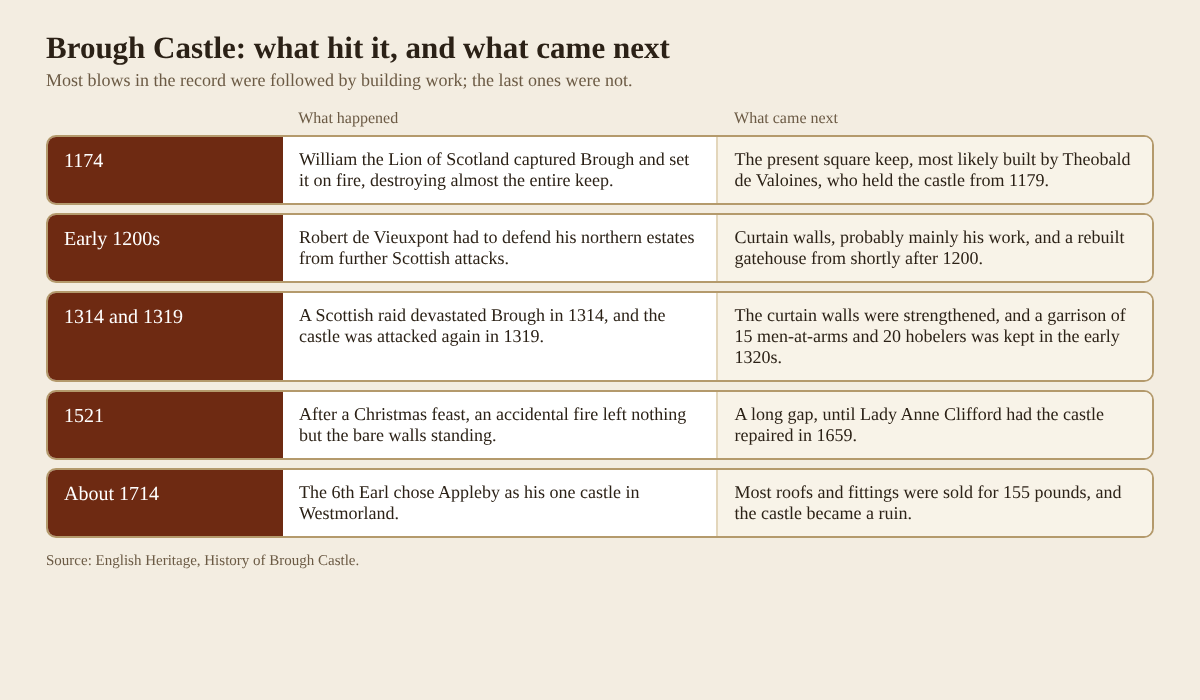
Brough was garrisoned for the king when, in 1174, William I of Scotland, William the Lion, invaded northern England to support that rebellion. English Heritage says he captured Brough and set it on fire, destroying almost the entire keep. The chronicler Jordan Fantosme related how the castle was bravely defended by six knights.
The answer came quickly. In 1179 Henry II granted the castle to Theobald de Valoines, who held it through the reign of Richard I and is the most likely builder of the present square keep. The same Stainmore road had another Henry II keep at Bowes; read the Bowes Castle post.
The Vieuxponts, the Cliffords and the Scottish raids
In 1203 King John gave Brough, with the lordship of Westmorland, to Robert de Vieuxpont. He had to defend his northern estates from further Scottish attacks, and English Heritage says the curtain walls are probably mainly from his time. He rebuilt the gatehouse shortly after 1200. For what the walls were meant to do, see the post on the curtain wall.
Care did not last. Robert's grandson was a minor when he succeeded in 1241, the estates were administered rather badly, and in 1253 to 1254 the castle was described as "decayed". Then the castle passed by marriage. Isabella, one of Robert the Younger's two daughters, married Roger Clifford in 1268, and he probably added the round Clifford's Tower at the south-east corner in the late 13th century.
Roger and Isabella's elder son Robert became 1st Baron Clifford. He was killed at Bannockburn on 24 June 1314, the same year in which Brough was devastated by a Scottish raid. English Heritage says the castle was attacked again in 1319, and that 15 men-at-arms and 20 "hobelers" (cavalry) were kept there in the early 1320s. These attacks led to the strengthening of the curtain walls.
The fire of 1521 and Lady Anne Clifford
The Cliffords' fortunes followed the throne. With the accession of Edward IV in 1461, their estates were confiscated, because Thomas, 8th Lord Clifford, had taken the Lancastrian side. His grandson Henry, later 10th Lord Clifford, spent 25 years in hiding until Henry Tudor's victory at Bosworth in 1485, after which the family's honours and estates were restored.
Lord Clifford celebrated Christmas at Brough with a great feast in 1521. Shortly afterwards the castle was devastated by an accidental fire that, in Lady Anne Clifford's later words quoted by English Heritage, left "nothing ... but the bare walls standing". No enemy was needed. This blow had no quick answer in the record: the next repair came in 1659, well over a century later.
English Heritage says that without Lady Anne Clifford (1590 to 1676) the story might have ended there. After long legal battles she gained most of the Clifford inheritance in 1643. In 1649 she left London and travelled north, found five Clifford castles ruined or in poor condition, and gradually repaired them all. Her account of 1659 says she had her "old Decayed Castle of Brough" repaired. An inscription recording the restoration was put up at the end of 1663, and when she stayed she always occupied the chamber at the top of Clifford's Tower.
It did not last. In about 1714, Thomas, 6th Earl of Thanet, decided he needed only one castle in Westmorland and chose Appleby. In about 1714 to 1715 most of Brough's roofs and fittings were sold for 155 pounds. An engraving of 1739 shows the hall and gatehouse range as a ruined shell, and in 1763 part of Clifford's Tower was pulled down to provide stone for Brough Mill. In 1920 the castle went into the guardianship of the Ministry of Works, and the south-west corner of the keep collapsed on 20 May 1920, before the work to consolidate it was done.
A worked example: read a castle by its repairs
Brough lets you practise a simple way to read any castle. Take one blow from its history and ask three questions, using only what the record says.
- What hit it? In 1174 the Scots burned the keep. In 1314 and 1319 raids devastated and attacked the castle.
- What was built in answer? A new square keep, most likely built by Theobald de Valoines after 1179. After the raids of 1314 and 1319, stronger curtain walls and a garrison of 15 men-at-arms and 20 cavalry.
- What happened when the answer stopped? After the fire of 1521 the record shows no repair until 1659. After about 1714 the roofs were sold. A castle is only as strong as the owner's wish to pay for it.
The same habit works on other castles. The Carlisle Castle post reads a castle that was besieged again and again, and the post on slighting a castle shows owners and enemies choosing to wreck one.
The same question in Two Towers
Two Towers asks you to do this reading every stage. Your goal is to hold the city gate, and every stage comes stronger, faster or in greater numbers than the last. If the gate falls, the game is over, and it then tells you what broke it: "The gate fell mostly to" an attacker, with the share of damage that attacker did. That is Brough's first question, asked of you.
The gate's sheet answers the second. It reads "Repair what the attackers broke, or reinforce it." Repair gives +25% and is not available when "The gate is whole"; Reinforce adds strength for gold. The game's tip for the ram, the attacker that strikes the gate hardest, is "Rams hit the gate hardest: Reinforce the gate, and use Ballista bolts that ignore armor." Its general rule is "Spend your gold on Damage between stages, and Reinforce the gate."
A short plan in the spirit of Brough: after a loss, read which attacker broke the gate, find the game's tip for it, and spend your next gold on that answer. Do not keep paying for what answered the last threat, since the next blow will come from somewhere else. Gold in the game is in-game gold, never money.
Frequently asked questions
Who built Brough Castle?
English Heritage says the first castle may have been founded after William Rufus took Carlisle in 1092, and the earthworks are of the 11th century. Theobald de Valoines, who held the castle from 1179, is the most likely builder of the present square keep, after the fire of 1174.
Did the Scots capture Brough Castle?
Yes. In 1174 William the Lion captured Brough and set it on fire, destroying almost the entire keep. Brough was devastated by a Scottish raid in 1314 and attacked again in 1319.
What did Lady Anne Clifford do at Brough?
She had the castle repaired in 1659 after the accidental fire of 1521 had left nothing but the bare walls standing. She put up an inscription recording the work at the end of 1663.
Why is Brough Castle a ruin?
About 1714 the 6th Earl of Thanet chose Appleby as his one castle in Westmorland, and most of Brough's roofs and fittings were sold for 155 pounds. Its keep also lost a corner in 1920.
Get started
Brough shows that a castle lasts only as long as its owner keeps answering the last blow. Try that in Two Towers, free in your browser. Pick your two towers, read the tip for each attacker, and spend your gold where the next stage will hit.
Defend the castle gate, stage after stage.
Visit twotowers.vlvd.net↗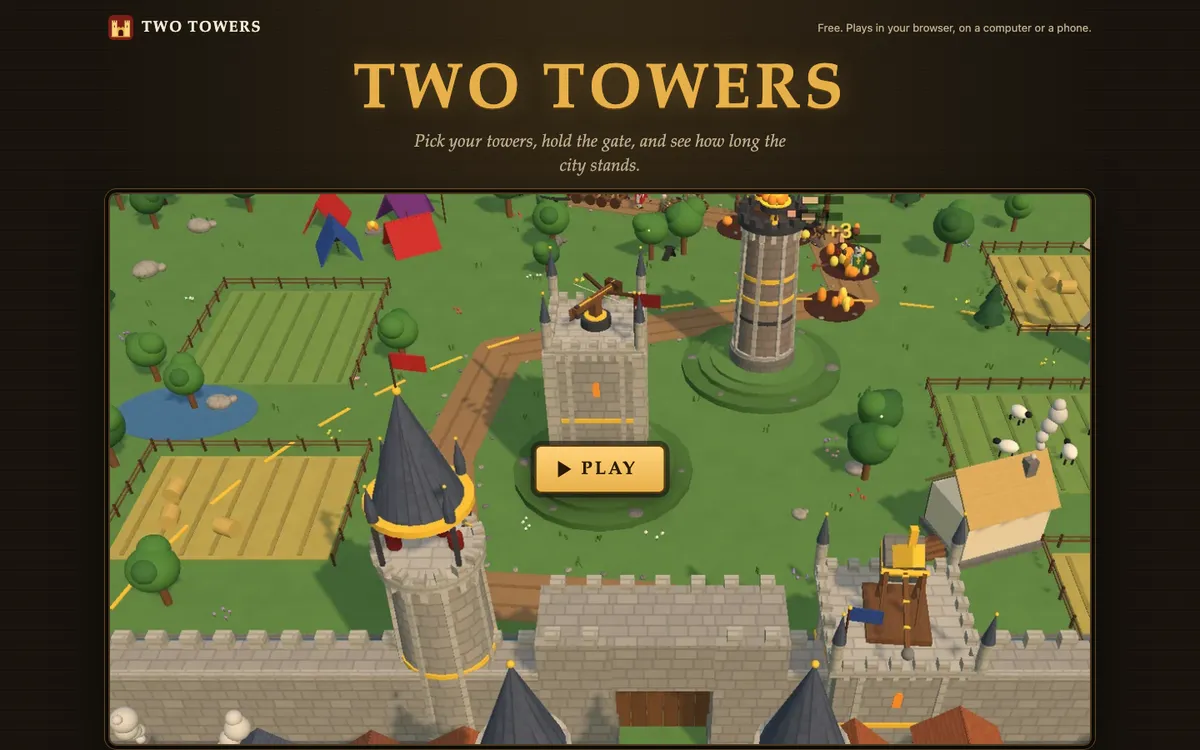
Comments
No comments yet.
Sign in or make an account to comment.