Problem Tree Analysis Example for an Everyday Problem
A problem tree analysis example for an everyday problem makes the method easier to learn than any definition. In short, you write one problem in the trunk, list what causes it in the roots, list what it leads to in the branches, and then decide which root to fix first. This post walks through one everyday problem from start to finish: always running late in the morning.
If you want to keep the tree somewhere it can grow, Problem Graph is a personal problem and solution journal drawn as a map, where you write each problem in one line, link the ones that belong together, and record what you tried and how it went.

What is a problem tree analysis?
A problem tree is a diagram with three parts.
- The trunk is the core problem, stated in one sentence.
- The roots are the causes. They sit below the trunk because they feed it.
- The branches are the effects. They grow out of the problem and show what it costs you.
The point is to stop treating a symptom as if it were the whole problem. If you only attack the trunk ("leave earlier"), you often fail, because the roots are still there. If you can see the roots, you can pick one and change it.
A problem tree is a close cousin of root cause analysis. If you want a second angle on finding causes, there is a root cause analysis template for personal problems on this blog.
Pick an everyday problem: always running late in the morning
Good practice problems are small, real and repeated. Lateness fits all three. It happens most weekdays, you already have opinions about why, and the effects are easy to name.
Here is the situation we will use. You need to leave at 8:00. Most days you walk out at 8:15 or later. You have tried setting an earlier alarm. It did not stick.
Step 1: Write the core problem in one clear sentence
Most people start too vague. "Mornings are bad" cannot be analysed. "I am a disorganised person" is a verdict, not a problem.
A usable core problem has three traits. It describes something that happens. It is specific enough to notice when it is gone. It does not blame a trait.
Compare these:
- Weak: "I am bad at mornings."
- Better: "I leave the house 15 minutes after I planned to, most weekdays."
Use the second one. It names the behaviour, the size of the gap and how often it happens. That is your trunk.
Step 2: Map the root causes (the roots)
Now ask "why?" under the trunk. Do not stop at the first answer. Ask it two or three times for each cause.
Start with the obvious reasons, then dig:
- I wake up late. Why? I snooze the alarm. Why? I go to bed after midnight. Why? I scroll my phone in bed.
- I cannot find things. Why? Keys, bag and charger live in different places each day. Why? I drop them wherever I am when I get home.
- I start getting ready too late. Why? I treat the time before 7:30 as free time. Why? I have no fixed point where "getting ready" begins.
- Small decisions eat time. Why? I choose clothes and breakfast in the morning, when I am still groggy.
Notice what happened. The first answers ("I wake up late") were descriptions. The deeper answers ("I scroll my phone in bed", "I drop things wherever") are things you can actually change. Good roots are usually behaviours or setups, not feelings or personality.
Roots can also have roots of their own. Late bedtime and phone scrolling are linked. If you see that, draw the connection. A root that feeds another root is a strong candidate to fix first.
A quick check for a real root
Ask: "If this were fixed, would the problem shrink?" If the answer is "maybe, a little", it is probably a symptom. If the answer is "yes, noticeably", keep it as a root.
Step 3: Map the effects (the branches)
Branches show why the problem is worth your time. Ask "and then what?" about the trunk, again two or three levels deep.
- I rush, so I arrive stressed. Then I start the day on edge.
- I miss the first ten minutes of meetings. Then I have to catch up and I look unreliable.
- I skip breakfast. Then my energy drops before lunch.
- I feel guilty every morning. Then I snap at people at home or at work.
Be honest and concrete here. The branches are your motivation, so write the real costs, not the dramatic ones. Also be careful with the word "stress". It is fine as a plain description of your day, but a problem tree is a thinking tool, not a way to treat any condition.
The finished problem tree analysis example for an everyday problem, at a glance
Here is the whole tree in text, from roots to branches.
Trunk (core problem): I leave the house 15 minutes after I planned to, most weekdays.
Roots (causes):
- Late bedtime, caused by scrolling my phone in bed.
- Snoozing the alarm, which follows from the late bedtime.
- No fixed place for keys, bag and charger.
- No set time when getting ready begins.
- Choosing clothes and breakfast in the morning.
Branches (effects):
- Arriving rushed and on edge.
- Missing the start of meetings and looking unreliable.
- Skipping breakfast and running low on energy.
- Guilt, and a shorter temper with people around me.
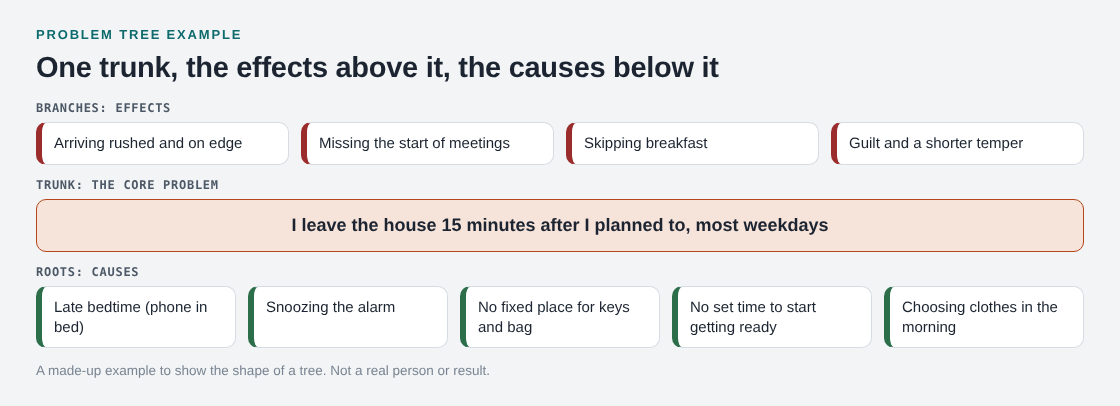
That is the full analysis. It took a handful of sentences, and it already tells you something the first idea ("set an earlier alarm") missed. An earlier alarm treats one root, snoozing, without touching the late bedtime that causes it.
Turn the tree into an action plan: which root to fix first
A tree you never act on is just a drawing. To choose a root, score each one on two simple questions.
- Reach: how many other roots or branches does it affect?
- Effort: how easy is it to change this week?
In our example, the phone in bed has the most reach. It drives the late bedtime, which drives the snoozing. It is also cheap to test: charge the phone across the room for one week.
The "no fixed place for keys" root has low reach but almost no effort. A hook by the door fixes it in a minute. Do that one too, because quick wins build momentum.
So a sensible first move is two small experiments:
- Charge the phone outside the bedroom for seven days.
- Put a tray by the door for keys, bag and charger.
Leave the bigger roots, like deciding clothes the night before, for the following week. One or two changes at a time is enough to learn from.
Record what happened
This is the step people skip. After the week, write down the outcome of each experiment: it worked, it partly worked, or it failed. A partial result is useful. Maybe the phone across the room cut snoozing but you still went to bed late, because you read on a tablet instead. That tells you the real root is a bedtime habit, not one device.
Keeping the tree in Problem Graph
You can draw a problem tree on paper, and for a one-off problem that is fine. A problem like lateness comes back, though, and you will want to remember what you tried.
In the Problem Graph app, you could do it like this:
- Write the trunk as a problem in one line: "I leave the house 15 minutes after I planned to." Put it in the personal lane.
- Write each root as its own problem, such as "I scroll my phone in bed", and link it to the trunk.
- Attach a solution to each root, like "charge the phone across the room". Mark it as one you are trying.
- When the week ends, record the outcome as worked, partly, or failed.
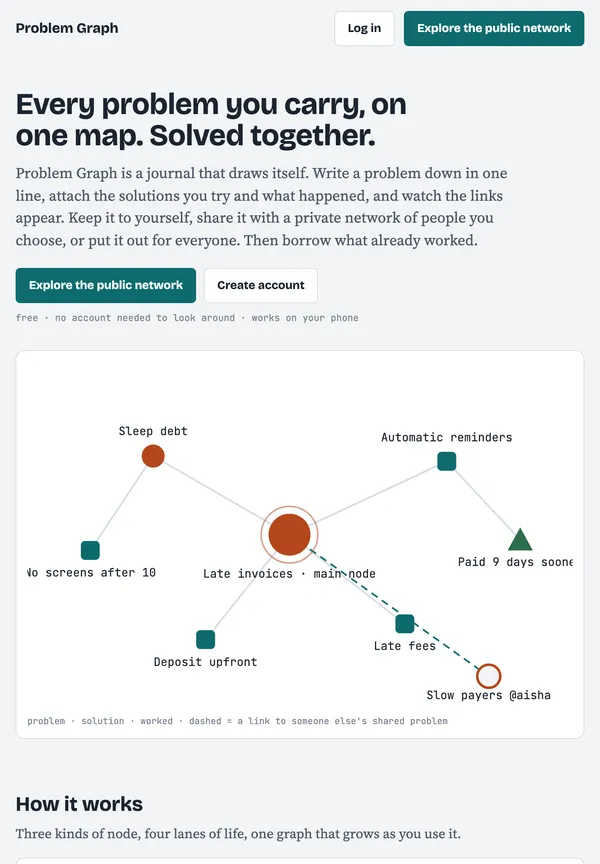
The map shows links as you add them, so a pattern across problems can show up that a flat list would hide. If "scrolling in bed" also connects to a problem about poor sleep, you will see it. And a solution that failed stays on the map as a failed solution, so you do not try the same thing twice without noticing.
By default a problem is private and only you see it. Problem Graph also lets you share a main node with a private network of people you choose, or publicly. Lateness is probably a private one, but a shared household problem, like a family's morning routine, could suit a small network.
Frequently asked questions
What is the difference between a problem tree and a fishbone diagram?
Both look for causes (see the fishbone diagram example). A problem tree also maps the effects, so you see what the problem costs you, while a fishbone diagram focuses on grouping causes under categories.
How many roots should a problem tree have?
Between three and seven is usual for an everyday problem. If you have more, group related ones or pick the few with the most reach.
Can I use a problem tree for a personal problem?
Yes. Small, repeated problems like lateness, clutter or procrastination work well because the causes are behaviours you can test and change.
What if I cannot tell which root matters most?
Run a small experiment on the cheapest one for a week and record the result. What you learn will point to the next root.
Do I need special software to make one?
No. Paper works. A tool helps when you want to link several problems and keep a record of what worked and what failed.
Get started
Pick one problem you keep running into. Write the trunk in one specific sentence, list the roots with three rounds of "why?", and choose one cheap experiment for this week.
Try Problem Graph: it is free, and you can look around the public network without an account. Write one problem down in a line and attach the first thing you will try.
Comments
No comments yet.
Sign in or make an account to comment.