Root Cause Analysis Template for Personal Problems
A root cause analysis template for personal problems is a short set of questions you fill in so you stop treating symptoms and find the cause underneath. You write the problem in one sentence, ask why until you hit something you can change, and pick one small fix to test. This post gives you the template, a worked example, and a way to record what happened.
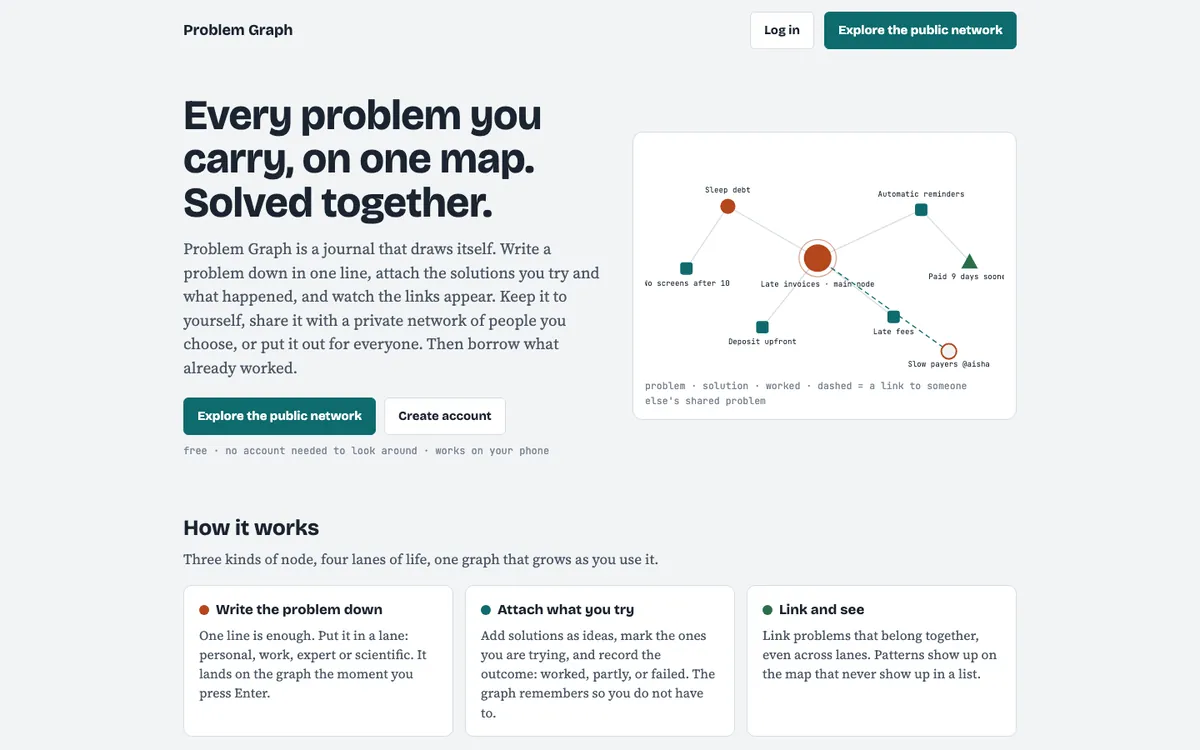
If you want somewhere to keep the results, Problem Graph is a personal problem journal drawn as a map: you write the problem in a line, attach the fixes you try, and mark each as worked, partly, or failed.
XXs the problem coming back
A symptom is what you notice. A cause is what produces it. If you only fix the symptom, the cause keeps producing new ones.
Say you keep missing deadlines. The symptom fix is to work late the night before. It works once. Next month you are doing it again, because nothing about how the work gets scoped or started has changed.
Symptom fixes feel good because they are fast. Cause fixes feel slow because you have to look first. But a cause fix only has to work once, while a symptom fix has to be repeated forever.
There is a second trap. When you fix a symptom and it returns, it is easy to conclude that you lack discipline. Usually you just aimed at the wrong thing.
A root cause analysis template for personal problems (copy and use)
Copy this into a note and fill it in. It fits on half a page.
- Problem: one sentence, in plain words.
- Why 1: the first reason it happens.
- Why 2: why that reason happens.
- Why 3: why that one happens.
- Why 4: keep going.
- Why 5: stop when you reach something you can change.
- Likely cause: the one you will test.
- Small fix: one action you can do this week.
- How I will know: what you will check, and when.
- Outcome: worked, partly, or failed, plus a line on what happened.
The last two lines matter most. Most people stop after the fix. The check is what turns a guess into something you learn from.
Step 1: Write the problem as one clear sentence
Vague problems produce vague answers. "I am disorganized" cannot be tested. "I leave the house 15 minutes after I planned to, most weekdays" can.
A good sentence names what happens, how often, and avoids blame. Leave out words like always, never, and lazy unless they are literally true. If you cannot fit it in one line, you probably have two problems. Write them separately.
Step 2: Ask why five times
Ask why the problem happens. Take the answer and ask why again. Repeat about five times. Five is a rule of thumb, not a law. Stop earlier if you reach a cause you can change, and go further if you do not.
Three rules keep this honest:
- Answer with facts you have seen, not feelings about yourself.
- If an answer is "because I am bad at X", ask what specifically happens instead.
- If a why has two answers, follow both on separate lines.
That last rule is where a graph helps. Real problems branch, and a straight list hides it. If you track related problems, see screen time problems: log what you changed and what happened for the same habit of recording changes and results.
Step 3: Pick a cause you can test and a small fix
After the whys, you will have several candidate causes. Pick one. Choose the one that is both likely and cheap to test.
Then choose a fix small enough to do this week. A fix that needs a new personality is not a fix. A fix that changes one object, one time, or one rule is.
Write down how you will know it worked. Make it observable: "I leave by 8:00 on four of five days." Without that line you will end up judging by mood, and mood is unreliable.
Worked example: always running late in the morning
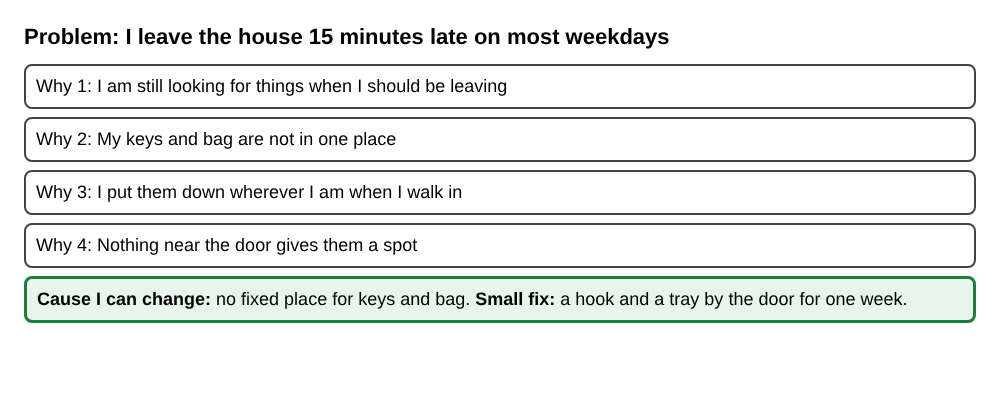
The worked example as a chain of whys.
Problem: I leave the house about 15 minutes later than planned on most weekdays.
- Why? I am still looking for things when I should be leaving.
- Why? My keys and bag are not in one place.
- Why? I put them down wherever I am when I walk in.
- Why? Nothing near the door gives them a spot, and I am tired by then.
- Why? I never set up the entrance, because it did not seem important.
A second branch from the first why: I also pick clothes in the morning, which takes time. Write that on a separate line as another candidate.
Likely cause: no fixed place for keys and bag.
Small fix: put a hook and a tray by the door, and use it for one week.
How I will know: I leave within five minutes of plan on at least four of five weekdays.
Outcome after a week: partly. Keys were found every day, but I still left late on two days because of the clothes branch. That outcome is useful. It tells you the first cause was real, and it points at the second.
Notice that "partly" is a real result. You did not fail, and you did not finish. You move to the next candidate with better information.
How to track fixes and see what changed
A note works for one problem. It gets harder with ten, because causes overlap. Late mornings, poor sleep, and a messy evening may share a root, and a flat list will not show it.
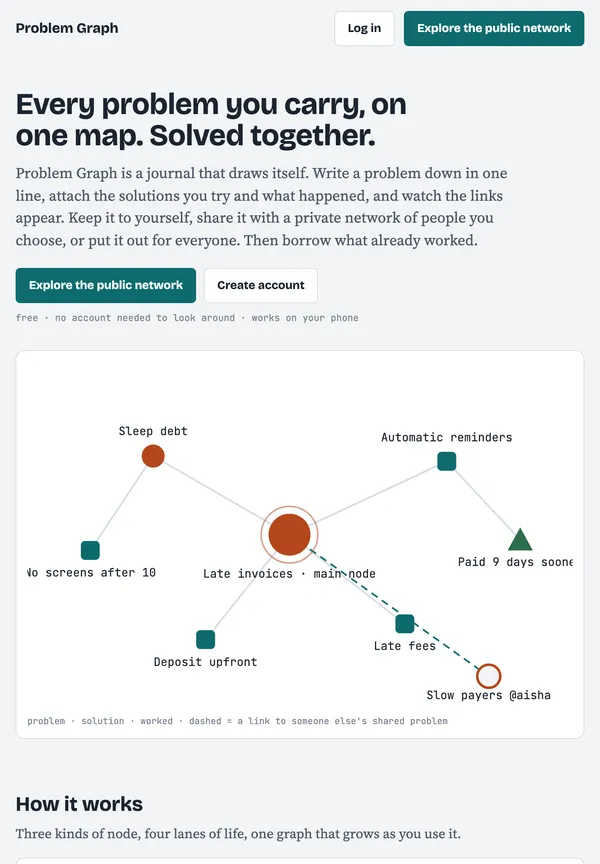
This is the job Problem Graph is built for. You write the problem down in one line and put it in a lane: personal, work, expert, or scientific. Then you attach the solutions you try and record the outcome as worked, partly, or failed. You can link problems that belong together, even across lanes, so patterns show up on the map that never show up in a list.
Failures stay on the map too. That is the point. A fix that failed three times is information you do not want to rediscover. The same habit helps with other recurring areas, such as meal planning problems, where you log what you tried each week, or shared costs in flatmate bill problems and one shared list for the house.
Your problems are private by default and follow you to any phone or computer you log in on. If a problem involves other people, you can mark it as a main node and share it into a private network, such as a family or a team. Members of that network can see it, and nobody else can. For a group setting, see youth group leader problems and one shared list for leaders.
You can also look at similar problems other people have shared and see which of their solutions worked, then borrow one into your own graph. Those are proposals to test, not answers. Run them through the same template: small fix, a check, an outcome.
Frequently asked questions
How many times should I ask why?
About five, but stop when you reach a cause you can change. If you reach one at the third why, you are done. If the fifth answer is still vague, keep going or rewrite the problem sentence.
What if there is more than one root cause?
That is common. Follow each branch on its own line, then test one cause at a time. Changing several things at once makes it impossible to tell what helped.
Is this a substitute for professional help?
No. It is a method for sorting out everyday problems like habits, routines, and workload. It is not medical or mental health advice, and it does not replace a professional.
What counts as a failed fix?
A fix fails when the check you wrote in advance does not pass. Record it anyway. A failed fix rules out a cause and saves you from repeating it.
Do I need special software?
No. A note and the template above are enough to start. A tool helps once you have many problems and want to see how they connect.
Get started
Try Problem Graph: it is free, and you can look around the public network without an account. Write one problem down in a line and attach the first thing you will try.
Comments
No comments yet.
Sign in or make an account to comment.